
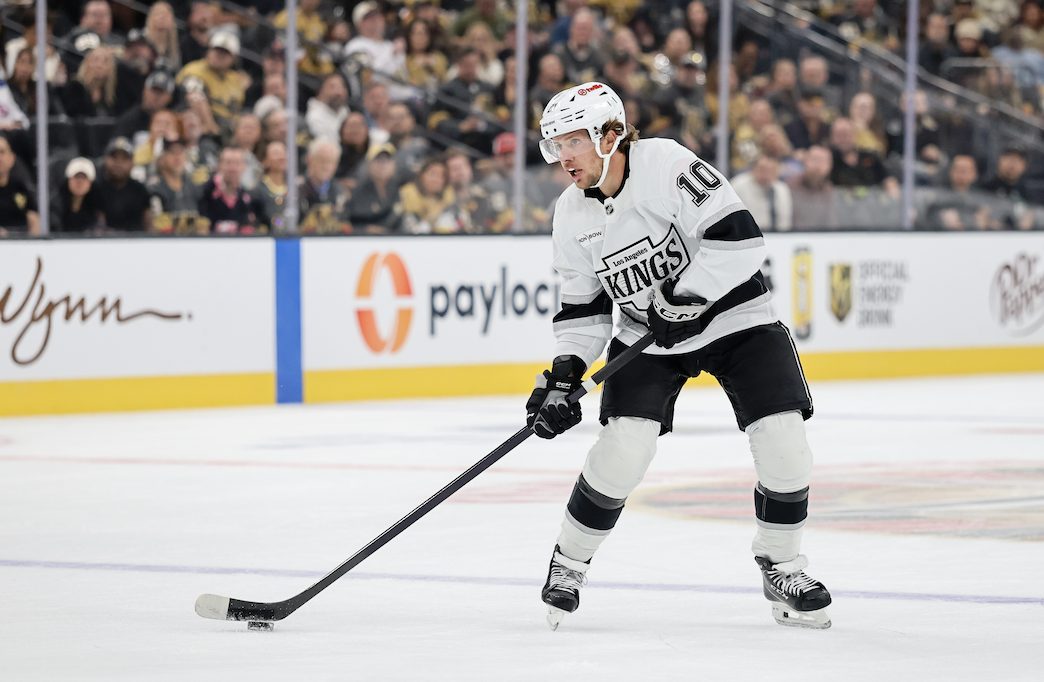
In back-to-back games, both 2-1 defeats, the Kings have had a 5-on-3 chance. And not just a partial 5-on-3, but over a minute of 5-on-3 time in both instances.
In total this season, no team has spent more time playing 5-on-3 than the Kings, who have two minutes and 51 seconds in those situations with nothing to show for it. Those two are often correlated. When you continue to play with a two-man advantage and don’t score, the time adds up. Good 5-on-3 teams would probably rank lower in that area.
In a pair of one-goal defeats, the 5-on-3 could’ve made the difference. And it didn’t.
In speaking about the 5-on-3 looks after the game, Adrian Kempe called that unit “unacceptable”, going two extended sequences without a goal.
“Not good enough, unacceptable in my opinion,” Kempe said. “Second time we had a 5-on-3 this season. We’ve got to dial it in, move the puck more and get some shots on net. Those are basic things, but something we’ve got to do.”
Against Florida, I felt the biggest problem was with the zone entries. On four attempts, the Kings only got in cleanly, with possession, once. Against three defenders, regardless of how good a stand was, there’s really no excuse for it not to be almost every single time. Every failed entry or failed retrieval in the offensive zone, without establishing or retaining possession, is 20 seconds wasted, as Artemi Panarin brought it up today. 5-on-3’s will almost never be a full two minutes so that can make all the difference.
In Vegas, the entries were better. In four sequences again, the Kings established possession all four times. Quinton Byfield won the first faceoff, which led to possession early. Two clean entries after that, with Kempe the leader there, before Byfield won a second faceoff. That part was better. What wasn’t better was what happened in-zone. The Kings, again, weren’t able to get a ton of quality looks, despite the two-man advantage.
The first sequence, Byfield tried to go across the crease from in tight, but the pass was broken up and quickly left the zone. Too much of a one-and-done, without a shot on goal. On the second, one too many passes got broken up on the left side and the puck was cleared without a shot attempt.
On the third, I thought Byfield passed up a one timer chance, but they recycled and the Kings retained possession. The best chance they had came from a Panarin shot and rebound, with Kempe at the top of the crease for a rebound look. Off the second faceoff win, a Panarin one-timer was blocked and eventually cleared.
I looked at 5-on-3’s extremely black and white – you either score or you don’t. I don’t think there are all that many positives to be taken from a good sequence that doesn’t score and if the Kings had scored on say that Kempe rebound, a goal on a bad sequence is a good sequence. Simply put, especially in tight games, those are moments when you need a goal. The reasons as to why, front facing, aren’t that important. For those on the ice, though, they have to be important because they have to improve.
Today, the guys who play in those situations put a lot of work into it, led by Panarin.
In Panarin’s eyes, there are two keys to improving in those situations – movement and shots.
The former is something they worked on today. Especially playing with a two-man advantage, there’s a ton of room on the ice, which allows players to rotate around and get into different positions. Panarin often rotates up top, while Kempe moves around too, in hopes of finding a shooting opportunity.
In 5-on-3 situations, he penalty killers can only take away so much. Often times, it’s a focus on the seams and seam passes, with the intention of taking away one timers and low-to-high shooting situations with the shooter crashing down. That focus neutralizes a one-timer to Kempe, at least on the first rotation. But if that comes later, as you wear them down, those lanes begin to open up.
“I think we’ve got to start moving a little bit, we practiced that today and then just take more simple shots,” Panarin said. “Sometimes you can’t do one-timers, because like guys stay between us, like Eichel stayed last game between me and Juice, so we’ve go to take wristers too, with a good screener. We don’t need much for goals, you’ve got to find where the goalie doesn’t see it, find that line and deliver it. Then, you grab the puck again and then deliver it again. For me, it’s simple stuff. If you make it like six shots in 5-on-3, you probably score.”
Sometimes, having that extra space enhances the problem, in that when there is so much space, sometimes you over pass. You hold onto the puck for longer than you need to. The best chance the Kings actually had in the 5-on-3 situation was a Panarin shot from distance, which forced a save, and led to a Kempe rebound opportunity. The best chance overall, though came from Panarin in a 5-on-4 situation. Kempe fired a hard pass to Panarin in the slot and he changed his release point before snapping a shot off the post and in. It was simple. But so effective.
Panarin made a good reference – a simple watch still tells time.
In those moments, he wants to have more of a shoot-first mentality himself and wants his teammates to do the same.
“I prefer to just shoot it right away when you have opportunity,” Panarin said today. “Sometimes, you have big plans, lots of guys have to move, the ice isn’t that good for a perfect pass. The percentages for scoring is the same if you just take a wrister, without any passes. It’s like having more details in watches, because you can just break it faster. When it’s simple, you can deliver a wrister every time, but if you’ve got to do four passes before, it’ll never happen, probably, because it’s just too many passes.”
In the moment, I looked at the statsheet and saw eight shot attempts on the power play in the first period. That’s not a bad number.
But in looking back, it does feel like the Kings passed up too many looks, especially because passing up on one look might mean passing up on several looks, as Peter Laviolette framed it today.
“I think that there were opportunities to deliver pucks to the net, similar to the way [Panarin] did when he scored,” Peter Laviolette said. “It wasn’t [5-on-3] then but just that mindset that there’s a lane and there’s traffic in front of the net. Sometimes, the best offense can be the simplest offense and that might break something down for something that might be open for a seam. So, just having that mindset to deliver the puck.”
The shot that led to the most dangerous chance didn’t feel like a great shot. But it got through, with a screen, and led to a rebound in a dangerous area. I don’t subscribe to the theory that there are no bad shots 5-on-3, but the shot you take might be the shot that actually sets up the right chance on the next reset. Retrievals become important and as penalty killers get tired, other lanes open up that might not have before. The Kings didn’t work that group hard enough and weren’t rewarded. If presented with another tomorrow, or going forward, it’ll need to be a different approach.