
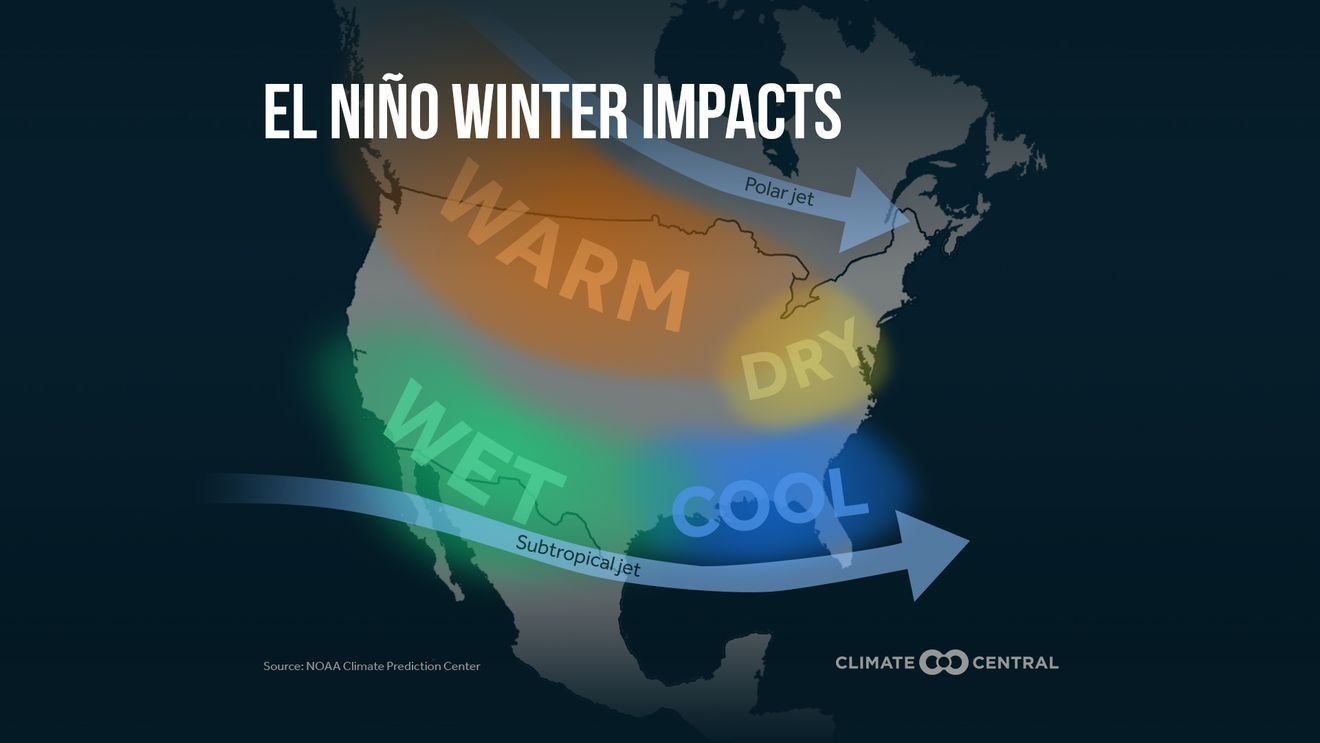
A powerful El Niño continues to develop in the tropical Pacific Ocean, and it could become one of the strongest events on record according to the Climate Prediction Center. Expected to peak in December 2026, the El Niño’s influence is likely to extend well into 2027, increasing the potential for extreme heat, drought, flooding, and agricultural impacts in vulnerable parts of the world.
But this developing “super” El Niño is occurring against a much larger backdrop, a planet that has been steadily warming due to human caused climate change, largely through greenhouse gas emissions. According to Climate Central, understanding the difference between these two influences is essential to understanding where global temperatures are headed. El Niño can temporarily boost global temperatures, but greenhouse gas pollution is driving the long-term warming trend that continues to push the planet into record territory year after year.
More: Click here to learn about how the natural atmospheric greenhouse effect works: “The Greenhouse Effect and How Humans Enhance it”
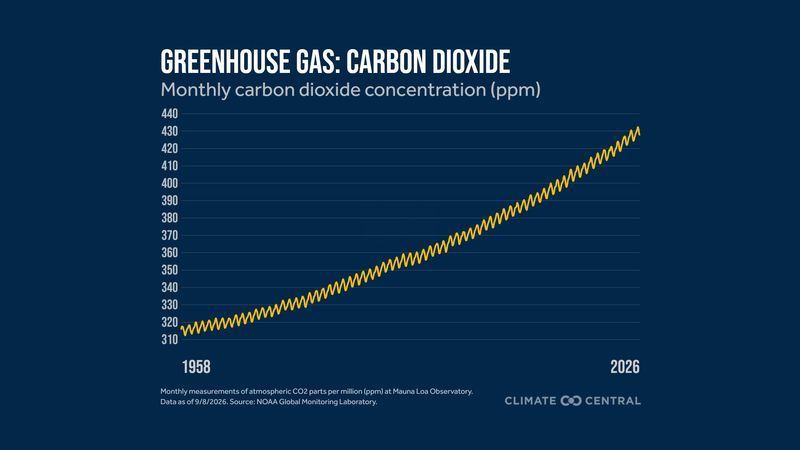
Climate Central – Monthly measurements of carbon dioxide in parts per million at Mauna Loa Observatory through September 8, 2026
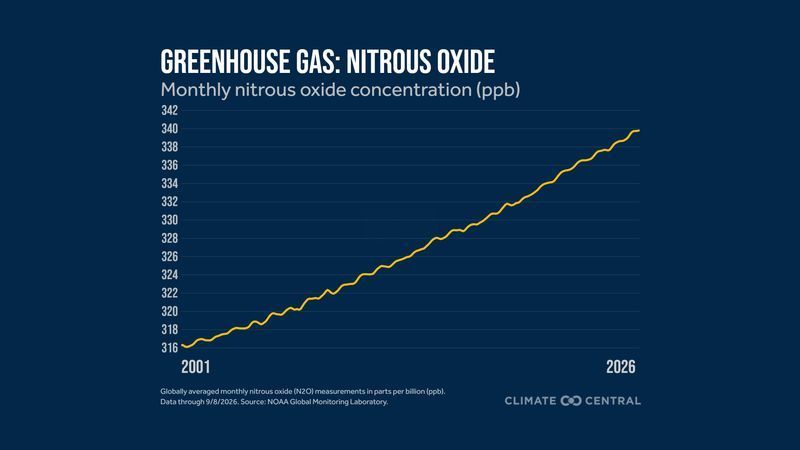
Climate Central – Globally averaged monthly nitrous oxide measurements in parts per billion through September 8, 2026 (NOAA Global Monitoring Laboratory)
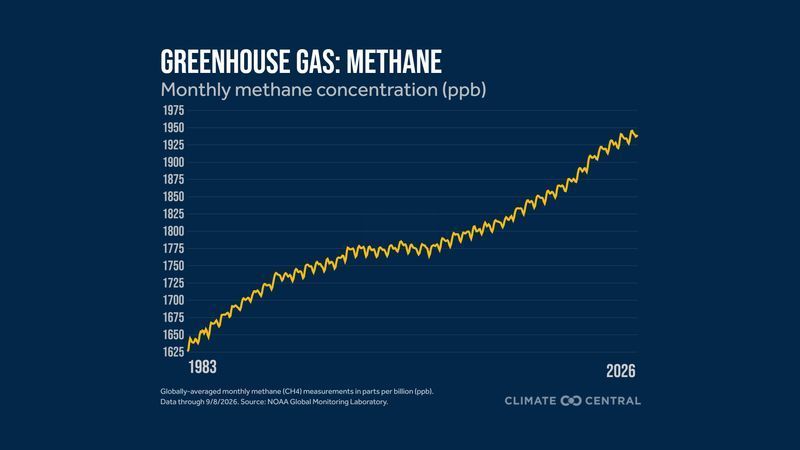
Climate Central – Globally averaged monthly methane measurements in parts per billion through September 8, 2026 (NOAA Global Monitoring Laboratory)
Three Key Takeaways
Explaining El Niño ‘s Role in Global Heat and What the Current El Niño Could Mean for Global Temperatures1. Climate Change Is Driving Long-Term Warming. El Niño Adds a Temporary Boost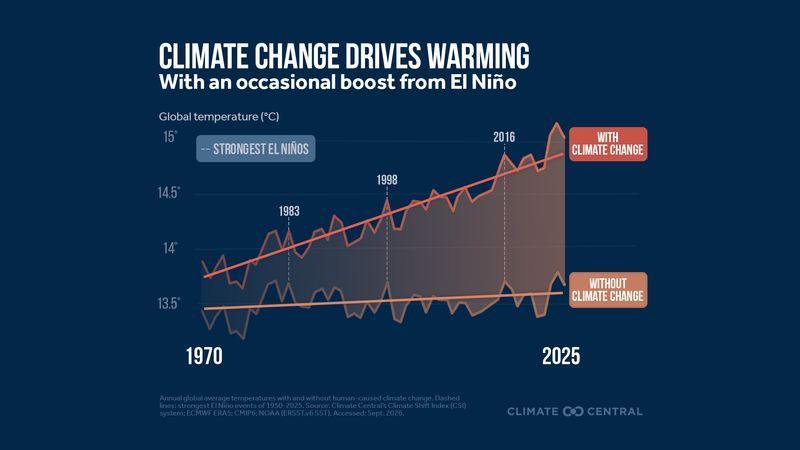
Climate Central – Climate Change drives warming, but El Niño occasionally gives it a boost
El Niño is a natural climate pattern that develops when sea surface temperatures in the central and eastern tropical Pacific become unusually warm. As ocean and atmospheric circulation patterns change, heat is redistributed from the ocean into the atmosphere, influencing weather and temperatures around the world.
This can temporarily raise the global average temperature by a few tenths of a degree Celsius. Strong El Niño events, however, have historically provided a noticeable boost to global temperatures, sometimes helping push a particular year into record breaking territory.
However, this natural warming occurs on top of the much larger, long-term warming trend driven by greenhouse gases released primarily through the burning of fossil fuels. The distinction is important because El Niño causes global temperatures to fluctuate by redistributing heat that’s already here. But it’s the human caused climate change that continues to raise the underlying baseline.
Think of it this way, El Niño can temporarily lift global temperatures higher, but climate change keeps raising the floor from which those temperatures rise so each big El Niño event results in even higher global temperatures.
Historical temperature records illustrate this relationship. During the strongest El Niño events, global temperatures have temporarily surged, but those records have eventually been surpassed as the planet has continued to warm.
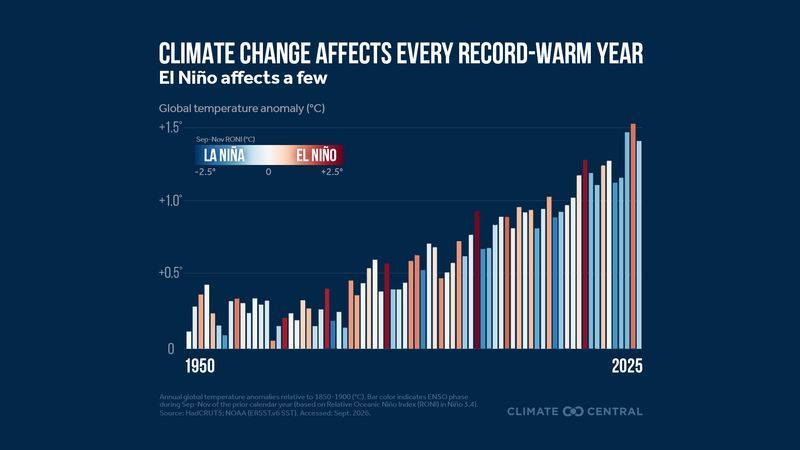
Climate Central – Climate change affects every record warm year, El Niño affects a few
Without human caused climate change, El Niño would still produce natural temperature fluctuations. The difference is that those fluctuations would occur around a much more stable long-term temperature baseline versus the rising temperature baseline we observe today.
2. El Niño Can Help Set Temperature Records, but Climate Change Is the Bigger Driver
A strong El Niño can be an important contributor to an exceptionally warm year, but it is not necessary for global temperature records to fall. Climate Central reports that past strong El Niño events have added approximately 0.1 degrees C to 0.3 degrees C to global average temperatures during affected years. That additional warming can be enough to push an already exceptionally warm year into record territory. Yet the underlying reason records are becoming more frequent is the continued rise in global temperatures caused by human activities.
Consider this: The 10 warmest years in the global temperature record have all occurred since 2015, even though most of those years did not coincide with El Niño.
Top 10 Warmest Years Globally Since 1850 (National Centers for Environmental Research)
2024 – El Niño2023 – El Niño2025 – La Niña/Neutral2016 – El Niño2020 – La Niña2019 – Weak Niño/Neutral2017 – La Niña/Neutral2015 – El Niño2022 – La Niña2021 – La Niña
The cooler phase of the same natural climate cycle, known as La Niña, offers another revealing comparison. La Niña tends to temporarily suppress global temperatures, but that cooling influence has not been strong enough to overcome the planet’s long-term warming trend. According to Climate Central, each of the six most recent La Niña years included in its analysis still ranked among the 10 warmest years on record. In other words, even when natural climate variability temporarily pushes temperatures downward, the long-term warming trend remains firmly in place.
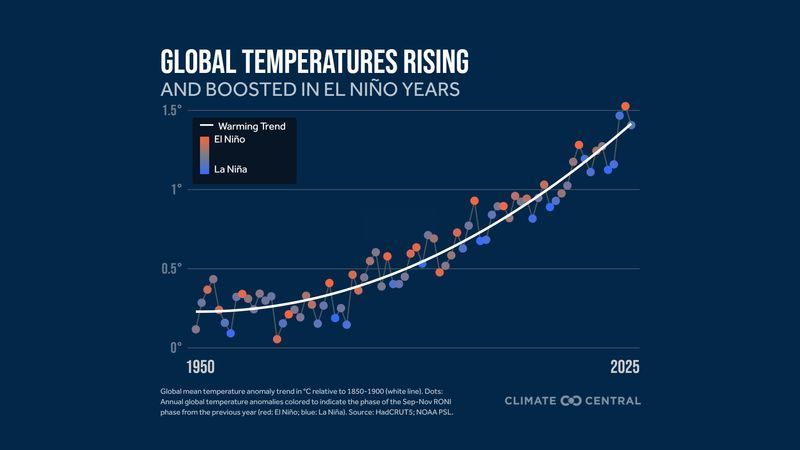
Climate Central – Global Temperatures are rising, with that rise boosted in El Niño years
The developing 2026–27 El Niño could provide another significant boost. Climate Central’s October 2026 analysis indicates that 2026 is increasingly likely to rank among the warmest years on record, while the lingering influence of the developing El Niño could help make 2027 the warmest year on record.
That outcome is not guaranteed, since global temperatures also depend on other natural influences and the timing and strength of the event. But even if a new record is set, it would reflect the combined influence of an elevated global temperature baseline and a temporary El Niño boost.
3. El Niño Redistributes Heat – Climate Change Warms the Entire Planet
Although El Niño and climate change can both contribute to higher global temperatures, they do so in fundamentally different ways.
El Niño primarily redistributes heat that is already stored in the climate system. Changes in Pacific Ocean temperatures influence atmospheric circulation, shifting weather patterns and creating a patchwork of warmer and cooler conditions across different regions. Some areas experience unusual warmth, while others may experience cooler conditions or shifts in rainfall. The effects vary by location and season.
Human-caused climate change operates differently. Greenhouse gases accumulate in the atmosphere and trap additional heat, raising temperatures across the globe over the long term. Although the amount of warming varies from region to region, virtually every part of the planet is warmer today than it was before industrialization.
Climate Central’s analysis highlights this contrast by comparing the geographic pattern of warming associated with El Niño with the broader warming pattern attributable to human-caused climate change. El Niño’s influence is concentrated most strongly in the tropical Pacific, with varying effects elsewhere. The fingerprint of climate change, by contrast, extends across the globe. This difference helps explain why the long-term warming associated with greenhouse gas pollution is much more widespread and persistent than the temporary temperature boost associated with El Niño.
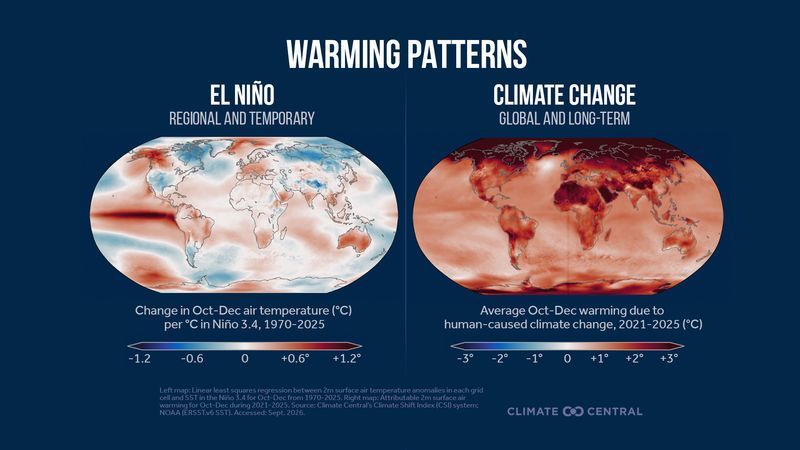
Climate Central – The short term impacts of El Niño versus the long term impacts of global warming
The Bottom Line: El Niño Is Arriving on a Much Warmer Planet
The developing super El Niño could significantly influence global temperatures and weather patterns through 2027. Its potential to contribute to another record-warm year deserves attention, particularly given the associated risks of extreme heat, drought, flooding, and agricultural disruption in vulnerable regions. But El Niño is not the underlying cause of the planet’s long-term warming. Human-caused climate change has steadily raised global temperatures, making today’s El Niño events unfold in a much warmer world than comparable events in previous decades. The relationship is straightforward: El Niño can temporarily add to global heat, but greenhouse gas pollution is continually raising the baseline. As this new El Niño develops, separating those two influences will be essential to understanding both the immediate climate risks and the longer-term direction of global warming.
More: For a look at how the El Niño could shape our winter click here: “A Strong El Nino – What it Can and Can’t Tell Us About the Winter Ahead”