
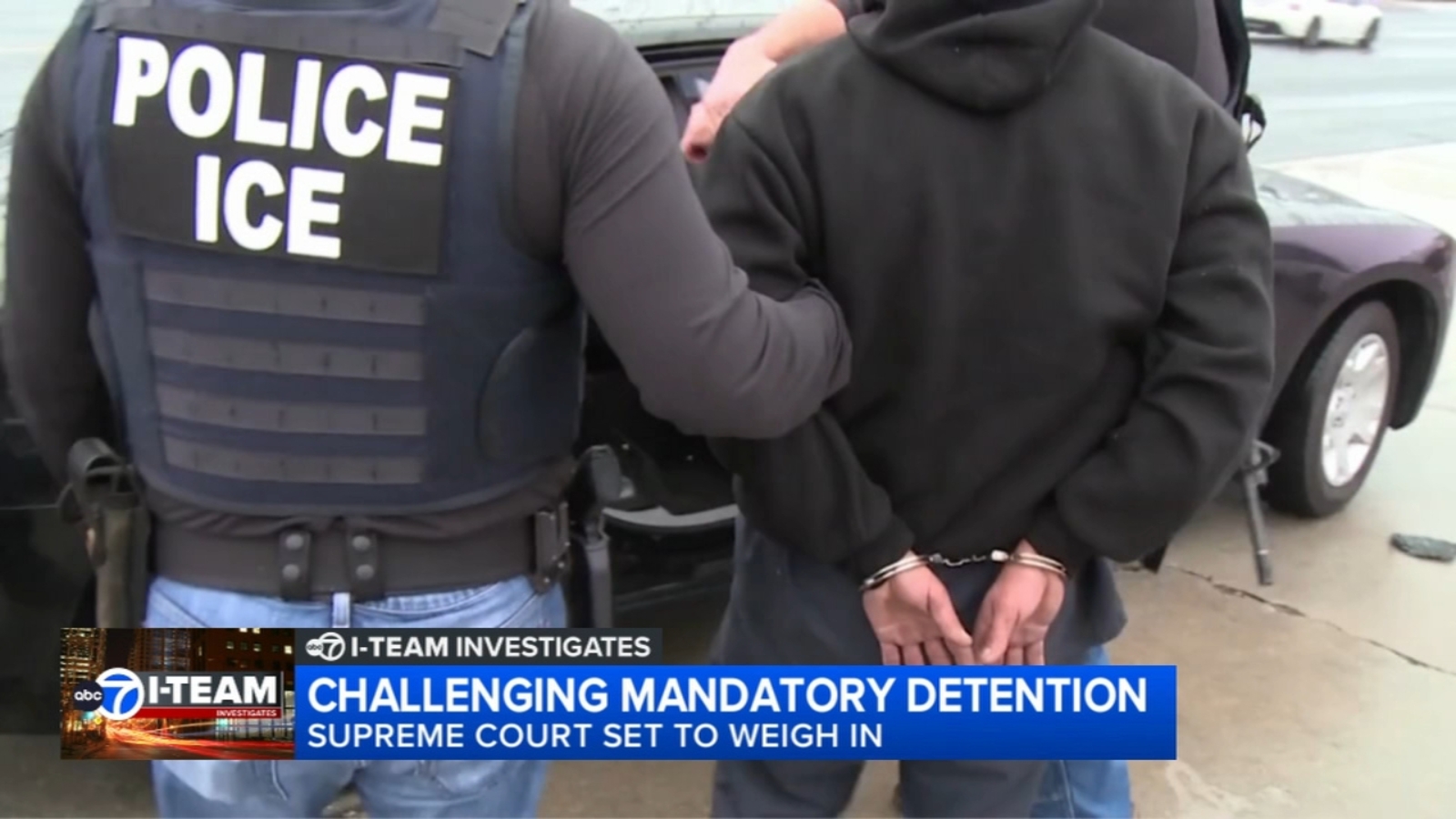
CHICAGO (WLS) — The decision from a looming U.S. Supreme Court case could impact millions of undocumented families across the country, many in Chicago.
It’s a crucial beam holding up President Trump’s deportation agenda: Mandatory detention for all undocumented immigrants detained, regardless of if they have a criminal history.
But as the ABC7 I-Team has reported over the past year, many have successfully challenged the policy in court, earning a temporary freedom.
ABC7 Chicago is now streaming 24/7. Click here to watch
Now, the U.S. Supreme Court has agreed to take on a case weighing whether the administration’s policy shift is lawful.
Over the last year, the I-Team was there to capture moments some parents feared they wouldn’t see when they were reunited with their families back in Chicago after they were arrested by federal immigration agents.
“Every day felt like an eternity for me being in there,” said Josue Pire-Hidalgo, a Chicago Public Schools custodian that was released after 42 days in custody.
“All I wanted to do was cry with happiness,” said Ramiro Cabrera, a father who spent 41 days in ICE custody.
Cabrera, Pire-Hidalgo, and thousands more were held in ICE detention after the Trump administration reversed decades of precedent, imposing a mandatory detention policy for all undocumented immigrants.
The Administration argued it was closing “loopholes” that previous administrations used to allow immigrants to remain free.
But these men, and many more, successfully challenged that policy in court.
“They were in very, very large numbers… challenging the lawfulness or the constitutionality of that detention,” said Eva Saltzman, a former Chicago immigration judge.
For ten years, Saltzman determined whether a person was eligible for release while their deportation or removal cases proceeded.
She says the policy shift last year led many people to choose deportation over detention.
“People who would otherwise be seeking relief, who may be eligible for asylum or cancellation of removal, are increasingly going to forgo, forego that application, and forgo that opportunity simply so that they’re released from custody as quickly as possible,” Saltzman said.
After the policy shift, Saltzman said she continued to review cases based on their merits.
In the case of Ruben Torres-Maldonado, he was arrested by ICE a year ago but asked to be released to spend time with his daughter who was dying of cancer.
Despite the administration’s new policy, Saltzman granted the father’s release.
Then, this past July, Saltzman said her career in immigration court ended abruptly.
“I was fired or terminated without cause, so I don’t know the official reason for my termination. I did handle a number of very high profile cases,” Saltzman said.
Saltzman told the I-Team, “I do have concerns for what due process looks like in our immigration courts.
The Trump Administration’s efforts to make its “mandatory detention” policy permanent have now reached the U.S. Supreme Court.
On Oct. 1, the Supreme Court announced it had agreed to hear the case of Rhoney v. Barbosa da Cunha, a case centered around a Brazilian citizen with no criminal record who had applied for asylum, but was placed in mandatory detention after he was arrested by agents last year.
Federal judges across the country have delivered more than 9,300 rulings against the administration’s mandatory detention policy, according to a Politico analysis.
Two Appeals Courts sided with the Trump Administration, asking the Supreme Court to weigh in.
The Supreme Court will hear the case early next year.
Saltzman said the Justices’ decision will be consequential.
“You suddenly have a new situation where millions of people in the United States could be immediately subject to mandatory detention, and that would be a very, very significant change,” Saltzman said.
Copyright © 2026 WLS-TV. All Rights Reserved.