
Last weekend, a young woman named Brecca Stoll, reporting on behalf of Ben Shapiro’s Daily Wire, snapped a photo and shared it on X. It showed a scoreboard at the Coleman Coliseum in Tuscaloosa, Alabama, where a raucous crowd, driven indoors by the approaching remnant of Hurricane Isaias, had gathered ahead of a top 10 clash between the Crimson Tide and the Georgia Bulldogs.
“College GameDay,” ESPN’s flagship Saturday morning college football pregame show known for funny, wacky, sometimes inappropriate audience-made posters, was responsible for the gathering, and Stoll’s photo showed the show’s long-standing rules, spelled out in white block letters above center court:
“No food or drink”“No vulgar signs”“No .com, QR codes, or # signs”“No political signs”“No religious signs”“No bags, no purses”“No markers, pens, pencils, dry erase board”“No throwing objects”“All person’s entering are subject to search”
Stoll had scratched a red oval around the middle of the list. “College GameDay says ‘no religious signs,’” she captioned. Her post earned 14 retweets and 72 likes, along with a handful of comments heaping shame on ESPN for supposedly stifling Christian expression. The post also garnered a disproportionate 180,000-plus views, aided in part by Jon Root, a “content creator/writer” for Outkick, a conservative sports and culture website owned by Fox.
He shared Stoll’s post and wrote a story about it. “I wouldn’t go as far as calling this religious persecution,” he admitted. Rather, his issue was about uneven enforcement of the rule, which ESPN claimed had been in place for a long time. It was, indeed, a puzzling explanation.
Anyone who watches “College GameDay” on a regular basis knows religious signs are common, if not an outright expectation. They’re often large and loud, written in neon green or yellow and positioned strategically to make them difficult to ignore. Love them or hate them, they’re there, broadcast after broadcast, and have been for years.
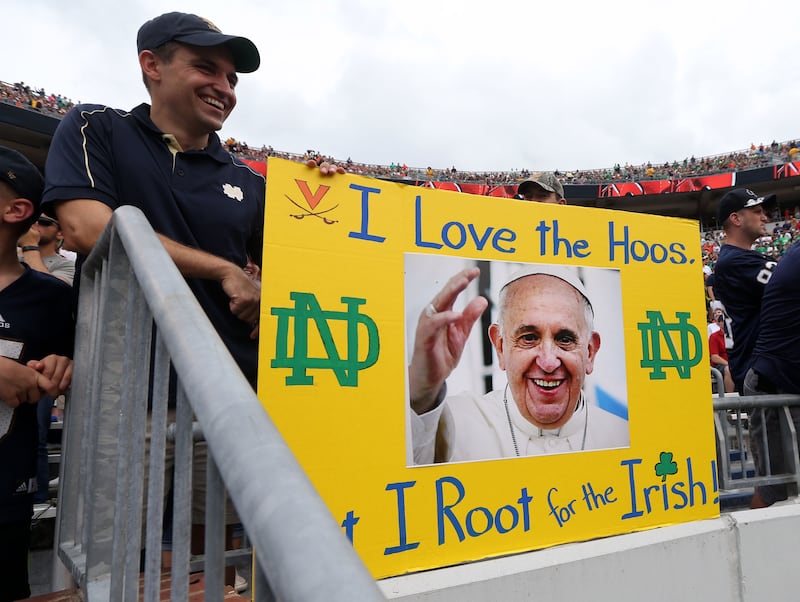 A Notre Dame fan holds a sign bearing a photo of Pope Francis during an NCAA college football game against Virginia, Saturday, Sept. 12, 2015, in Charlottesville, Va. | Andrew Shurtleff, Associated Press
Yet this weekend, whether the sincere, overt, somewhat routine signs in the key of “turn toward Jesus” or “Jesus saves” make an appearance or not, they won’t be needed to probe the intersection of religious expression and corporate policy that led to last week’s dustup.
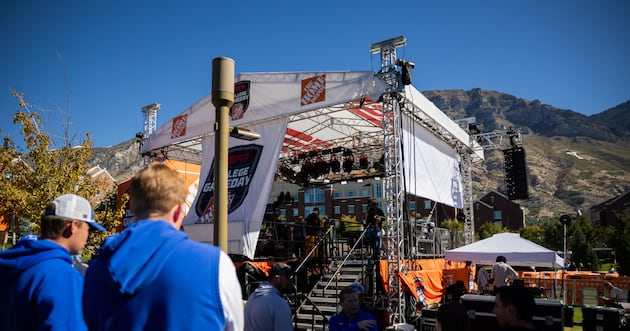
When the show heads to Provo for another top 10 matchup, this one between BYU and Notre Dame, it will mark the first broadcast of “GameDay” from BYU since 2009, and its first ever from a clash between the nation’s two most prominent religious football programs.
A laboratory, in other words, to test ESPN’s “No religious signs” policy as never before.
Rainbow Man and his heirs
Before the banners declaring “Call out to Jesus” or “Just talk to Jesus,” there was Rollen Stewart, aka “Rockn’ Rollen,” aka “Rainbow Man.”
In the 1970s and 1980s, Stewart was a visionary ahead of his time; a sort of “Marlins Man” before Marlins Man, who made a national name for himself by courting the attention of TV cameras at major sporting events. Stewart was known for his rainbow wig, a beard that dangled like Spanish moss and, most of all, for a white T-shirt with black letters that always spelled out a Christian message — most often, and most famously, “John 3:16.”
Florida Gators legend Tim Tebow would later make that Bible verse even more iconic in the sports world when he scrawled it onto his eye black during Florida’s 2009 National Championship victory over Oklahoma, touching off a debate over the link between sports and faith that rages to this day.
It isn’t clear when the first overtly Christian sign appeared on “College GameDay,” but Reddit users have been complaining about it for a long time.
One post from five years ago, shared in the “CFBmemes” community, used a Lisa Simpson meme format to say, “ban all religion signs from College Gameday.” Nine years ago, another user in the “CFB” community shared that he’d recently attended “GameDay” at Penn State and that “the place was littered with (Jesus) signs” — despite, he noted, the posted warnings about “no religious signs.” So the signs themselves, and ESPN’s policy, have been around for at least a decade.
Yet both the signs and the policy persist.
“I think that people see that there’s light and darkness in the world, and they’re doing their best in whatever way they can to be a light.”
— Will Dawson, Christian Broadcasting Network
One explanation for the apparent dissonance is that the prohibition of religious signs, as well as ESPN’s other prohibitions, are only enforced in “The Pit,” the area directly behind the broadcast. But given the prevalence and prominence of religious signs generally, that effectively makes the policy toothless.
Plus, ESPN has stepped in to remove other inappropriate signs from outside The Pit — most notoriously the multiple times fans have raised banners using “ESPN” to refer to the male anatomy.
When the show made its only other appearance in Provo, ahead of a 2009 matchup between BYU and the TCU Horned Frogs, signs included “D-Day: The invasion of Mormandy”; “Mormons eat frog eyes in their Jello salad”; and “Horny toads aren’t even Christian.” It isn’t clear whether these signs would be considered “religious” under ESPN’s policy.
“We worked with (“GameDay”) on the sign standards,” a BYU spokesman told the Deseret News. “And I can confirm that religion is a category we talked about with their staff.”
A follow-up question on how “religion” was defined on a broadcast celebrating a game between two religious schools received no response. And perhaps reasonably so.
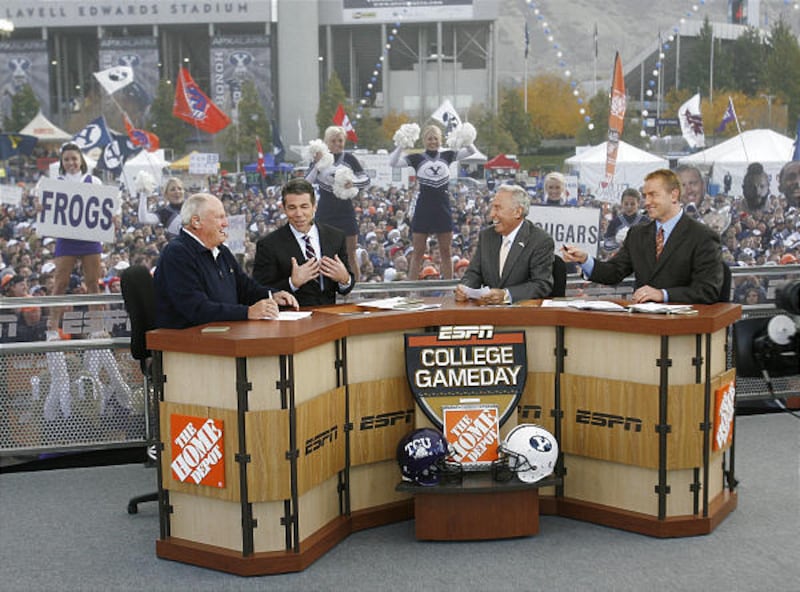 Former BYU football coach LaVell Edwards is interviewed by ESPN’s Chris Fowler, Lee Corso and Kirk Herbstreit during the ESPN “College GameDay” broadcast in Provo. | Jeffrey D. Allred, Deseret News
This subject is tricky, this week more than ever. The question of where sports and religion should intersect has been bickered over since at least the era of Rollen “Rainbow Man” Stewart, because where some see a welcome revival, others perceive an annoying distraction, and it can be difficult to transcend tribal allegiances and reactionary takes to see things as they are beneath the surface.
Stewart, for instance, eventually had a breakdown that led to kidnapping convictions and three life sentences. Should his activism be remembered for its pioneering use of sports to celebrate a religious cause, or as a cautionary tale?
Similarly in the present, ahead of BYU-Notre Dame, what does ESPN’s prohibition of religious signs protect — and, potentially, erase?
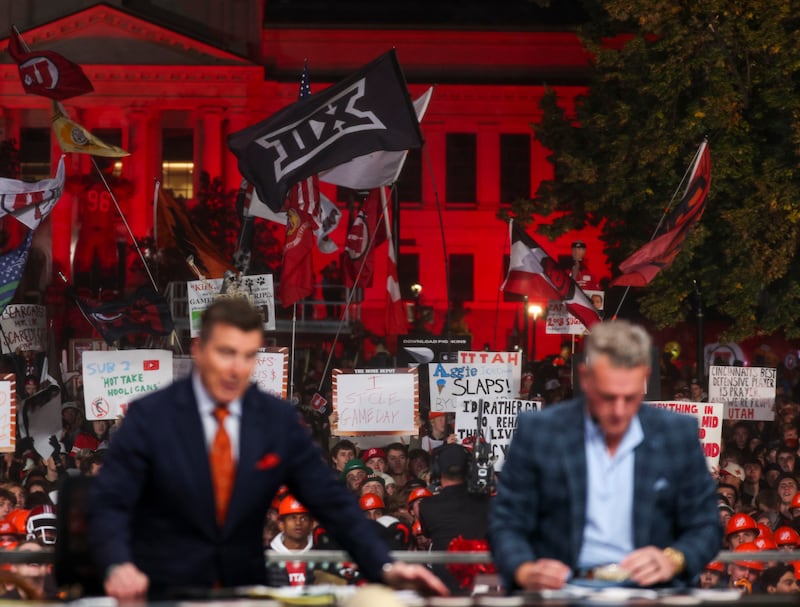 Utah fans wave flags and hold up signs during ESPN’s “College GameDay” at Presidents Circle at the University of Utah in Salt Lake City on Saturday, Nov. 1, 2025. | Rio Giancarlo, Deseret News What counts as religious?
A few weeks before last week’s controversy, Christian Broadcasting Network’s Will Dawson, host of a Christian sports podcast called “Fuel the Fire,” published a video that foretold what was to come. Titled “A Jesus moment is sweeping college sports,” Dawson explained that players, coaches and fans of college football are becoming much more vocal about their faith this season — especially on “College GameDay.”
His very first example pulled from a recent episode of the show in which, directly over host Nick Saban’s shoulder, a sign written in white block letters reads, “To every underdog don’t give up.” Then, in Gatorade-green neon, “Find hope in Jesus.” Dawson framed this sign as part of a larger movement.
“I think that people see that there’s light and darkness in the world, and they’re doing their best in whatever way they can to be a light,” he tells the Deseret News. “And I think those signs are part of it.”
That’s the beauty, Dawson adds, of the First Amendment. It allows movements to build — even if he concedes ESPN isn’t obligated to follow it.
“ESPN can generally choose what appears in its broadcast,” explains a recent article by Freedom Forum discussing the legal ramifications of ESPN’s sign bans, “but public universities remain subject to the First Amendment when regulating speech on campus.” Private universities — like BYU and Notre Dame — don’t have to follow the First Amendment, though for an event like “GameDay,” they’re likely to do so regardless, just to embrace the spirit of the law. Should ESPN do the same?
“You run into dangerous ground by censoring,” Dawson adds, “and that is essentially what (ESPN’s policy) is: Censoring certain messages while allowing some (others).”
Yet Dawson’s view is rooted in the proliferation of Christian signs, specifically. What about signs promoting Islam (which, as best as I can tell, has never happened on “GameDay”)? Would that change the equation?
Plus, for BYU-Notre Dame, couldn’t almost any branded T-shirt or ball cap be interpreted as “religious”? “The schools themselves are already religious symbols,” says Cody Musselman, an assistant professor of American Studies at Notre Dame who specifically studies religion and sports. “So just having a Notre Dame or a BYU shirt on could be enough to communicate the religious mission of the institution.”
Joseph Price, professor emeritus of religious studies at California’s Whittier College, agrees that this presents a challenge for ESPN, especially just a week removed from its heaviest religious sign controversy in years.
“How does ESPN define religion?” he wonders. “Is it simply the use of God language, or reference to a scripture passage? What about something like ‘awe-inspiring’? That could be understood as a religious expression, and yet will it be disallowed?”
“Awe-inspiring” doesn’t seem too likely to get written on a “College GameDay” sign, but what about something more culturally specific to Latter-day Saints or Catholics? A reference to “The Secret Lives of Mormon Wives,” for example, or to Pope Leo XIV? “This is a conundrum at the heart of the Establishment Clause,” Musselman says, referring to the First Amendment’s guarantee to “make no law respecting an establishment of religion, or prohibiting the free exercise thereof.”
“Are we having a secular space completely devoid of religion,” Musselman adds, “or are we having a secular space that is pluralistic and embracing very visibly of all religion?”
 ESPN College GameDay comes to BYU in Provo on Thursday, Oct. 15, 2026. | Kristin Murphy, Deseret News Whose movement, exactly?
The religious signs that have become common on “College GameDay” are not obviously denominational, and no single group has claimed responsibility for them — even though they often bear striking similarities. In general, though, they’re of a born again/evangelical character. They ask people to come to Jesus broadly, from wherever they are.
That doesn’t necessarily exclude Latter-day Saints and Catholics, since both groups worship Jesus Christ. But it’s also difficult to imagine either group putting up signs with similar messaging, or even messaging of their own — “2 Nephi 2:25” or “Pray the Rosary” haven’t made appearances on the show.
“If I was to think of where I’d be more likely to see a proliferation of those signs, I think it would be places that are more deeply saturated in a white evangelical megachurch-ish or nondenominational Protestant kind of culture,” says Matt Brown, a longtime college football reporter who runs the Extra Points newsletter. “That’s not really BYU and that’s not really Notre Dame.”
That’s where the conversation gets really tricky.
“Both (The Church of Jesus Christ of Latter-day Saints) and Catholics historically have been outsiders to the American religious mainstream,” Musselman says. “And so that’s changed some of the ways that they might present themselves on a national stage.”
In other words, Catholics and Latter-day Saints are more likely to self-censor — and even if they did decide to lean in to the religious signs that have preceded them, would anyone come to their defense should ESPN enforce the ban against them? All of which helps explain why ESPN, which is trying to produce a fun, energetic college football pregame show, would have a prohibition against religious signs to begin with.
It’s not discriminatory, this line of thinking goes — it’s just trying to avoid distraction.
“A sign inviting you to come unto Christ, which may be valid in many other contexts, is not a college football joke,” says Brown. “If you throw open the signs to any kind of possible thing, not only are you going to see a lot of religious and political signs — you’re also going to see a lot of signs explicitly promoting other brands. People will see this as a guerrilla marketing opportunity. And if that becomes the backdrop, that does diminish what the show is.”
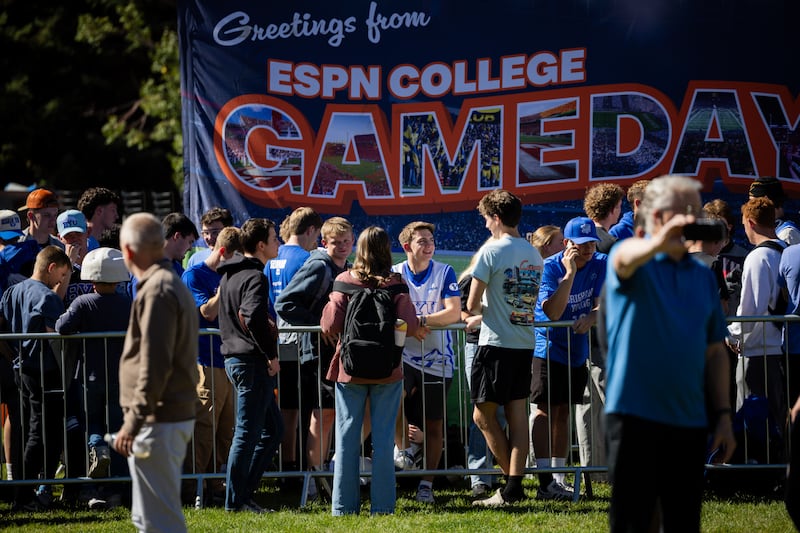 BYU students wait in line for a spot to watch ESPN’s “College GameDay” on the lawn at Heritage Halls on BYU campus in Provo on Friday, Oct. 16, 2026. | Tess Crowley, Deseret News Part of the culture war?
On Wednesday, Outkick ran another story about last weekend’s viral post, interviewing Texas A&M fan and 40 Days For Life CEO Shawn Carney.
He criticized ESPN, saying, “It’s dumb corporate America doing what they often do all the time, which is decide that they just want to ban a group, and it’s almost always Christians.”
Somehow, in the days leading up to a football game between two religious schools, the sign rules for “College GameDay” became part of the outrage machine that demands churning.
Which, more than any principle or heady question about religious expression in the public square, might be the best explanation for last weekend’s controversy.
“Given the midterm election and the proliferation of bot traffic or explicitly manufactured outrage that exists on social media,” Brown says, “I wouldn’t be shocked if almost any kind of controversy over something that’s been kind of ubiquitous for a while is not entirely organic.”
On the other hand, viewership for “GameDay” averages nearly 3 million. It means something to decide what’s acceptable to express in such a forum, and how. Especially this weekend.
Price, the Whittier scholar, says an old professor of his once defined an atheist as “someone who doesn’t care about the outcome of BYU-Notre Dame.” Perhaps a better definition to ponder heading into Saturday morning is what makes a college football fan, and what unites instead of divides them.
“I think what ESPN wants to do, which is, ‘Let’s make a show about college football and college football jokes,’ is pretty defensible,” Brown says. “I get what they’re trying to do. I also get that there’s going to be entities that want to turn this into a culture war thing.
“I don’t think it has to be.”