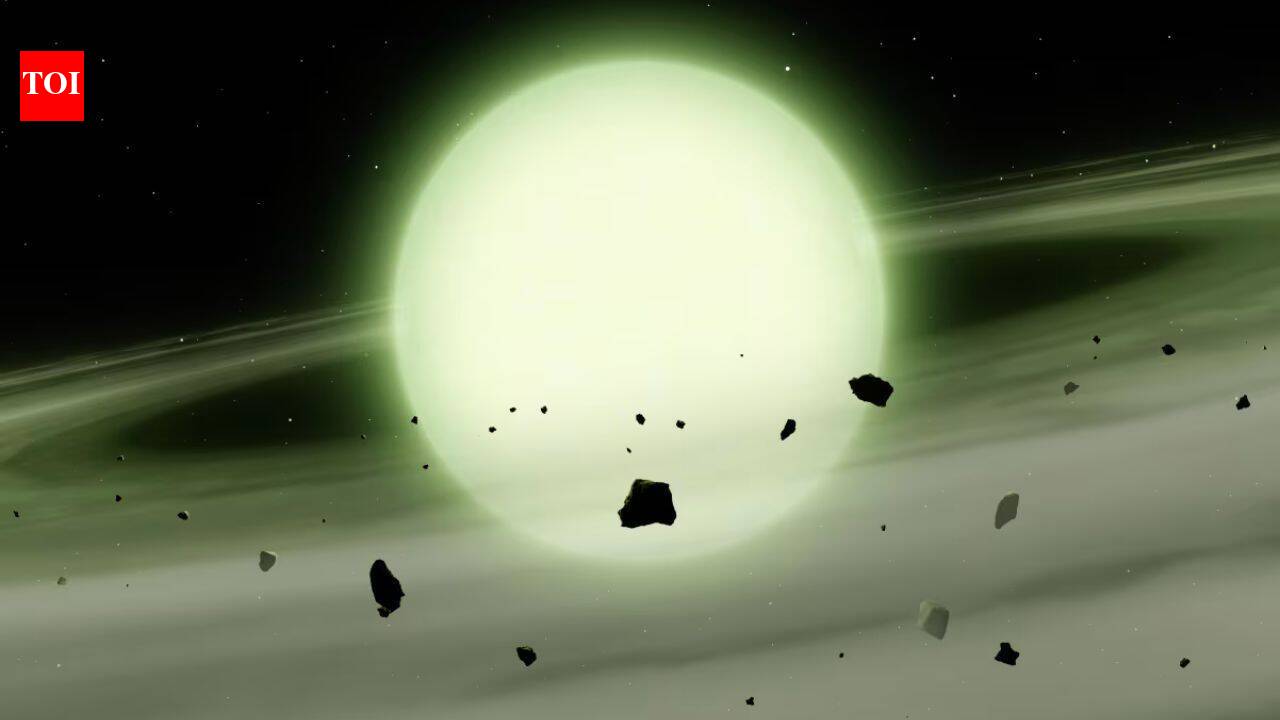
 A representation of the green star (Courtesy Mark A. Garlick/University of Warwick) Astronomers have discovered a star that appears green, an unusual celestial sight that could change how scientists understand the colours of dying stars.According to a study published in RAS Techniques and Instruments, the white dwarf WD J1330+6435 lies about 280 light-years from Earth in the constellation Draco and has a chartreuse-green hue caused by the way sodium interacts with helium under the star’s intense atmospheric conditions.The discovery is part of a broader study into the unusual colours of white dwarfs, the dense remnants left behind when stars exhaust their nuclear fuel and shed their outer layers.According to CNN, the researchers found that the chemical composition of a white dwarf’s atmosphere can significantly alter the light it emits, making some of these stellar remnants appear in colours beyond those typically associated with stars.“The colors that normal stars can have are pretty much only orange, white or blue,” Mark Hollands, an astrophysicist at the University of Warwick in England and lead author of the study, told CNN.He explained that the unusual green appearance of WD J1330+6435 is linked to the physical conditions in its atmosphere, which alter the wavelengths of light absorbed by the star.The green appearance of WD J1330+6435 is linked to the behaviour of sodium in the white dwarf’s extremely dense atmosphere.Under these conditions, sodium interacts with helium in ways that alter the wavelengths of light absorbed by the star, while other elements, including calcium, also influence its spectrum. Researchers used spectral data and models of human colour perception to calculate how the star would appear, rather than relying on a direct photograph showing it as green, according to CNN.The green star 280 light-years awayThe green star, WD J1330+6435, is located about 280 light-years from Earth in the constellation Draco. But what does that distance actually mean?A light-year is the distance light travels in one year, around 9.46 trillion kilometres. So, the light travelling from this star takes approximately 280 years to reach Earth. When astronomers observe it today, they are effectively looking at the star as it appeared 280 years ago.The white dwarf has an estimated temperature of around 4,000 degrees Celsius and is extremely compact, roughly comparable in size to Earth.