
An intimate experiment in writing beside two departed authors. 
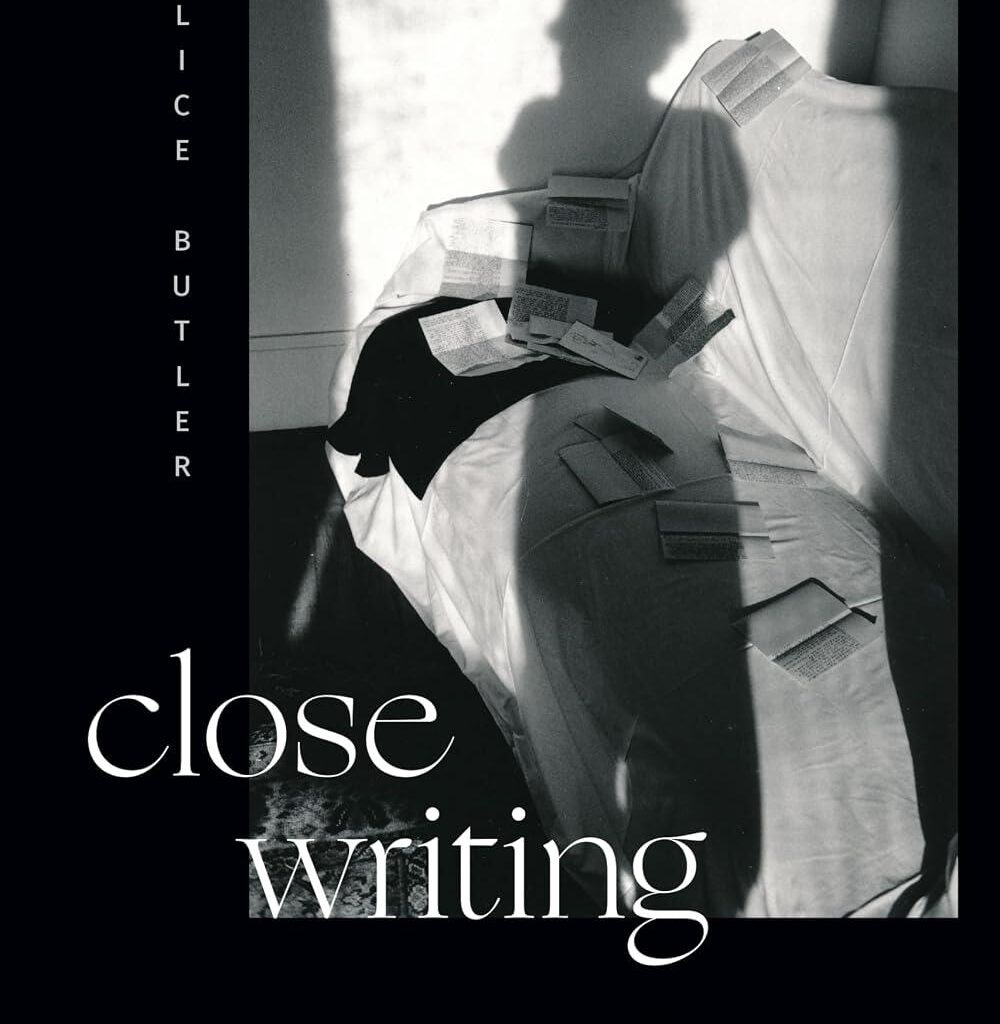
Close Writing: Kathy Acker, Cookie Mueller, & Love-in-Pieces by Alice Butler. Duke University Press, 2026. 304 pages.Buy on Bookshop.org
Become a member for 15% off at Bookshop.orgDid you know LARB is a reader-supported nonprofit?
LARB publishes daily without a paywall as part of our mission to make rigorous, incisive, and engaging writing on every aspect of literature, culture, and the arts freely accessible to the public. Help us continue this work with your tax-deductible donation today!
“WHAT DOES IT MEAN to fall in love with a writer?” ask Eve Kosofsky Sedgwick and Adam Frank in their 1995 essay “Shame in the Cybernetic Fold: Reading Silvan Tomkins.” In Close Writing: Kathy Acker, Cookie Mueller, & Love-in-Pieces (2026), the British writer and academic Alice Butler critically and unashamedly falls in love not once but twice, committing herself to the lives and work of two dead writers, whom she affectionately refers to as Kathy and Cookie.
The familiar address of her subjects becomes the first of many scholarly subversions Butler makes in a process she describes as “collapsing archive into art into writing into performance.” Without clause, pause, or break, this proposition becomes prophetic of the breathless, obsessional, and mimetic bent of the prose that lies ahead. Hardly deferential to scholarly standards of rigor, balance, and substantiated argument, Butler offers an insurmountable “fuck you” to them—and to the conventional tone of critical writing—by bringing Kathy and Cookie into contact through a series of tenuous connections.
It is true that both were anti-intellectual good-time girls, lovers of surface—of hair and clothes, of sex and art—who died too young: Kathy of breast cancer at 50, Cookie a decade earlier, at 40, of AIDS-related illness. They also shared a scene: a late 1970s and ’80s Manhattan shaped by conceptual art and New York School poets (such as mutual friend Bernadette Mayer), combined with a burgeoning underground club scene, captured in perpetuity by the likes of Nan Goldin and Robert Mapplethorpe. Kathy and Cookie did, at some point, also share a publisher, the Native Agents imprint of Semiotext(e), headed up by fellow writer Chris Kraus, and both had their author portraits taken by friend and associate Mapplethorpe. Butler reminds us how, on Valentine’s Day 1980, they performed alongside one another at the Mudd Club. At best, “they were casual friends,” Butler writes of Cookie and Kathy’s broad connection, “but I’m bringing them closer together—drawing out their shared political commitments to rewriting the sick body and its desires, the intimacies and care networks they crafted—in this strange, writerly love triangle.”
Butler wields, perhaps even perverts, the objectivity of a biographer, the intent of a critic, and the license of a poet in order to bring the two figures together on the page, though she admits that the deepest connection between Kathy and Cookie is her own love for them—for their lives and writing—referring to them as her “beloveds” and drawing them into a literary “threesome” in which she speaks of and to and, eventually, beside them. This trialectic form also structures the book, which is split into three chapters, with a centerfold of archival materials: Cookie’s lists on pink paper, her letters on marbled card; Kathy’s diaristic notes and their corresponding Mapplethorpe portraits. Butler’s long introduction reminds us that this is a work of scholarship—formerly her doctoral dissertation—cycling through her motives, approach, references, and formal intentions. The first chapter centers on Kathy and her early diaristic practice (four hours a day without fail), which Butler discusses—with some license—as if it were an artwork intended for public consumption. The second chapter follows Cookie’s early epistolary practice, which Butler perceives as adolescent gestures: “scrappy, sloppy, piecemeal.” The third chapter brings Kathy and Cookie closer, through their eventual turn to fiction writing: published and unpublished, self-published, never-realized fragments of stories that work through sickness, sex, art, and eventually death.
Beyond their near-mythic presence in that near-mythic moment, that long decade in the East Village, what draws Butler to Kathy and Cookie is their nonstudious, unrefined, and often unfinished approach to the page—or pages—and to a kind of writing that is secondary to living, a living in which fucking and earning money and being sick often became impediments to the writerly life. “This diary is (about) the destruction of myself,” writes Kathy in her notebooks around 1972. For both Kathy and Cookie, the destruction of the self was also a destruction, or deconstruction, of gender, which played out first through their image and then on the page. Kathy paired a buzz cut and androgynous clothing with lace bodysuits. With her heavy slick of eye makeup, sinewy body, and strong jaw, Cookie was often mistaken for a drag queen. Theirs was the kind of queerness that manifested from a white middle-class adolescence in the suburbs (Cookie) or uptown (Kathy), shedding, or losing, their biological families to forge their own in and around New York, but also in San Diego and Los Angeles (Kathy) and Baltimore and Provincetown, Massachusetts (Cookie). Butler describes the adolescent impulse in Cookie’s writing as a “queerly oriented perversion, full of ambiguous gendering and a sexual identity that slips and slides between recognizable binary categories,” while Kathy, often bedbound and incapacitated by pelvic inflammatory disease, lets “sickness and sexual fantasy intertwine” as she “deviates from the promise of heterosexual genital ‘union’ to waywardly wander in the pleasures of writing.”
Kathy and Cookie wandered sexually. Between them, their list of former lovers reads like a who’s who of downtown art and literary circles—from filmmaker Peter Wollen and the Mudd Club’s Steve Mass (Kathy) to filmmaker Sharon Niesp (Cookie). But the queerest thing about them was the way they integrated those relationships into their writing, what Butler refers to as an “autoerotic production,” explicit, playful, and unrestrained by literary or sexual expectation: “I didn’t want to watch watching Lenny fuck someone & not being involved would blow me,” writes Kathy. In the catalog that accompanied a group show organized by friend Nan Goldin, featuring David Wojnarowicz and Peter Hujar, on the devastating impact of AIDS on their immediate community, Wojnarowicz proposes that the imagination is “one of the last frontiers left for radical gesture.” Butler folds these artists’ thoughts and words into her own, in a heady consummation. Wojnarowicz refers to this frontier as an “ungoverned” space, “like writing,” Butler adds. That is “where [Wojnarowicz] can dream/write of fucking somebody ‘without a rubber’ […] or dousing the obscene-censoring Senator Jesse Helms ‘with a bucket of gasoline and set his putrid ass on fire.’”
Like Cookie and Kathy, Butler’s writerly wanderings are the queerest thing about her. Seemingly cis, heterosexual, and longing for a baby, Butler is transgressive in her accumulative writing—rich and heavy and sticky with citation—which does the work of queering literary scholarship and criticism: “Is this how you ink-scratched your sick life, your sex life, the close edges between them? Is this how you slipped between it all, the plural pages of your body?” she writes to either one or both of her beloveds, teasing out some shared endeavor in their writing, and then participates in it. Butler’s own desire is not explicitly sexual or defiant of gender but drives the book’s intellectual proposition, in which the heart and mind are unapologetically entwined: “I take you—or is it that you take me (?)—with this belated touch.”
Expanding upon the practice of close reading—a cornerstone of New Criticism in the mid-20th century and later developed by the likes of gender theorist Eve Kosofsky Sedgwick, feminist critic Jane Gallop, and Butler’s mentor, the writer and academic Carol Mavor—Butler moves closer still. Broadly, she defines close writing as a way to “touch, explore, write, and breathe life (momentarily, partially)” into the lives of a subject, but it is also an attempt “to draw closer, without fully healing, the severed line separating life and death, the present and the past.” Early on, Butler uses the term afterlife—a fashionable way to refer to what a writer or artist leaves behind: their impression, or trace. She imagines how a person can be constantly made anew in the present: “You transform states of sickness into events of beauty within the stories it contains; it is a project you give life to, over and over, again,” Butler writes to, and of, Cookie, while grasping the “annotated, bended, and much-creased pages” of her book. Kathy’s and Cookie’s stories are gathered from the glitter-strewn floor of a party or from a sickbed, which Butler eruditely weaves with meaning through gender theory and careful critical analysis while all the time tugging on the loose threads and tender affections of close writing: “I flirt with improper conduct in knowledge making.”
Despite these tonal and stylistic conceits, Close Writing is rigorously researched, drawing upon a range of sources that demonstrate Butler’s deep reading in the field. The distinction between Close Writing and conventional scholarship lies in Butler’s refusal to render something comprehensively whole—licked and sealed like an envelope. Instead, she moves through a description of Robert Mapplethorpe’s portrait of Kathy, musings on Josef Breuer’s hysteria patient Berthe Pappenheim, and an Émile Zola character named Madame de Boves, tethering them together with the image of a “lace envelope” the undergarment worn by Kathy in the picture. The form of a folded envelope, unstuck or left unsealed, becomes emblematic of Butler’s approach to her subjects—often tenuous and wildly speculative, brilliantly so.
At the heart of Butler, Cookie, and Kathy’s shared practice of close writing is the epistolary form—intimate in its direct address, often furtive, sometimes forbidden. For Kathy, letter writing became a panting and horny form of artistic experimentation, exhausting the subject of her romantic obsession, as in her “strange letter to the artist Alan Sondheim, asking him to collaborate on an epistolary art project that would explore the mutual desire they shared for one another after a brief meeting in New York.” For Cookie, it was forging connections across time and place, as she did with musician-turned-poet-and-novelist Richard Hell on home-marbled postcards. And, like them, Butler employs letters—love letters—to get close, and then closer still, to her subjects, though not always being “duly precise.” She describes the “affective, attentive, desiring, erotic, loving, fantastical, and speculative energies of the love letter” while perverting its conventional form. The gendered implication of a love letter, performed by women from within the privacy—or entrapment—of the home, is upended first by Kathy and Cookie and then by Butler, who addresses them directly in sapphic fragments, punctuating the overarching essayistic mode of the book:
You scribbled your address on the inside cover of a ring-bound notebook, veiling and unveiling your visceral insides. It is a lipstick watermark. A mouth parted. An unsealed envelope. A first-person smear. Did you do this on purpose, so I could send you a reply? So bodily is your notebook writing: It wants to be touched again. Here it is, Kathy. My kiss. My stain. X. I hope it reaches you.
Butler draws on Sappho’s poetic fragments—“luminous in their very incompleteness”—in order to express the “contradictory, messy, plural, wayward, and oblique angles of desire.” A break or shattering produces a fragment, but for Butler the fragment produces the break—against essayistic flow.
“Accompanying the reader throughout all of this, too, is Me,” writes Butler, which feels like the wrong verb for the breathless, obsessional, sometimes lusty eruptions she makes to the calm surface of the essay. For Butler, form is content, but the reverse might also be true: her subjects—their content—also shape the form of the writing. In the first chapter, Butler lingers on the adolescent bent of their work, which for Kathy plays out at the level of the sentence: rarely using punctuation, her sentences pour, as if from her mouth, onto the page. Cookie, meanwhile, took to creating staccato lists on Barbie-pink paper, which read like a teenage girl’s ambitions. Neither of them could ever finish anything, sometimes not even a sentence. For Kathy, and sometimes Cookie, the “subversive angles of the adolescent’s creative and erotic imagination” manifested in a fandom that sits beside, or within, adolescence. “I figured out my male stars are David Antin, L. Weiner, Ashley, Peter. Dan Graham on outs. You & E. Antin [are] my female stars,” Kathy tells Bernadette Mayer around 1974. Butler writes:
Like erotomania, like kleptomania, like masturbatory mania, like the manic collecting of clothes, fandom has also been understood as involving a network of pathological symptoms—irrational, overemotional, excessive, hysterical, deviant, compulsive, sick—which is often felt in the (adolescent) body.
I think of acne, growing pains, and unexplained spikes in hormones but also those blurrier spaces—being sick, as in misunderstood, or perverse, as in curious.
Butler cites Sedgwick, who said that obsession is “the most durable form of intellectual capital,” and writes from an inexhaustible and unashamed love of her subjects—the way they loved theirs. Butler calls it “an affective, networked, and citational kind of fandom,” playfully and knowingly fanatical. Butler trades the toxic star-fan hierarchy (one predicated on capitalist exploitation) for writing beside Cookie and Kathy, the way Cookie wrote beside Mapplethorpe, “as fan, lover, carer, and ally.” This prepositional shift from to to beside “captures the subject/object closeness of the writing act: as in at the (bed)side of, or right next to […] [T]o write beside is to inhabit reparative, horizontal kinships—across the living and the dying, the sickbed and the bedside.” Writing with or beside Cookie and Kathy begins to mean writing with or beside sickness and death. “Together but apart, my beloveds cared for the often-hidden, always-plural perversities and pleasures of lovesickness (meaning loving, and writing, in and with sickness).” Cookie “wrote palliatively beside and not against” illness—beside her friend Hujar, as he died of AIDS-related complications, but against the violent stigma facing those with AIDS in the United States under Ronald Reagan. The effusive appetite of Butler’s writing reads like a queer elegy for the queer dead, not just for Kathy and Cookie but also for the concentric communities surrounding them, and all those lost to AIDS.
It becomes contagious, this lovesickness, this perversity of loving and writing beside sickness, and I find myself beside Butler, reading with her the way that she writes with Cookie and Kathy. It is during this time, as I am reading with Butler, that my father begins his final, fatal, decline. When he finally slips away from us, all correspondence (his consistent greeting of “hello sweetie” down the phone whenever I called, or the badly written boomer text message containing too many exclamation marks) is cut short. That silence—no return caller, no responding message, no voice at all—is the hardest thing about his passing. So, when my best friend sends me a stack of books that are, in one way or another, about grief, and a card that reads “some words for when there are no words,” I am reminded that there are literally no words, not from him or to him. I include this personal aside in the manner of Butler and Cookie and Kathy, but also because my loss creates another way of reading what Butler calls “love-in-pieces.” Her caring for the bodies and lives of her subjects, through and “across life and text and scattered archives,” becomes particularly poignant in my father’s wake, as tributes and stories pour in, and photographs are dredged up from the past. But “love-in-pieces” takes on a secondary meaning: it becomes the breaking into pieces that happens to us in a person’s wake, one that Butler resolves through her close writing with the dead. “I conjure (out of love) close hospitality with the dead,” she writes, and it resonates.
As Butler draws to a close, she returns to her initial impulse to write: discovering, liking, and then loving her subjects, conjoined by love, sex, illness, and, of course, New York; loving not just their work but also their self-mythologizing, their corporeal lives and material afterlives, their garments, their correspondences, and their photographic portraits. Butler plumbs the archive unceremoniously, prizing the inconsequential and lesser-cared-for objects from its depths, bringing them close, but never forensically. She loves in order to continue the “unfinished task of close writing,” the implication being that a life extends beyond the body mortal. “When I say goodbye, it is only a beginning,” she adds.
Butler hails from a new school of critical writing in which “critical” means not cutting something down but building it up, the way love builds. Returning to Sedgwick’s earlier question—“What does it mean to fall in love with a writer?”—Butler’s answer, I imagine, might be in the plural and in the reparative mode. As a work of creative scholarship, Close Writing refuses “to mend the past, to cohere it, to repair or clean up” what W. E. B. Du Bois calls the “tears, frangible edges, erasures, abrasions,” or if it does, it is in the manner of Lauren Berlant’s “non-reproductive repair: tending to broken social and material infrastructures without trying to restore the old, harmful status quo or reproduce traditional life patterns.” Butler attempts non-reproductive repair by allowing Kathy’s and Cookie’s own tears, edges, and abrasions to be part of the work, the way it was for them: conjoined by living and loving and writing and dying.
LARB Contributor
Rose Higham-Stainton is a writer whose work explores gender and art-making and is published by Los Angeles Review of Books, Apollo, TANK, Flash Art, Texte zur Kunst, The White Review, Art Monthly, Bricks from the Kiln, and Worms Magazine, among others. She has written several chapbooks, and her debut book, Limn the Distance, came out with JOAN Publishing in 2023.
Share
Copy link to articleLARB Staff Recommendations
Nathan Dunne reviews Cookie Mueller’s “Walking Through Clear Water in a Pool Painted Black.”