
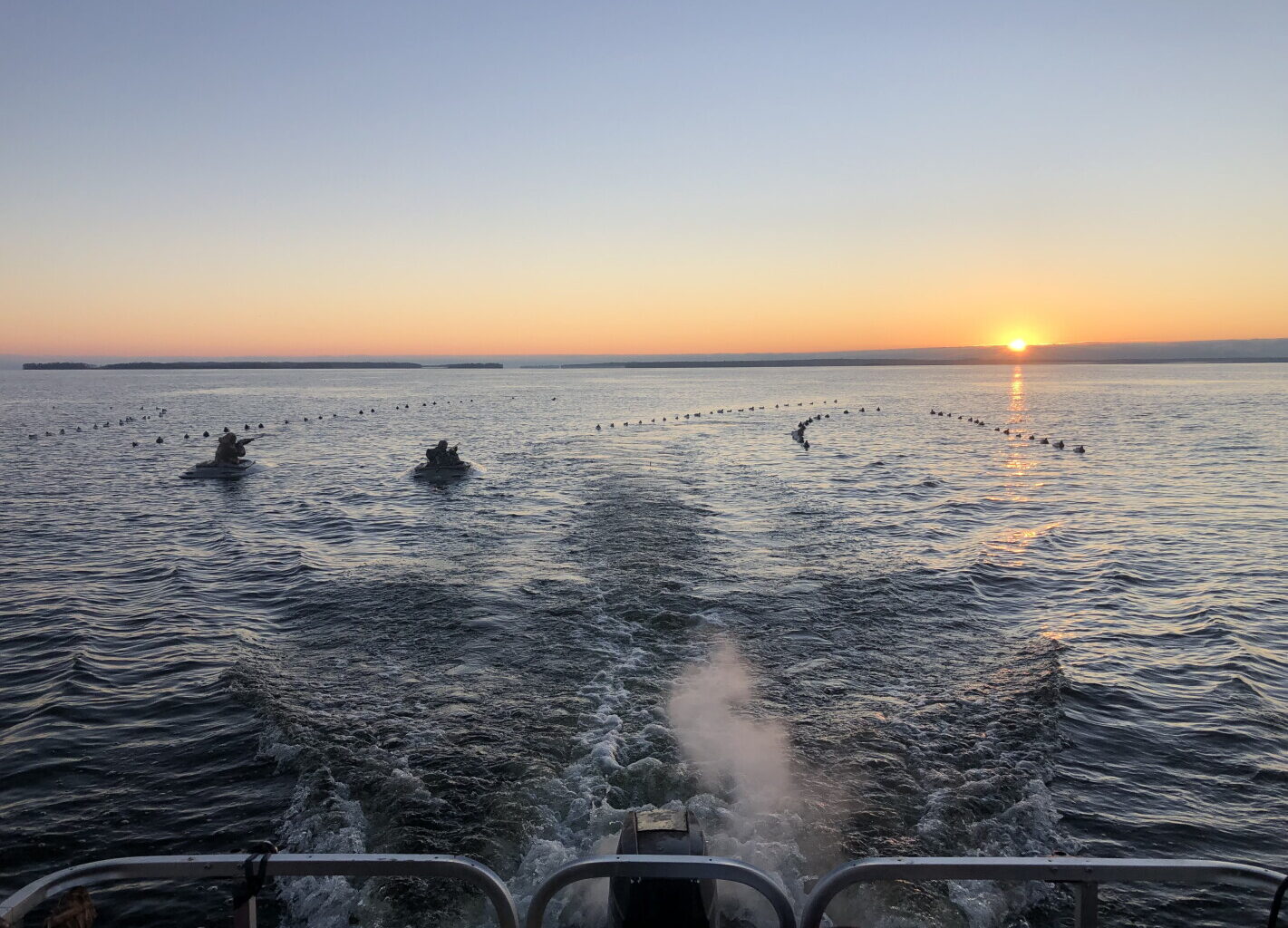
Andy Reaves lies in a boat, his chin upon his chest, shotgun in hand as he scans the sky overhead, waiting for the divers to come in. Before long, they do.
Reaves sits up, takes aim and brings down a duck. Maybe more than one, because here on the water, away from shore, he’s in the midst of the waterfowls’ landing site.
This is layout boat hunting, a type of duck hunt that Reaves, a lifelong waterfowl hunter from northern Minnesota, especially enjoys.
The place is Lake of the Woods in Minnesota’s Northwest Angle, not far from the Canada border and one of few places in the state where boat layout hunting is allowed.
Reaves says hunting waterfowl this way, particularly ducks, his favorite kind of bird to harvest, has been a game-changer for him.
Often, when Reaves is on a layout boat, there are three other similar boats nearby, each also carrying a waterfowl hunter. That’s because only one hunter can fit into a layout boat, thus the multiple floaters.
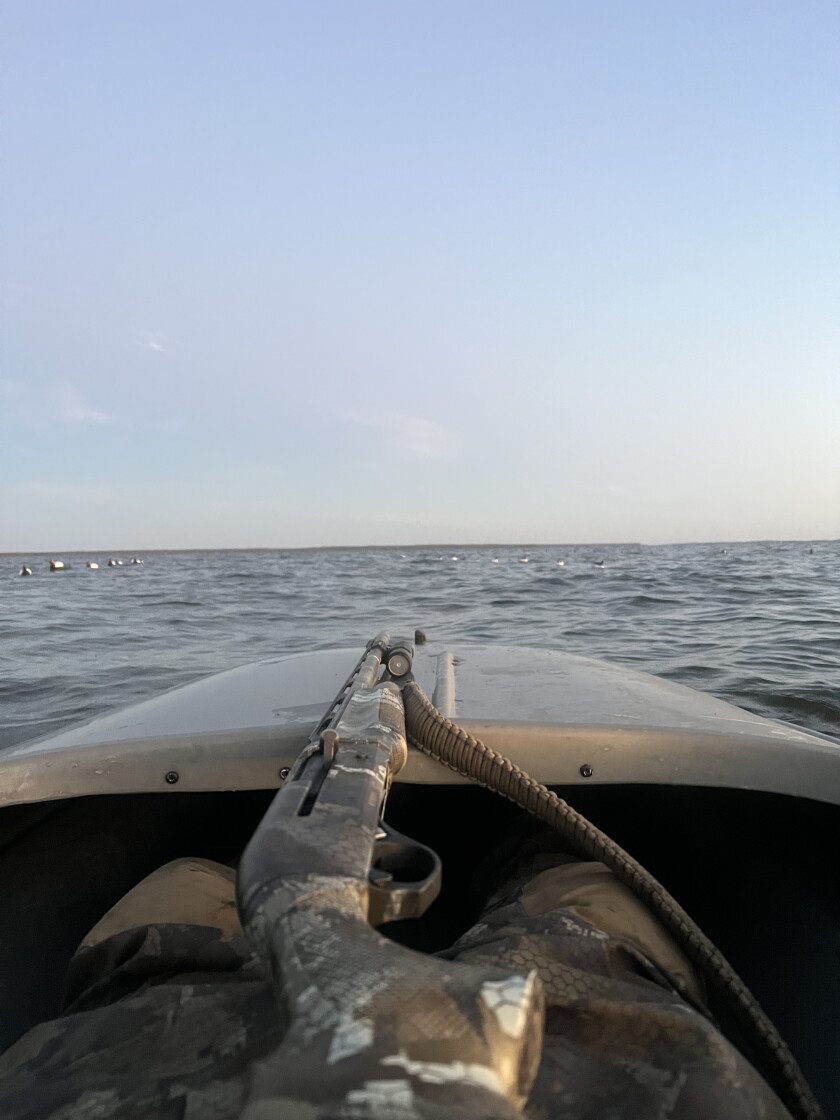
A hunter lies in wait in his layout boat on Lake of the Woods in Minnesota’s Northwest Angle.
Contributed / Andy Reaves
At least, this is the typical way Reaves would hunt if he snuggled into a layout boat. Usually, he is on a pontoon boat with his business partner watching the show in real time.
Reaves, owner of Reaves Fins and Feathers, and friend Forrest Huset, owner of Angling Addicts, guide waterfowl hunters on Lake of the Woods using layout boats. But only during a short window in fall.
It’s a unique hunt in the Upper Midwest. Only five waters in Minnesota allow layout boat hunting: Lake of the Woods, Lake Superior, Lake Pepin, Mille Lacs Lake and portions of the Mississippi River.
Minnesota’s waterfowl season runs through Nov. 24 in the northern zone, but there’s a shorter window for layout boat hunting. Reaves says he won’t do it past the first Sunday after Halloween.
“That’s my hard cutoff,” he says.
After that, Huset, who lives in Moorhead when he’s not running his business in the Angle, heads to Blaine, Minnesota, to tour trade shows with Thorn Brothers Tackle, and Reaves heads to Kansas, where he works for a waterfowl outfitter in the Sunflower State.
But Reaves also guides anglers, starting in April for lake sturgeon on the Rainy River, an adventure he typically wraps up around the first week or two in May, depending on the close date for the dinosaur fish. By Mother’s Day weekend, he’s again in the Angle for the Minnesota fishing opener, and then the week after that he’s in Ontario, where he spends a good chunk of the summer fishing and guiding.
“I’m fishing for anything and everything starting in July when all seasons are open,” he said.
But all of that, for now, is in the future. It’s the duck season he’s most interested in at this time — he and Huset on their pontoon, their clients in their layout boats, waiting for another diver.
Reaves has been a waterfowl hunter for most of his life, and still hunts in the marshes. But once he started using the layout boat technique, it changed the way he approaches the hunt at Lake of the Woods.
What might sound ironic, he says, is that it is both challenging but also easier because it puts hunters in the middle of where the ducks are on the water. If the ducks don’t want to land, Reaves says they’re at least close enough for a hunter to take good aim.
“From a hunting standpoint, it’s exactly everything a hunter could ask for as far as the shooting distance goes,” he says.
What makes it challenging is that the hunter in the layout boat is bouncing with the waves, with a narrow shooting window as far as hunter movement goes — “between your 8 o’clock and your 2 o’clock … because the boats don’t flex with you,” he says. “Whereas if you’re in a layout blind hunting ducks or geese, you have fabric that will stretch with you so a guy can turn a lot more. But with the waves and all these diver ducks flying anywhere between 30 and 40 mph as they’re coming through the spread, it makes for some really challenging wing shooting.”
The guides will place their decoy lines between 25 and 40 yards out from the boats. Reaves says that gives the clients a good idea on the distance they need to shoot.
“If the birds are trying to set in, it’s a pretty easy shot,” he says. “You don’t have to lead them too far. If they’re flying through or someone else takes the first shot and now you’re playing catch-up because of all the birds trying to get out of the hole, you could be having to put a 5- to 12-feet lead on the bird.”
Reaves says he and Huset run up to four boats in a spread. Several years ago they took a pontoon boat and stripped it down to no more than the driving console. This opened it up so they can load and transport all of their layout boats and decoys to the preferred location on the lake.
“If a guy doesn’t have a pontoon boat, he might be making one trip per layout boat, for as many boats as he might have. It can be a big operation,” Reaves says. “That’s why we have two guys. It is really a two-man job.”
The Angle’s duck visitors
Huset has been guiding since 2014, both fishing and waterfowl hunting. A lifelong duck hunter, he came to know Reaves and decided to partner with him to give the layout service a try. Huset calls it “a neat little opportunity.”
He knew he couldn’t do it alone, agreeing with Reaves that it’s definitely a two-person job setting the boats, planting the decoys, retrieving the downed birds and so forth. So the two teamed up, deciding to give it a whirl and even did a little advertising.
“It was a pretty big hit and we still do a decent amount of it now,” Huset says. “Everyone who comes out to try it just loves it , so we keep on doing it.”
He says for someone who has never tried hunting with a layout boat, the first time can be a memorable experience.
“You’re in the middle of the lake, two or three miles from shore, shooting ducks,” Huset says. “It’s a pretty interesting deal.”
Sometimes they might have to hunt longer into the day, but there’s never been an issue filling the bag limits. Minnesota’s daily bag limit is six ducks per day per hunter.
“We’ve had as many as 10 hunters at times and harvested 60 ducks in a couple of hours,” he says. “It just keeps getting better the later in the day you go.”
Huset and Reaves watch the hunters from their pontoon boat, each hunter in his layout boat raising one arm if they missed a duck and two arms if they downed a bird. The two guides will then go out to retrieve the bird immediately if there is a heavy wind or they might wait until after a couple of shooting rounds if there’s a lighter breeze. They use a net to retrieve the downed birds from the water.
Most of the ducks the hunters harvest on the lake are game bufflehead, but they also will sometimes harvest bluebills, goldeneye and a few sea ducks such as scoters and even some long-tailed ducks — “but obviously a little more rare with those,” Huset says.
Reaves says they like to have a group minimum of four hunters per trip. Cost is around $300 a day per person, and services do not include lodging. Instead, clients choose where they’d like to stay and the guides will pick them up from there on hunting day.
The downfall of October in the Angle is that there is often limited room availability, according to Reaves. He says many of the lodgings also have group minimums, which is another reason he and Huset also require a minimum number of hunters for each hunt.
With just a couple of weeks left in the season, the two guides are busy planning their next adventures and look forward to spring, when they’ll get heavy into fishing again before another round of layout boat hunting begins next fall.
For now, there is still time to get up close and personal with the ducks at the Angle’s Lake of the Woods.
Huset says they’ve had clients come from as far away as Texas, Utah and Colorado, among other states.
“From all over the place, really,” he says. “I think it’s just a totally different experience. It is truly a unique experience. I think that’s what gets a lot of people up here to do it, because the only other places to do it, for the most part, is the Great Lakes and if you go out to the ocean. It’s just a nice option for us here in Minnesota.”