
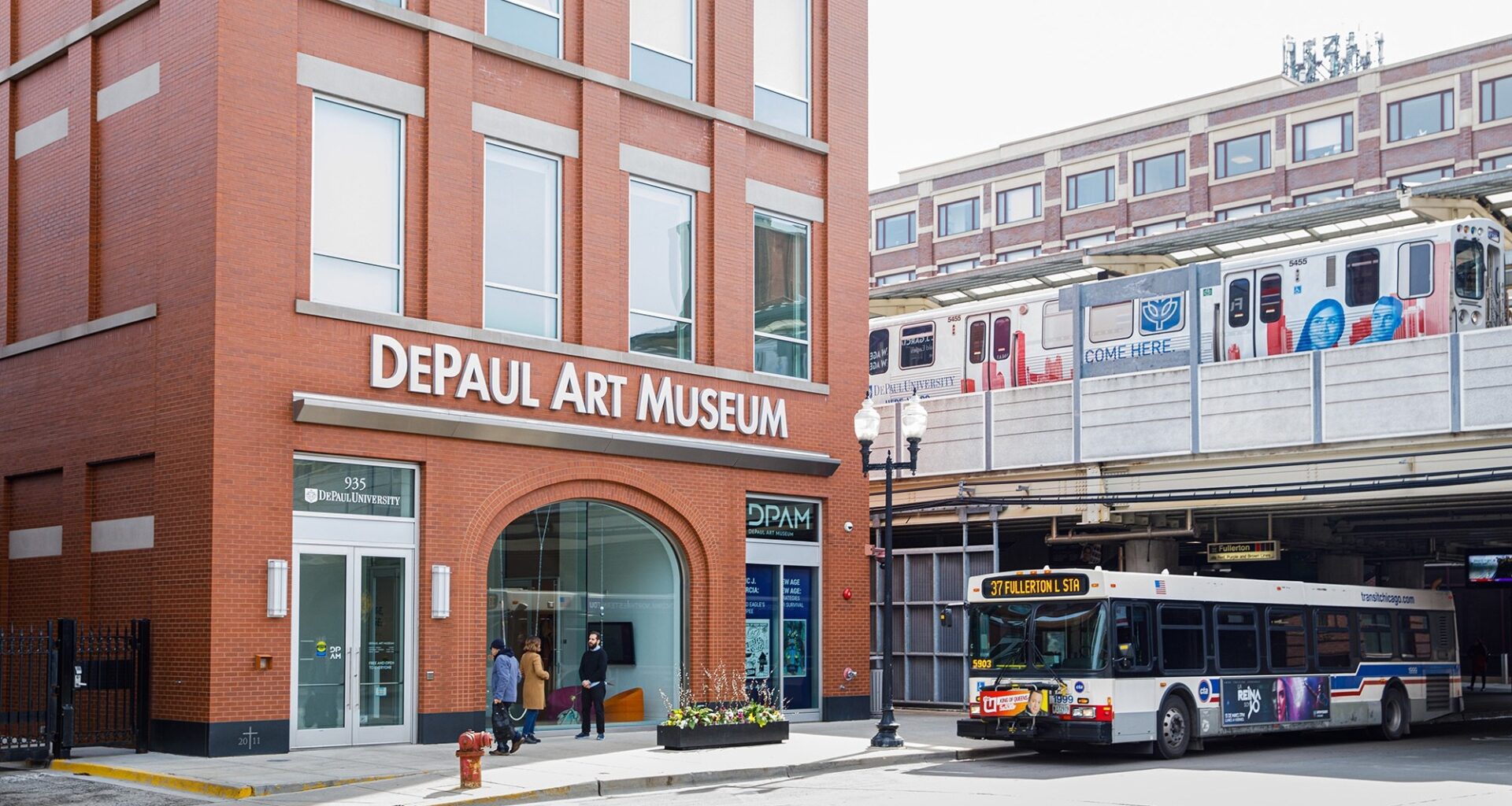
Louise Lincoln, my wife for the past 55 years, died last Sunday. From 1997 to 2014, she served as director of the DePaul University Art Museum. She transformed a small, little-visited gallery in the basement of Sanctuary Hall into a lively, full-scale museum with a growing collection of multicultural works and a gorgeous new building, which she helped design.
Working with a minuscule budget, she mounted better than 100 exhibitions, many of which focused on Chicago artists while others ranged across the globe and deep into history. Support from members of DePaul’s administration was steady, reliable and principled, for they understood the importance of the arts not just to a well-balanced education but also to society in general. Support from the faculty was enthusiastic, and Louise worked closely with professors in many departments to ensure the museum’s exhibitions complemented their classes.
The onset of Parkinson’s disease led Louise to retire, despite her love for DePaul, the museum and its mission. No decision she ever made was harder, but she understood that the progression of her illness would compromise her ability to provide the high level of service the institution needed and deserved. With great regret, she opted to turn the museum over to someone younger and healthier, who could build on what she started, making the museum a vibrant center for art in Chicago. In the years following her retirement, she was deeply gratified to see continued progress toward that end.
Last winter, when I learned of DePaul’s plans to close the museum, I could not bear to tell my wife of that decision, as it would have broken her heart. Not just for the loss of her life’s work, but more importantly for the loss to the university, its faculty and students, to Chicago’s brilliant arts community, and to the city in general. That the university is prepared to sacrifice a vital cultural resource in order to save a relatively small amount of money strikes me — and others as singularly short-sighted and ill-advised. The protests being lodged against that decision provide some comfort, and Louise would have been grateful for them.
I only hope DePaul’s administration will have the wisdom and courage to reverse course and let the museum achieve its full potential.
— Bruce Lincoln, Chicago
SNAP and cancer treatments
When my sister was diagnosed with breast cancer in 2024, our family learned that the diagnosis was just the beginning. Her diagnosis required 16 rounds of chemotherapy, 25 rounds of radiation, 17 immunotherapy infusions and two major surgeries.
While undoubtedly a hardship, relative to many cancer survivors, she had both the financial and emotional support needed. Many patients do not.
Every October, there are conversations about early detection and mammograms; breast cancer remains among the most commonly diagnosed cancer in the United States. We talk far less about what comes after. So many grapple with the logistics and costs of treatment. A breast cancer diagnosis is a life-altering medical event, and it is also a financial one.
Referred to as financial toxicity, a diagnosis can result in harmful economic burden, stress and debt due to high out-of-pocket medical costs stemming from diagnostic tests, treatments, prescription drugs and hospital stays. For many patients and their families, something has to give, and too often, it’s food, as 17% of working-age cancer survivors report moderate to severe food insecurity.
Food insecurity changes what people eat, likely increasing their reliance on inexpensive ultra-processed foods, and makes dietary advice less feasible to implement during and after treatment. Additionally, cancer survivors who are food-insecure are more likely to forgo medications and care because of cost.
All of this can affect survivorship.
The most effective tool against food insecurity is the Supplemental Nutrition Assistance Program (SNAP). Yet SNAP is harder to keep. In February, Illinois began applying expanded work requirements for SNAP, and 350,000 Illinoisans have since lost benefits. A 55-year-old home health aide in the middle of chemotherapy cannot work 80 hours a month. She may qualify for an exemption, but only if she is medically certified as unable to work and files the paperwork correctly and on time, while managing her treatment.
My sister successfully finished treatment because she had people and resources around her. Every woman and her family facing a breast cancer diagnosis deserve the same.
Cancer centers need to screen every patient for food insecurity, with on-site help enrolling in SNAP and filing exemption forms. Health systems and insurers must treat food as part of treatment.
Illinois and other states must make SNAP exemptions automatic for anyone in active cancer treatment. It’s time to do better for breast cancer patients and survivors — in October and all year.
— Vanessa M. Oddo, associate professor of nutrition and Cancer Center member, University of Illinois Chicago, Chicago
Dismissal of real concerns
Regarding the letter “Destruction of public education” (Oct. 11): As a young Hispanic Chicagoan, it always staggers and stuns me how easily political loyalties can masquerade as class analysis.
At a time when the mayor’s political indebtedness to the Chicago Teachers Union is hardly a secret, dismissing legitimate concerns about the city’s fiscal future and the burdens our children will inherit as “CTU Derangement Syndrome” is little more than Trumpian, post-truth rhetoric.
The notion that an “elite white power class” fears a union whose teachers are disproportionately white relative to their students, whose median earnings substantially exceed those of Chicago workers and whose bargaining demands have even threatened the interests of lower-paid Service Employees International Union members is a remarkable distortion of class politics.
Defending public education does not require treating the institutional interests of the CTU as synonymous with those of Chicago’s working class.
— Alan Rodriguez Tiburcio, Chicago
Reduce the need for tickets
Chicago can keep bike and bus lanes clear without turning enforcement into another cost of living in this city.
In a vote that will negatively impact Chicagoans, the City Council just approved expanding automated ticketing citywide. Cameras on CTA buses and city vehicles will issue fines of up to $250 for blocking bike lanes.
The goal is reasonable: safer streets and more reliable public transportation. The problem is that a ticket doesn’t fix a street that wasn’t designed to work in the first place.
Consider our neighborhood businesses. Restaurants, grocery stores and shops depend on deliveries, yet too many commercial corridors lack adequate loading zones. A truck gets ticketed, but the next delivery still has nowhere to go. Those costs can eventually reach customers through higher prices, further exacerbating our affordability crisis.
Chicagoans are already paying enough. A $250 ticket represents nearly two days of gross wages for someone earning the city’s minimum wage.
Meanwhile, the pilot program has assessed nearly $4.5 million in fines, and City Hall projects $6.1 million in net revenue from the expansion in 2027. With an $882 million budget deficit looming, residents deserve to know whether success means safer streets or more money collected.
Here’s what’s interesting: City officials reported that 82% of drivers who received warnings never received a ticket. That suggests education and clear enforcement can change behavior without punishing people financially.
Before expanding cameras into every neighborhood, there are more sensible, actionable solutions. Chicago should provide workable loading zones, preserve first-offense warnings, and publicly report whether violations and crashes actually decline.
Nobody should have to dodge a parked car in a bike lane or wait for a bus because it’s blocked by an illegally parked vehicle. But we shouldn’t pit cyclists against drivers or small businesses against transit riders.
Success should be measured not by how many tickets City Hall issues, but by how effectively it reduces the need for them.
— Bill Thanoukos, small business owner and aldermanic candidate for 1st Ward, Chicago
Submit a letter, of no more than 400 words, to the editor here or email letters@chicagotribune.com.