
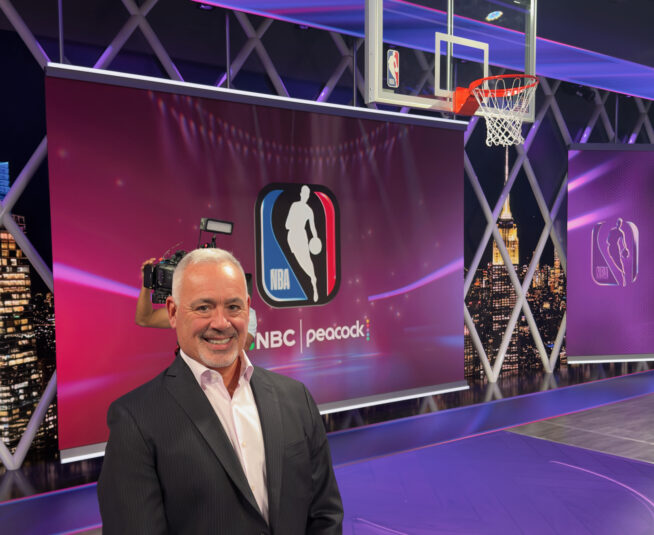
Regular-season game coverage will continue to be a mix of REMI and onsite productions, with the goal a seamless technical and broadcast operation
NBA on NBC is back for Year 2 of its current rights deal, and, for NBC Sports Executive Producer Sam Flood, Coordinating Director Pierre Moosa, and Coordinating Producer Frank DiGraci, the goal is to build on last season’s production efforts and, much like the teams they cover, to keep moving forward in terms of execution and capabilities.
“We just keep growing,” says Flood. “We want to take advantage of what we learned last season and build from where we finished the season, which was at a high level. But we have a team that worked in unison from Opening Night to Game 7 of the Western Conference finals. Every week, we would just work more collectively together so that makes us excited about this upcoming season.”
Moosa concurs, pointing out that everybody on the crew last year wants to come back and be part of what they all consider to be something really special. “Sam put together a perfect blend of NBC staffers, who know the NBC workflow and the NBC approach, as well as people who really know the NBA, like DiGraci,” he says of last year’s inaugural effort. “It was a good blend of us all working together and learning together what makes the NBA so special.”
Flood notes that the success hinged on things like Moosa’s outstanding technical plan with everything planned out, including contingency plans.
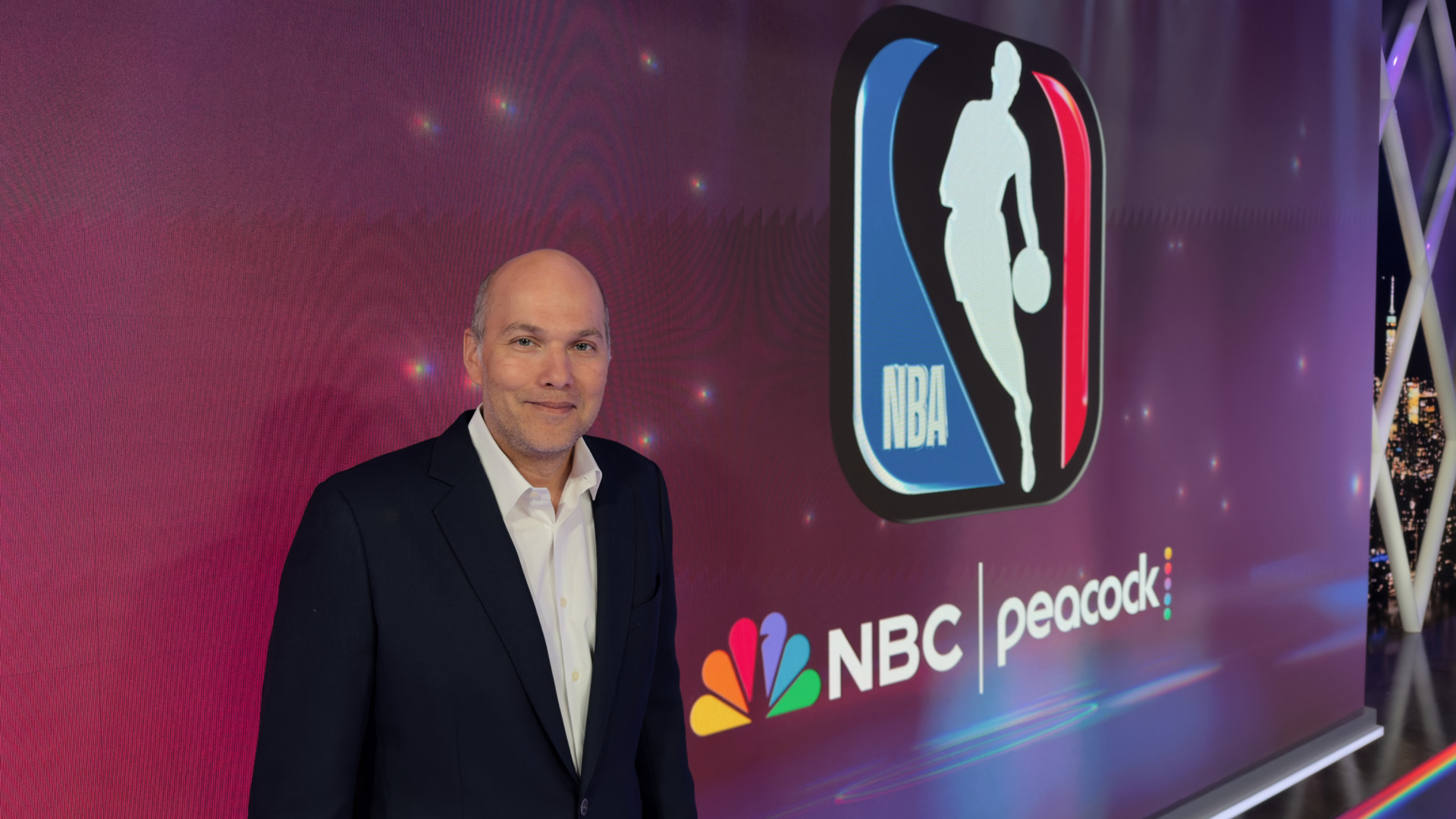 NBC Sports’ lead NBA director, Pierre Moosa, is looking forward to building on last year’s success.
“And then,” he adds, “Ken Goss, EVP, remote and studio operations, and Ryan Soucy, VP, operations, studio, and field scheduling, made sure the production team had everything they needed, both facilities-wise and logistically. Lastly, bringing in Frank [DiGraci] and his understanding of how to handle the basketball side of things was really important.”
Once again, this year’s slate comprises 100 games across three nights and across NBC, Peacock, and NBCSN. The season tips off tonight with a tripleheader, followed by Peacock NBA Monday, beginning Oct. 26; and Coast 2 Coast Tuesday, beginning Oct. 27. Sunday Night Basketball, meanwhile, returns on Jan. 24, 2027, with the season featuring seven Sunday Night Basketball games, two quadruple-headers, and 2027 NBA All-Star coverage from Phoenix Feb. 19-21.
With respect to tech, DiGraci says the bar was fairly high last year in terms of camera count, super-slo-mos, graphical elements, replays, and other tools. As a result, a key theme this year isn’t adding new toys but figuring out how to get the most out of the existing tools.
“We’re going to have more telestration and use the Piero system more because those systems help with educating the viewer,” says DeGraci. “Last year was really about getting on the air clean early in the season and getting a little bit better each week for the playoffs. For example, last year as the season progressed, we learned we liked having 12-second graphics analysis packages because we can get those in more easily during free throws or out of a break rather than trying to pack in a longer segment.”
NBC Sports will continue to produce games via a mix of fully onsite productions as well as productions with components of the production handled from NBC Sports headquarters in Stamford, CT.
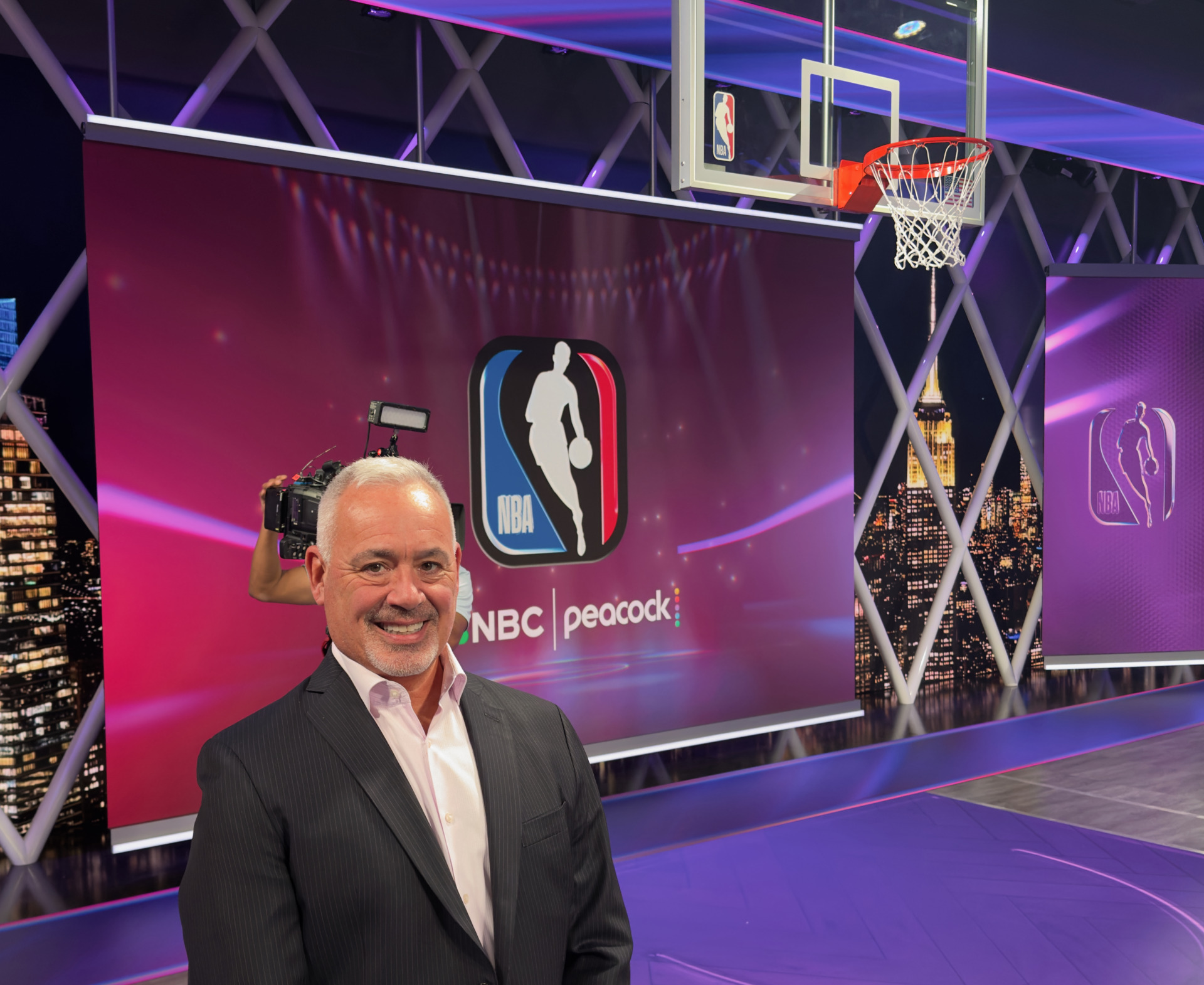 NBC Sports’ Lead NBA Producer Frank DiGrace says that, when it comes to storytelling, a goal this year is to use telestration and other analysis tools to their fullest.
“NEP will once again be our great partners for NBA facilities,” says Soucy, adding, “The Opening Night tripleheader games will all be produced onsite with graphics done out of our Stamford facility. After Opening Night, the productions will be a combination of REMI and onsite throughout the season.”
DiGraci gives a shout-out to NBC’s tech side, which keeps things running smoothly: “Our technical team deserve incredible credit as the workflows from here make it feel no different than if we are in the bowels of an arena.”
Adds Flood, “There are occasions when the coverage is almost better-suited to be REMI versus onsite. The REMI model has reached the point where it works incredibly well, but, for the bigger games, we’re going to be onsite. But we know how to do REMI and how to excel at it.”
The ability to have different workflows is great, Moosa says. “We’ve even had replay operators working from home, but the most important thing we do is make sure that the entire technical and broadcast operation is seamless so that we can put on the best broadcast.”
For DiGraci, who previously spent 26 years producing games for the New Jersey and Brooklyn Nets, the biggest challenge last year was learning how to quickly come up to speed on two teams versus one. “When you’re covering a local team, you know your local team, so you have a head start. But here, when I’m preparing for, say, the Blazers and the Suns, I may not have seen the teams in a couple of weeks. That added homework is something I had to learn because our goal is to dive deep into both teams, so that the viewer feels they are watching a show where we know as much about both teams as both local broadcasters.”
DiGraci has a good feel for the pace of play at an NBA game and when you can have a replay or tell a story or do a break down without missing the action, Moosa observes: “Our NBC philosophy is always serving the viewer. Frank has done many NBA 101 tutorials with us, and we have a lot of meetings discussing our philosophy and approach. Last year, we had a good blend of both so we could respect the game and celebrate the game.”
He adds that the on-air talent is also a big part of the mix and enthusiasm that drives both the NBC team and the viewers at home to stay focused and tuned in. “When you have announcers like Mike Tirico, Reggie Miller, Jamal Crawford,and Zora Stephenson calling the games, their excitement and enthusiasm for the NBA is infectious, and that translates to the viewer at home and our whole team. It has been a lot of fun to create this, especially as I worked on NBA on NBC way back. Our focus now is making sure we do the best possible job and serve the viewer.”
Adds DiGraci, “There’s no secret that Tirico, Miller, and Crawford are going to be on the best game of the week. But we also know that the others, like Ian Eagle or Grant Hill, are going to be just as good. And now we added Doc Rivers. Honestly, we are a team and look at the whole family that we just added another one. Our depth is what we’re excited about.”
The Sunday-night NBA broadcasts won’t begin until Jan. 24, and DiGraci says to expect more Sunday doubleheaders and 10 more games on NBC during the regular season.
The productions for Peacock will continue to innovate with the return of “On the Bench,” where analysts are sitting beside the players rather than behind the broadcast table. “We thought that was a great innovation,” he adds, “and we’ll do that for every Peacock game on Monday nights. That will make it a destination for viewers.”
Looking ahead, Flood says the key is not only a talented crew but also one that gives everyone a voice, a chance to make an impact, and keeps moving in the same direction. “When you have that, you’re going to have great success, and it’s about everyone: the camera crew, the operations team, the on-air talent, the support staff.
“We’re very fortunate,” he continues, “to have an awesome team where everyone loves what they do and they love the NBA. Those two things combined with communication so that everybody works together well leads to success.”
DiGraci adds that flexibility is another key to production success. “Even though we have five different crews, we can mix and match anybody, and that’s the goal. We don’t want our production to feel any different on any different night: they’re all equally important. Last year, we learned that, during the regular season, we can mix and match but, once the playoffs hit, we get to more set production teams where the chemistry rises.”