
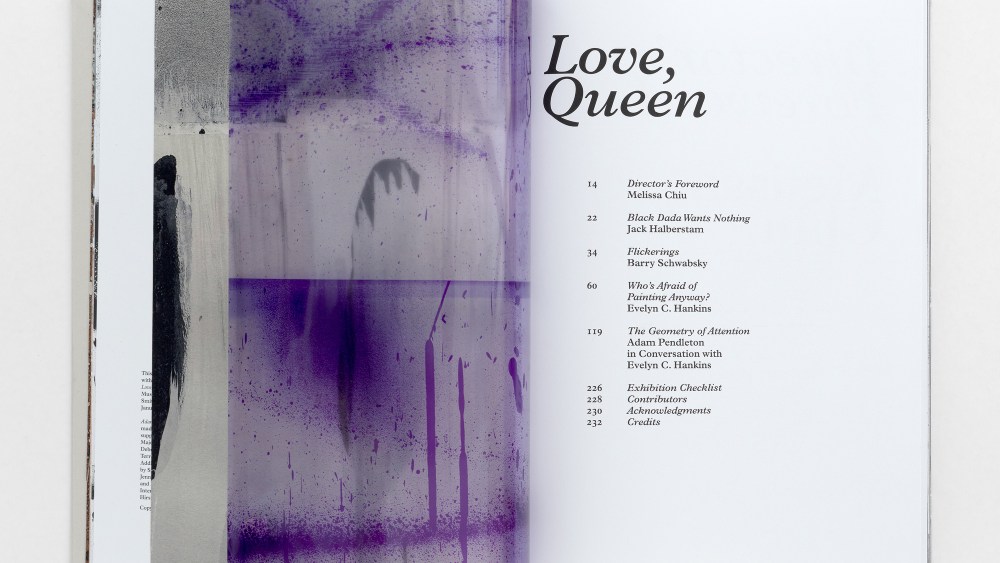
Adam Pendleton wants you to notice everything — and ponder without the need for resolve. His polyphonic paintings, made of marks unconfined by canvas or concept, almost demand of it. There is always more to see.
In his new monograph “Love, Queen,” Pendleton invites you to experience his work with an intimacy previously unseen.
“I’m curious about how paintings or drawings articulate themselves. How we come to approach them and how we come to understand them,” the artist says. “But even that word ‘understand,’ I think, is very loaded in this sense, because understand ‘what,’ right? What is there to understand? And I think that’s one of the things this book throws into question. When you do start to make these relationships, what are you ‘understanding’? What kind of knowledge or sense of being or construction or making is emerging?”

Adam Pendleton
Courtesy Photo
“Love, Queen” documents his exhibition at the Hirshhorn Museum and Sculpture Garden, which opened in April 2025 and runs through January 2027. The book is currently available at the museum and will be online in December.
“The goal with this publication was to capture the essence of making as it relates to my paintings and drawings,” Pendleton says. “If you were to flip through this publication almost on a psychic level, you would end up understanding, if not maybe perhaps not definitively, but spiritually, what goes into the making of my work.”
Most well-known for his “Black Dada” aesthetic and conceptual framework, Pendleton has long been inspired by his post-WWI Dada predecessors who responded to the absurdity of modernity through illogical and unprecedented artistic interventions. He’s succeeding the era-defining avant-garde with an expansion of what it means to “refuse.”
“Black Dada as a concept, as an idea, has been influential to my work for almost 20 years now,” Pendleton says. “I realized that it’s really an operating position. It allows me to be ‘bad,’ for lack of a better word, as an artist, and playful and embrace a sense of chaos and a particular sense of freedom as it relates to abstraction, to language, and as it relates to the general contours of ‘being’ — both as an individual, as a citizen, but I think ultimately as an artist.”
Adam Pendleton’s “Love, Queen”
Elisabeth Bernstein/Courtesy of Adam Pendleton
“It’s interesting to think about how art has always been a kind of mode and mechanism to put ideas into the world,” he adds. “My responsibility as an artist is to make sure that the ideas that I’m putting forward contribute critically and imaginatively to our future present dynamic.”
For the book, Pendleton applies a new level of precision and rigor to the presentation of his visual language. Using his iPhone, he documented his studio practice, capturing the essence of his alchemical and polyphonic mark making. He split the book into four parts, sorting through the hundred of photos he took of his studio of both full-space works and detail shots.
“You begin to see the different marks and gestures and how they accumulate literally within the space, on the floors, on the walls, but also how they accumulate on the sheet, on the page, on the paper,” Pendleton says.
With each turn of a page, the book animates the material praxis of his process. Varying paper types — glossy, matte, transparent and textured — emulate the tactile experience of his signature technique of first painting, then photographing, and screenprinting to create works that liberate painting simultaneously through gesture and concept.
“I think what organically happens as you flip through the book is you start to make these kinds of relationships and you understand, ‘wait a minute, what he has executed on this page is also in the painting,’” he says. “And you begin to understand on some level that there’s a process of translation and transformation at work.”
Adam Pendleton’s “Love, Queen”
Elisabeth Bernstein/Courtesy of Adam Pendleton
Pendleton was encouraged to make the book by his collaborator, the Dutch graphic designer and bookmaker Irma Boom.
“There was a level of insecurity because…I’m not a photographer. It’s not how I understand my eye or how I relate to things creatively,” he says. “I realized that that was the genius of Irma Boom. It was the conditions she created around the bookmaking that allowed the possibility of making a great book emerge. She gives books the space and time that they deserve. I went to Amsterdam several times and spent time in her office with her and also her team looking at every page, every image. And there was never this sense of ‘let’s hurry up and get this done.’ There was only ever the sense of ‘let’s make a great book. Let’s get it right.’”
The end result it his most ambitious project yet.
“It’s really a kind of commitment to authenticity,” he says. “In so many ways, this is my interior. This is me. The work is me. This book is me.”