
NEED TO KNOW
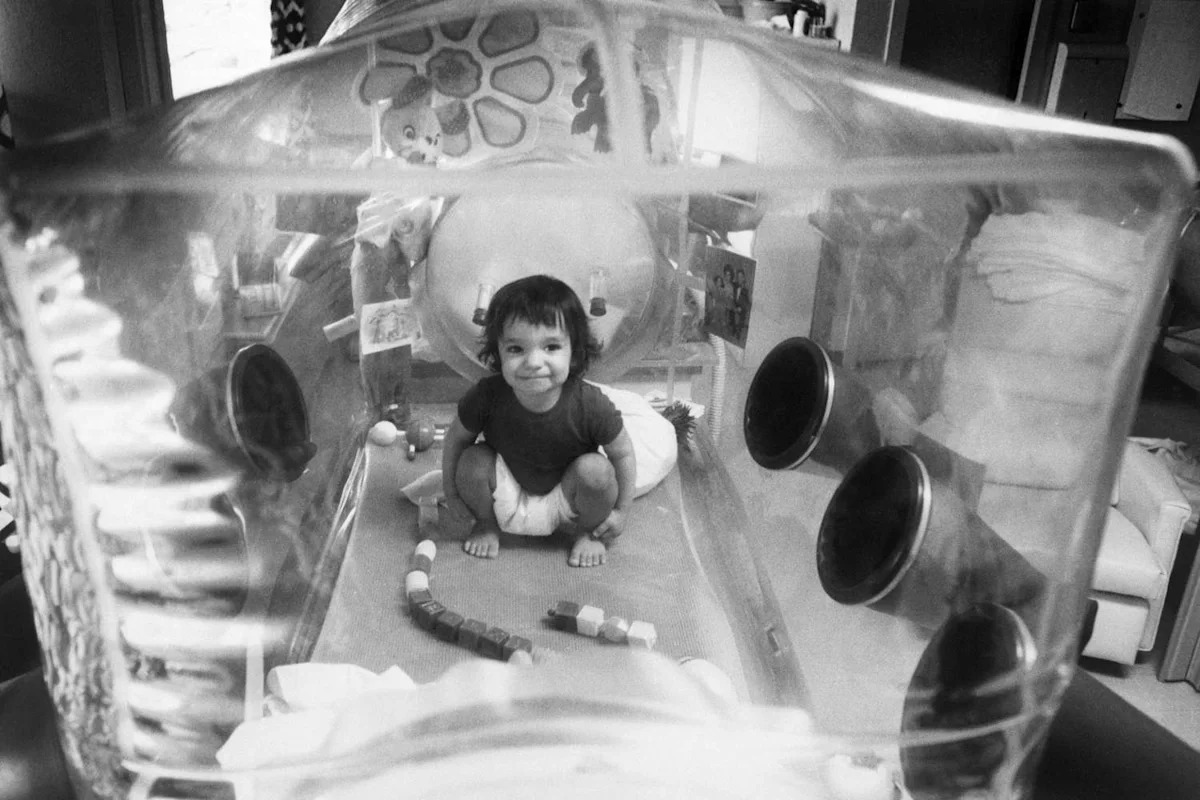
David Vetter lived with severe combined immunodeficiency, requiring an ultra-sterile plastic isolator from birth
He became known nationwide as “Bubble Boy” and later wore a NASA-designed containment suit
Texas Children’s Hospital established the David Center in his honor, advancing research into immune disorders
David Vetter’s family hoped for years that he would be cured.
Born Sept. 21, 1971 at Texas Children’s Hospital, the boy was was diagnosed with Severe Combined Immunodeficiency (SCID), a life-threatening disorder where people cannot fight infections due to a lack of T-cells or B-cells. With no immune system, even the common cold or flu could be fatal.
To keep him alive, David was forced to live in an isolated, ultra-sterile environment. The only way he could interact with loved ones was through a clear plastic bubble. He became known as “Bubble Boy” or “The Boy in the Bubble.”
He was eventually granted more mobility by wearing containment suits designed by NASA that resembled space suits.

David Vetter
Credit: Bettmann Archive/Getty
His story seized the attention of the American public. As his mom Carol Ann Vetter recalled, once he became aware of his fame, David “told me that he was a star because his picture was in the paper the day before and stars don’t have to clean up toys. I told him that his picture wasn’t in the paper today, so today you clean up your bubble!””
When David was 7 years old, he met Dr. William T. Shearer, chief of allergy and immunology at Texas Children’s, who writes that David “put his arms in the gloves extending from his plastic isolator system to shake my hand and began quizzing me to make sure I understood that he was special and was competent enough to care for him.”
He continued, “At 7 years old, David was a very bright young man who had a vocabulary as advanced as some of my peers and enjoyed learning. He was very brave and courageous handling his situation and fighting germs and brought a great sense of humor that lightened up the room.”

Dr. William Shearer talks to David Vetter
Credit: Bettmann Archive/Getty
Then an experimental treatment became available — one that doctors hoped would allow David to live outside the confines of his bubble. It was possible that a bone marrow transplant could help him develop an immune system.
“Our doctors told us that the operation was proving very successful, and that it was 99 percent safe. They said it would either work or not work. But if it didn’t work, we would simply be back to square one,” Carol Ann said, per PBS.
On October 21, 1983, David received a bone marrow transplant from his sister Katherine. Because he was in the bubble, he actively participated in giving himself injections.
But by Christmas, David began to get extremely ill. It turned out that his sister’s bone marrow had not been screened for the Epstein-Barr Virus, and it was now inducing a form of lymphoma in David.
As his condition continued to decline, he told his mother, “I’m tired. Why don’t we just pull all the tubes out and let me go home?”
On February 7, 1984, as death drew near, David came out of the bubble and was able to be physically embraced by his family.

David Vetter wears a sterile suit designed by NASA
Credit: UPI/Bettmann Archive/Getty
Take PEOPLE with you! Subscribe to PEOPLE magazine to get the latest details on celebrity news, exclusive royal updates, how-it-happened true crime stories and more — right to your mailbox.
On February 22, David spoke his last words — first to his friend and psychologist, Mary Murphy. As she was leaving, he told her, “Remember, I love you, Mary. Goodbye.” Then, he turned to his mother and said, “I love you all too.”
Carol Ann removed her mask and kissed her son for the first time. Moments later, David died.
“David was an incredible young man whose legacy has contributed to an even greater accomplishment and my life and has certainly been changed because of David and his family,” Shearer wrote, adding that Texas Children’s established the David Center at Texas Children’s in the late boy’s honor.
Read the original article on People