
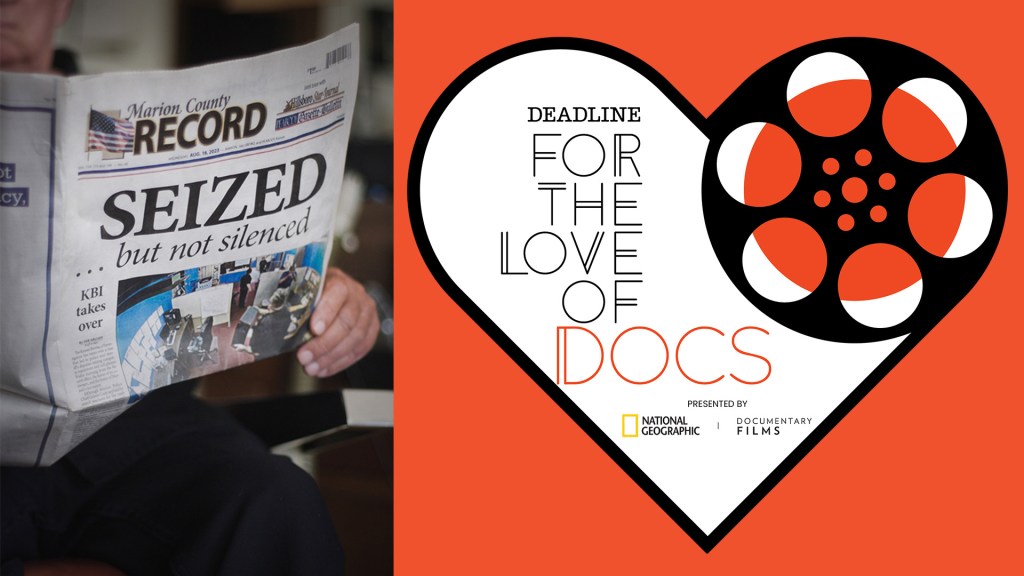
The award-winning documentary Seized contains enough fascinating characters to pack a bingeable Netflix dramedy.
For instance, there’s Eric Meyer, the old-school journalist and editor of the Marion County Record, a small-town newspaper in Kansas; Meyer’s occasionally cantankerous 98-year-old mother Joan Meyer, publisher of the paper; and Gideon Cody, Marion’s police chief who conducted a raid on the newspaper office and on the home of Eric Meyer and his mother, possibly out of spite or to please his girlfriend, a local café owner named Kari Newell. A bonus character: Newell’s ex-bestie, Pam Maag, who had shared dirt on Kari’s dodgy driving history.
The difference, of course: this is no make-believe miniseries but a true-life tale that raised critical First Amendment issues. The stakes ramped up even more after Joan Meyer, the nonagenarian publisher, dropped dead the day after the raid. Filmmaker Sharon Liese lives within about two hours’ drive of Marion, KS and got to town just as the incident was making national headlines.
Eric Meyer “knew that it was a canary in the coal mine story and he felt like if he was going to get justice, he really wanted the story out there,” Liese explained during a panel discussion about Seized that followed a screening of the film for Deadline’s For the Love of Docs event series. “I was really fortunate to be able to go there quickly. And since all of his equipment was seized [in the raid], he was not able to communicate with other documentary filmmakers at the time who were also wanting to scratch on the door about this.”

L-R: Eric Meyer, director Sharon Liese and Finn Hartnett attend the ‘Seized’ premiere at Sundance
Neilson Barnard/Getty Images
It didn’t take long for Liese and her filmmaking team to discover a long history of conflict in the town between supporters of Meyer and his sense of journalistic mission and other locals who felt he deserved to be toppled from his high horse. Liese calls the latter group the “anti-paper” faction. It fell to producer Paul Matyasovsky to get some of those Marion County Record critics to go on the record.
“Mike Powers, who is still the current mayor of Marion, Kansas, was not the mayor during the raids, was the first person that I reached out to,” Matyasovsky noted. “I’d seen that he had done a little bit of news media when [the raid] had first happened, but this was maybe six months now after the actual events and [we] told him where we were coming from on this project and feeling that it was important to not just hear about how everybody else felt, but to hear how they felt firsthand. At first, he was resistant, I’ll say, to the idea, but we talked and he came around and he was and is a very sort of well-respected figure in town. And once he gave his blessing by agreeing to be a part of it, other people followed from there.”
Another key participant, along with Eric Meyer and Mayor Powers: a cub reporter at the Record named Finn Hartnett who joined the staff after the raid. He becomes something of a proxy for the audience – an outsider to the town and its simmering feuds, animosities and differing perspectives on how a small-town paper should cover its leaders and goings on.
“We were really fortunate with the cast of characters that really we were given, because this was not a situation where you could go in and say, ‘Okay, who are we going to follow and who’s going to be our main person?’” Liese commented. “Eric was going to be our main person no matter what… And then Finn showed up and we were like, immediately, ‘We’re going to start the film with him.’ And then all the other people along the way that paraded through, I mean, we just had an embarrassment of riches in terms of the characters that we had in the editing room. So, it was amazing.”
Seized may leave many seized with laughter as the publisher and his antagonists butt heads. But the film by no means neglects the underlying significance of what happened in Marion, KS.
“It became clear that, and as we were looking for an editor, that we needed to imbue this film with a lot of humor because there was a lot of funny kinds of things that were going on with the town,” producer Sasha Alpert observed. “I think we did succeed in showing that this is a story with many, many sides, but in the end, love them or hate them, journalists are holding up a very, very important part of our society. And we see even now some very scary stuff going on when you ban journalists from the White House because you don’t agree with their politics or remove their offices from the Pentagon or whatever happened to [CNN’s] Don Lemon, et cetera.”
Seized won Best Documentary Feature at the Florida Film Festival and the Changemaker Award at the Woodstock Film Festival in New York. It won the Audience Choice award for Documentary Feature and the Heartland Filmmaker Award at Kansas City Film Festival International in Missouri – 150 miles or so from Marion, KS.
“We showed it in Lawrence, Kansas and in Kansas City [MO],” Liese shared. “People from Marion did show up to both of those and there was no picketing, there was no screaming at us. The people that came that wanted to see the film, I think really enjoyed it and felt like it was a fair portrayal, which we were really glad to hear.”
Watch the full conversation in the video above.
For The Love of Docs is produced with the long-time support of National Geographic Documentary Films. Films are presented free of charge to the audience and to the filmmakers. The series continues with weekly screenings, followed by conversations with filmmakers through December 1. Join us next week for The Life We Leave, directed by J.J. Gerber, a fascinating film about a man trying to revolutionize the funeral industry by introducing a new option – human composting. To RSVP for the screening, click here.