
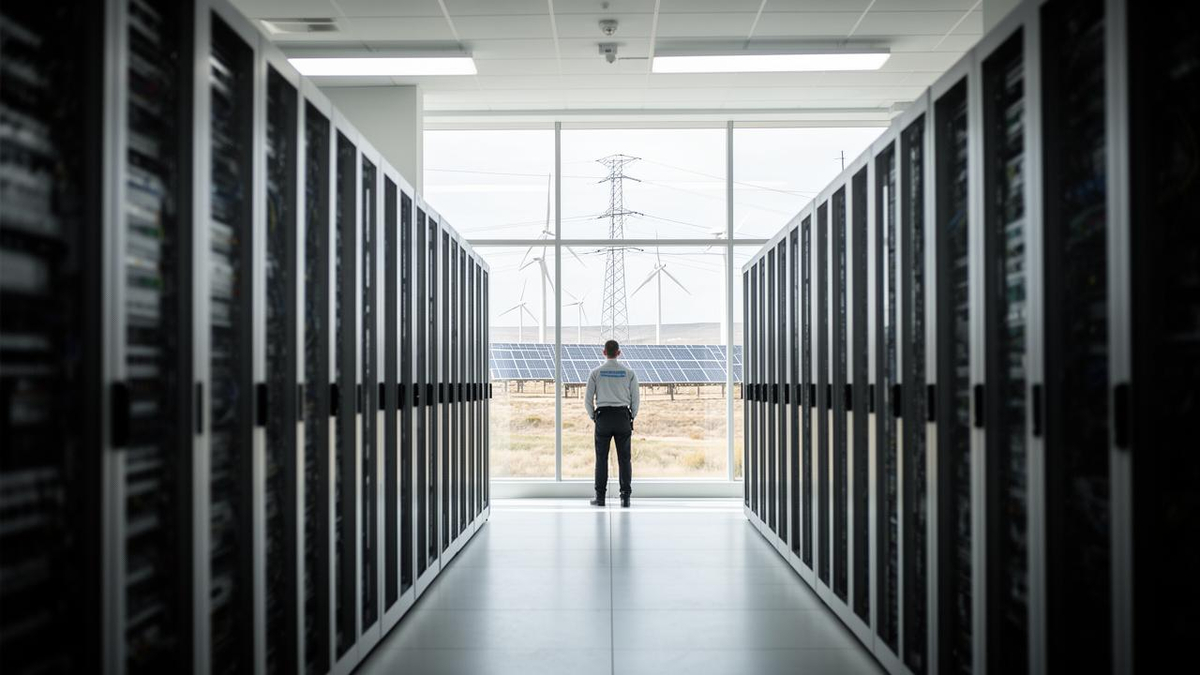
As artificial intelligence rapidly penetrates every industry, computing scale and electricity consumption are climbing in tandem, and the coordinated layout of green power and computing capacity is rising from an industry initiative to a national-level policy deployment. China’s 15th Five-Year Plan Outline explicitly calls for advancing the large-scale, intensive, green and inclusive development of computing resources, promoting the coordinated layout of green power and computing capacity, accelerating the coverage of new electricity demand by newly added clean energy generation, and improving the energy efficiency of computing facilities. The Opinions on Developing New Quality Productive Forces also require strengthening the efficient supply of computing power, algorithms and data, and accelerating the green transformation of energy use across production and daily life.
The policy direction is clear, but obstacles remain in implementation. Industry analysis notes that the integration of green power and computing currently faces constraints in four areas—evaluation philosophy, spatial layout, operational adjustment and market accounting—and that unless these are resolved, green computing may remain stuck at the single-point demonstration stage for a long time.
Pushing from Both Demand and Supply Sides
On the demand side, the explosive growth of artificial intelligence is driving a surge in data center electricity consumption. Large data centers have large power needs and strong continuous energy demand, creating basic absorption space for new energy. Load characteristics differ across types of computing businesses, and deferrable, migratable computing tasks also have the potential to participate in power adjustment. At the same time, computing companies’ green energy demands have expanded from a single compliance requirement to multiple goals including reducing carbon emissions, securing long-term stable green power supply and strengthening full-lifecycle carbon management.
On the supply side, China has built the world’s largest and fastest-growing renewable energy system, with wind, solar and hydropower resources creating conditions for computing facilities to expand green power use. Energy-rich regions in western China have the advantage of hosting computing businesses and promoting local conversion of green power; eastern China and central cities can expand green energy sources by combining local distributed new energy development with incoming clean power. The scale, spatial distribution and availability of green power resources are becoming important considerations in computing layout.
Institutional and technological support is also following up. Technologies such as liquid cooling, efficient power supply and distribution, and intelligent temperature control are being applied faster; the national integrated computing network continues to advance; and cross-regional computing dispatch and computing-power coordination pilots are being rolled out, creating conditions for some non-real-time tasks to be configured across nodes and operated across time periods. The scale of green certificate trading continues to expand, and inter-provincial and inter-regional green power trading is increasingly active. In 2026, the Cyberspace Administration of China and six other departments jointly issued the Implementation Plan for Promoting the Coordinated Digital and Green Transformation (2026-2030), further clarifying the goals of improving energy efficiency in computing facilities and the level of renewable energy electricity consumption.
Four Constraints to Resolve
Despite favorable fundamentals, deep integration still faces multiple obstacles. In development philosophy, the evaluation horizon is mostly limited to inside the data center, and power usage effectiveness can hardly reflect computing utilization rates and overall carbon emission levels. In spatial layout, western China is rich in green power but lacks computing demand, while eastern China has concentrated computing demand but limited green power, and the east-west coordinated dispatch mechanism is not yet sound. In operational adjustment, the intermittency and volatility of new energy conflict with data centers’ high-reliability requirements, and an adjustable computing load pool has yet to take shape. In market accounting, multi-year green power agreements are insufficiently covered, consumption accounting is mainly based on annual electricity matching without time-period linkage, and electricity, green certificate and carbon emission data are not yet connected.
Addressing these bottlenecks, related research proposes four paths:
Key LinkMain ConstraintRecommended DirectionDevelopment philosophyEvaluation limited to in-room energy efficiencyIncorporate computing utilization rate, energy efficiency per unit of computing, green power consumption ratio and carbon emissions per unit of computing into a unified evaluation; advance equipment upgrades and liquid cooling retrofits for existing projects; include new projects in full-lifecycle energy and carbon managementSpatial layoutWest has green power but lacks demand; east has demand but lacks green powerFocus on national hub nodes and key data center clusters; form three lists—new computing load, new clean energy supply, and grid and storage support; western China hosts latency-insensitive businesses, while eastern China hosts inference and edge computingOperational adjustmentNew energy volatility conflicts with high-reliability requirementsManage computing businesses by category; form adjustable load pools from large-model training, scientific computing and offline rendering; promote information exchange between computing dispatch platforms and power dispatch and trading platformsMarket accountingInsufficient long-term contract coverage; data not connectedSupport signing multi-year green power purchase and sale agreements; improve inter-provincial and inter-regional trading linkage; explore improving monthly and time-of-use matching precision; connect electricity, green certificate and carbon emission data to prevent double counting of environmental rights
Note: Table content is compiled based on public policy documents and industry research.
Supply Chain Already Making Supporting Moves
The push for computing-power coordination is also driving product iteration in the upstream industrial control and power distribution segments. According to a report by Futu, RS Group, a global product and solutions provider serving industrial customers, is supplying Omron automation’s industrial control panel products through its channel, covering switching power supplies, motor condition monitoring devices and liquid leakage sensor amplifiers, targeting power supply, availability and heat dissipation challenges in high-density data centers and edge AI scenarios.
According to data disclosed in the report, AI-driven construction of hyperscale data centers is pushing single-rack power density to the megawatt level, and new campuses and large-scale retrofit projects are placing higher demands on power supply capacity while generating severe thermal loads; some facilities target 99.9999% availability, equivalent to only about 30 seconds of downtime per year. Omron says its products, built on a “panel value design” philosophy, can save up to 50% of rack space and reduce wiring labor by about 60%; its flagship S8VK switching power supply can save 20% to 50% of installation space compared with conventional products. The motor condition monitoring devices can monitor vibration, temperature, current and insulation aging without structural changes or shutdowns, shifting maintenance from periodic manual inspection to condition-based predictive maintenance.
RS Group is listed on the London Stock Exchange under the ticker RS1, with revenue of $3.87107 billion for the fiscal year ended March 31, 2026. The report says it operates in 33 markets, stocking more than 875,000 industrial and specialist products plus 5 million related items from more than 2,500 suppliers.
What It Means
From a market perspective, the clarification of the computing-power coordination policy orientation will reshape data center site selection logic and energy use structure. Western hub nodes will be built around new energy bases, regulating power sources, energy storage and computing clusters, which is expected to drive local green power consumption and related supporting investment; eastern China will place more emphasis on application pull, with the match between inference computing, edge computing and industrial demand becoming the focus of competition. For computing companies, multi-year green power agreements, green certificate accounting rules and carbon footprint disclosure requirements are turning green energy use from a cost item into an operating factor that must be locked in advance.
For the power system, if an adjustable computing load pool can truly take shape, it will provide new demand-side flexible resources for new energy consumption. But this prospect depends on the balance among task migration costs, data transmission conditions and business continuity, and is still difficult to realize on a large scale in the short term.
For upstream equipment and power distribution manufacturers, the heat dissipation and power supply pressure of high-density racks is pushing niche products such as liquid cooling support, leak detection and condition monitoring into growth markets. However, the evaluation criteria for green computing have not yet been unified; if the evaluation system remains at the equipment energy efficiency level, the emission reduction effects of related investment will be difficult to measure accurately, and market recognition will be discounted.
The coordination of green power and computing is essentially a cross-departmental, cross-regional reform of resource allocation. The policy framework has been set up, and the real test lies in whether the east-west dispatch mechanism can be implemented, whether green power trading and carbon accounting data can be connected, and whether computing companies are willing to bear the operational complexity for adjustable loads.