
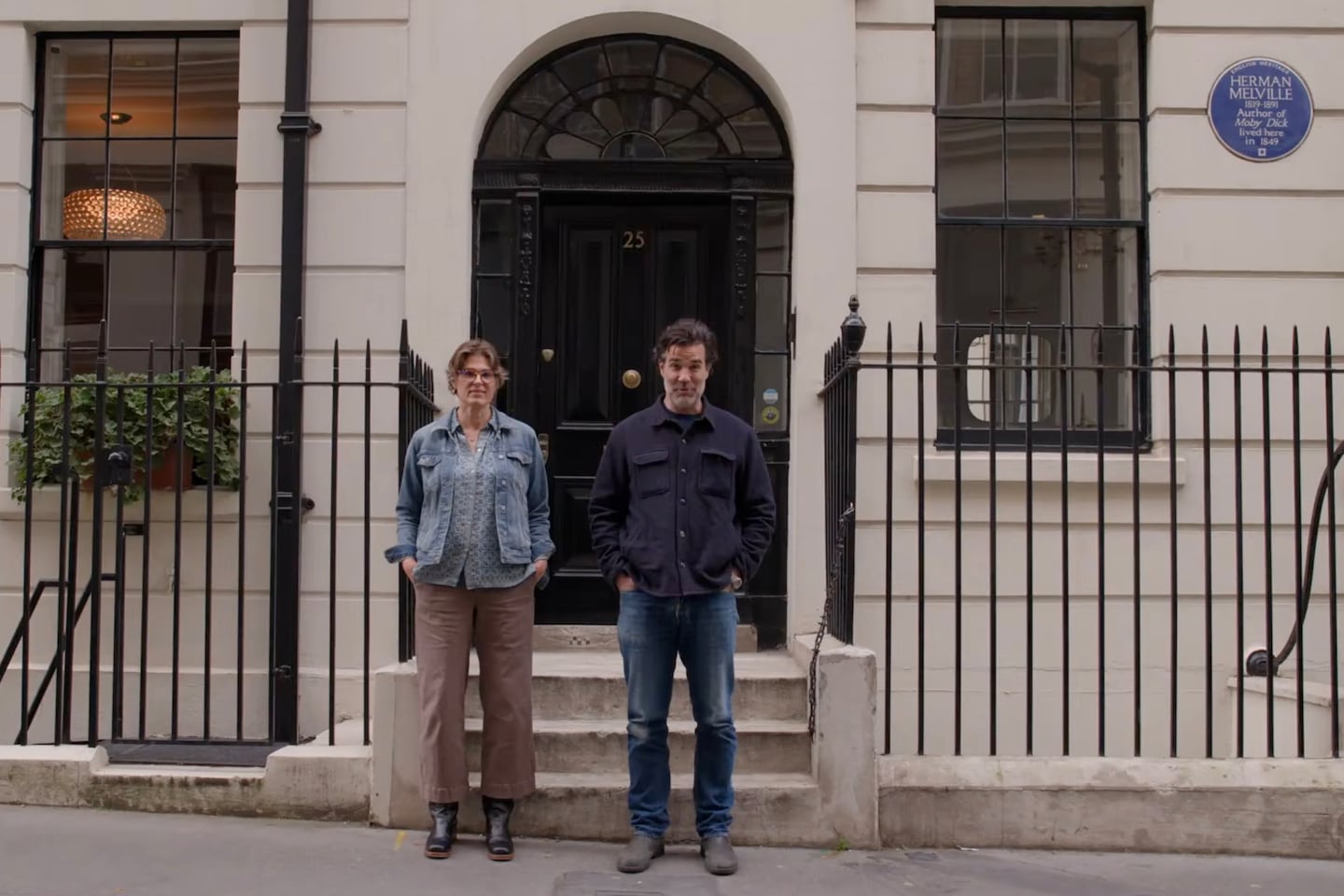
Actor Rob Delaney (“Catastrophe,” “Dying for Sex”) first read Herman Melville’s “Moby-Dick” while in college, home for the summer in his native Marblehead. Three decades later, he found himself in Melville’s one-time London home, recording the first several episodes of a video podcast about the book, which he cohosts with Hester Blum, a Melville scholar and professor of English at Washington University in St. Louis.
Delaney’s book editor suggested the podcast to him and “I couldn’t say yes fast enough,” says Delaney. “I knew that I would learn a lot that I could apply to my life if I approached the novel again; basically, I knew it would improve my life if I did the podcast.”
The podcast “Exploring Moby-Dick” is part of a project called Exploring the Greats. Others in the series include “Exploring Plato’s Republic,” led by actor and director Tim Blake Nelson and philosopher Agnes Callard; “Exploring Othello,” with British actor John Douglas Thompson and Columbia Shakespeare scholar James Shapiro; and “Exploring the Odyssey,” cohosted by famed classicist Mary Beard and the Guardian’s chief culture writer, Charlotte Higgins. Interested readers can visit exploringthegreats.com for more information and subscription pricing, and can view the trailer here.
Get Starting Point
A guide through the most important stories of the morning, delivered Monday through Friday.
The Globe sat down with Delaney and Blum for a discussion over Zoom.
Can you talk about when you first read “Moby-Dick”?
Delaney: I grew up in Marblehead, and so I was on boats a lot as a kid, but I realized I hadn’t read “Moby-Dick.” I’m pretty sure I was in college [at New York University], and it would have been one summer when I was home. I picked it up at a used bookshop in Manchester-by-the-Sea. And I read it and was like, what the hell? Why is this so funny? And why is it so urgent? And why is it so exciting? I just remember being stunned by how I tore through it. And I was just absolutely in love with it. I was really hooked from the first few pages.
Hester, how do your students react to “Moby-Dick” when they first read it?
Blum: I think they have a very similar reaction to Rob’s. They’re not expecting it to be so weird and funny and irreverent. So the humor hits them first. And then, especially in the last decade or so, the queerness of the novel has been pretty electrifying for students who don’t expect to see that in what they think of as, like, very, very old books.
Delaney: The book is quite interactive. The number of formats that the book toggles between is quite remarkable, and so it’s very interesting to see — like Christopher Nolan’s film “Dunkirk,” which takes three stories happening at different rates of time and weaves them together; Melville’s doing that, too. Is he just talking about catching whales? Or is he doing the very fine work in your soul when you’ve got good and evil grappling at their most sort of molecular level in this book?
Blum: Just the idea we have a narrator who’s depressive. And he’s so looking for human connection. That can be particularly appealing when you pick it up in college or in high school or in your youth. That kind of hunger for that connection, for learning more — that’s something that keeps it deeply available for new readers and old readers alike.
What was it like to do this podcast together? How was it to be in such a deep conversation about one book with one person?
Delaney: We were strangers until they said action on the first episode. And then Hester happens to be much more entertaining and vivacious than perhaps your average academic.
Blum: That is very kind of Rob. I immediately said yes, because I talk about “Moby-Dick” all day long no matter what the format is. I knew Rob’s work, but I was not aware of how exceptionally well-read Rob is. I don’t know that I have any other celebrity friends at this point. Um, but I can’t imagine that there’s like a better-read person working in entertainment.
Are you aware of this new statue of Herman Melville that they just put up in New Bedford? The Globe reported on it because it’s apparently unnervingly hot.
Blum: How could it not be?
Do you have any feelings about Melville the man, beyond the writer of “Moby-Dick”?
Delaney: You know, I think that the universe crammed some unbelievable material and spirit through Melville to us. [He has] just no peers in terms of the way that he wrote. He doesn’t sound like a fun hang. I mean, he really was quite tortured. So we’re very, very lucky that he lived and that he wrote, but he might not have been a fun guy to go to the movies with.
Blum: There’s an ongoing conversation always about how you separate the work from its producer. But the thing about Melville that kills me the most — and I’m deeply invested in Melville the man to a degree that in some days I feel is defensible, other days not so much — is his continual attempts to kind of envision a different world. The potential and the striving and the idea to continue to work towards it and be messy about it and not come to easy answers. I think that generative artificial intelligence is one of the bigger enemies we have to fight, and Melville is a great example of why you don’t want the easy summary or the digest, because the summary or the digest cannot ever contain the kind of vast scale, the prickliness, and strangeness of encountering ideas and humans and the world.
“Moby-Dick” was published 175 years ago this month. Why should people read it today?
Delaney: I mean, it’ll make you richer and happier. This book allows you to open your mind and your heart, and to become more porous, to let the world affect you with its darkness and its light. And so I think this book is a wonderful guidebook. I think a lot about parenting, and I think about how good parents show you wonderful things to do. And they also show you things that you shouldn’t do because they suffer. And so if you had to be raised by a book, I think that “Moby-Dick” could do it because it shows the darkness and the light. It shows you that they both have value.
Interview was edited and condensed.
Kate Tuttle edits the Globe’s Books section. You can reach her at kate.tuttle@globe.com