
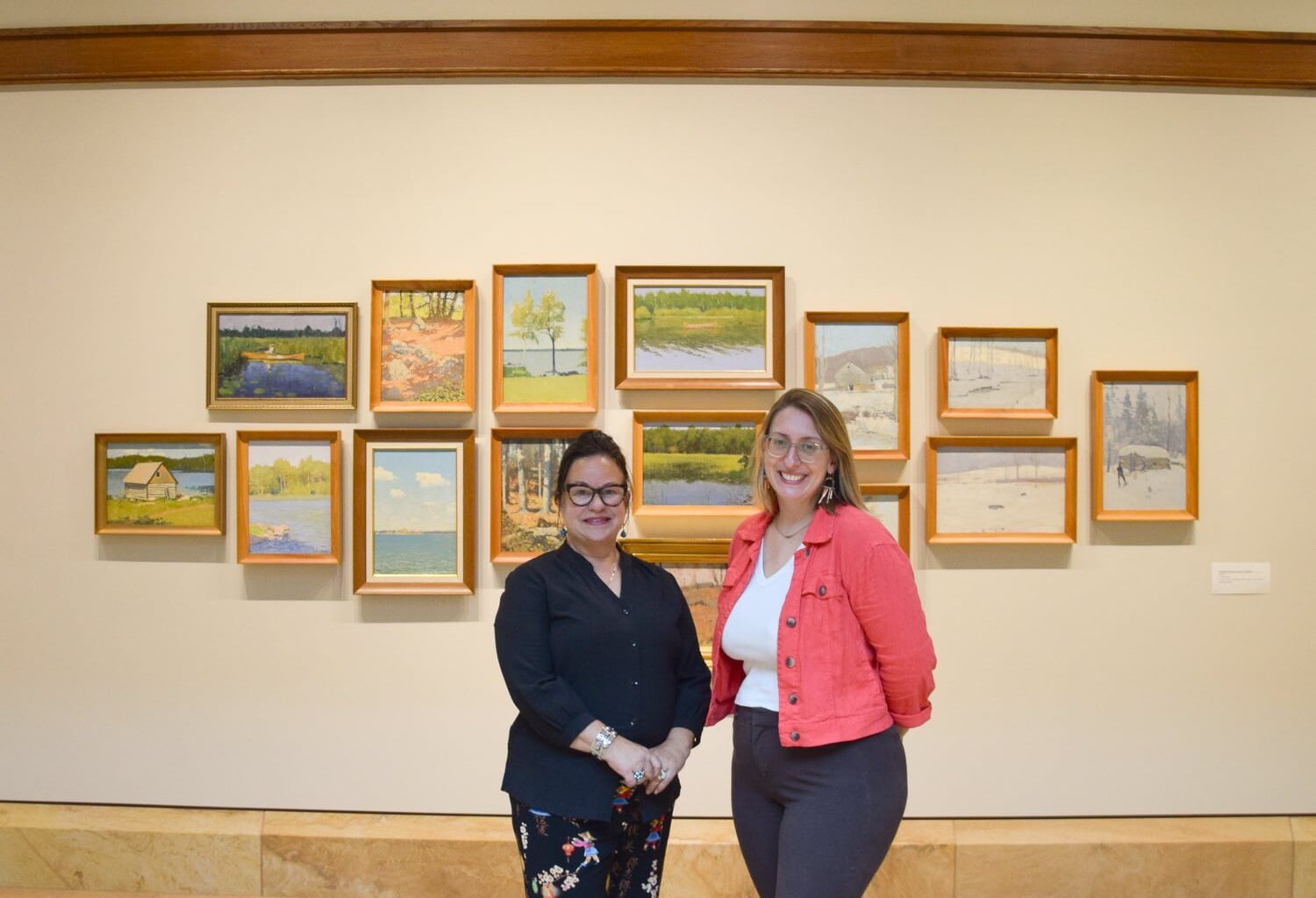

Three walks in the main gallery are now dedicated to Remington’s take on the North Country. Photo: Catherine Wheeler
Catherine WheelerIn Ogdensburg, the Remington Museum of Art wants you to see it through new eyes
The main gallery space inside the Remington Museum of Art in Ogdensburg used to be much more dramatic.
“This room had been a very deep, burgundy-red color since it was installed, which was striking in the greatest sense,” Maggie McKenna, the museum’s executive director, said
Instead of intensity, now the room feels like a breath of fresh air. Natural light from a generous skylight bounces off the new creamy, tan walls. It illuminates the real stars of the space: a few dozen paintings and sculptures.
“It’s just a totally different experience in here,” McKenna said.
The Remington has just wrapped up a revamp: new paint, new displays and a new attitude on how it can serve its visitors and community.
The seeds of change were planted when McKenna took up the head position in 2023, she said.
“When I started here, a lot of people said, ‘Once you’ve been to the Remington, there’s no need to go back because it’s just always the same.’ And I took that to heart,” McKenna said. “I said, ‘We can’t exist that way.’ We need people to have a reason and desire to come back here.”

The main gallery at the Remington Museum of Art has undergone some cosmestic changes. Photo: Catherine Wheeler
Beyond beautification, the biggest changes visitors will see are what’s hanging on the walls, McKenna said.
This main gallery was once filled with all of Remington’s master works. The room now tells Remington’s story and career in context—not just his legacy as one of the greatest Western American artists, curator Romi Sebald said.
“There is so much historical reference to be made, and he was so prolific that without having reference to each painting, it’s easy to get lost and not understand,” she said.
It starts with his black-and-white illustrations, moving through Remington’s military scenes, including his masterwork, “The Charge of the Rough Riders at San Juan Hill,” depicting a scene during the Spanish-American War in Cuba.
A band of soldiers rushes towards battle somewhere in the distance, guns in hand. Some are splayed in the grass, succumbing to injuries on their way.
Sebald said it’s from here that Remington starts to turn away from his enchantment with the military and war.
“He wants to be recognized as a fine artist rather than as an illustrator. And he starts this quest to understand color,” she said.
While Remington became famous portraying and romanticizing the West and its cowboys, the North Country was still in his mind.
Remington was born in Canton and lived there until he was 14, before going off to school. He returned in the summers and during holidays. Eventually, Remington and his wife bought an island in the Thousand Islands.
“If he visited Canton, he was still painting at his uncle’s house. He just could not stop sketching and painting, no matter what he was doing,” Sebald said.

Romi Sebald, curator, and Maggie McKenna, executive director have led the changes inside the Remington Museum of Art in Ogdensburg. Photo: Catherine Wheeler
Three walls of this main gallery are filled with Remington’s vivid takes on the North Country, from tiny cabins, rivers and ponds, to snowfall in a bare forest.
“There’s actually a sketch of Singer Castle, which he saw being built, and so there’s actually a painting of Singer Castle, and supposedly he was complaining about the construction noise of that castle at the time,” McKenna said.
This room may not have every famous Remington work, but Sebald said she hopes it pushes people to explore on their own.
“We want people to be able to go down these rabbit holes as far as they want to go and then go off and discover more,” she said.

A gallery inside the Remington is now dedicated to Remington’s nocturnes. Photo: Catherine Wheeler
Just through the doors, there is more.
“We are in this beautiful bright light room, and then we are walking into darkness,” McKenna said. “We’re walking into the night,” Sebald added.
Navy walls envelope visitors. Even the light is dimmer.
“This is another one of those ‘Oh’ kinds of moments for me when I walk in here. I’m just like, ‘Oh, I can breathe a little differently,'” McKenna said.
Remington’s nocturnes line the walls. They’re a series of paintings set under the stars and moonlight. The artist and his contemporaries were setting out to capture what night in the West looked like before electricity and other modernities changed its landscape forever.
The museum holds the largest collection of Remington’s nocturnes, and this room is a celebration of that, McKenna said.
“We really wanted to be able to pull all these paintings into this space and create a new atmosphere and show these last works of Remington’s,” she said.
Remington’s iconic “Coming through the Rye” sculpture takes center stage in the room. Four rambunctious cowboys on horseback wave their pistols in the air. Light bounces off the sculpture’s folds and ridges.
“There’s 16 hooves on those four horses, and only six of them are actually touching the ground,” McKenna said of the work. “So it really also speaks to Remington being this visionary and, really, this game-changer in the world of sculpture.”

Remington’s sculpture, “Coming Through the Rye” takes center stage in a room now dedicated to the artist’s nocturne paintings. Photo: Catherine Wheeler
Other new exhibits explore Remington’s legacy in the modern era, whether that’s through media or a temporary exhibit from the Cowboy Artists of America.
McKenna said it all shows the Remington is moving into its own new era.
“We want to be respectful of tradition while also finding a true path forward that is innovative in a way and will allow us to actually sustain this second century of this great museum,” she said.
McKenna said she wants the Remington to grow in its role as a community space. That ranges from hosting more events to building up a volunteer program.
The goal is to teach people about Remington’s collection so they can become tour guides or ambassadors, McKenna said.
“We’re really hoping that people of all ages will be able to participate in so that we can have this deeper tie to the community and the community can have a deeper tie to us,” she said.
It doesn’t matter now whether you’ve never been to the Remington or haven’t been in years, McKenna said. Anyone will be able to see the iconic North Country artist through new eyes.

The Remington Museum of Art in Ogdensburg has recently completed a revamp of its galleries. Photo: Catherine Wheeler