
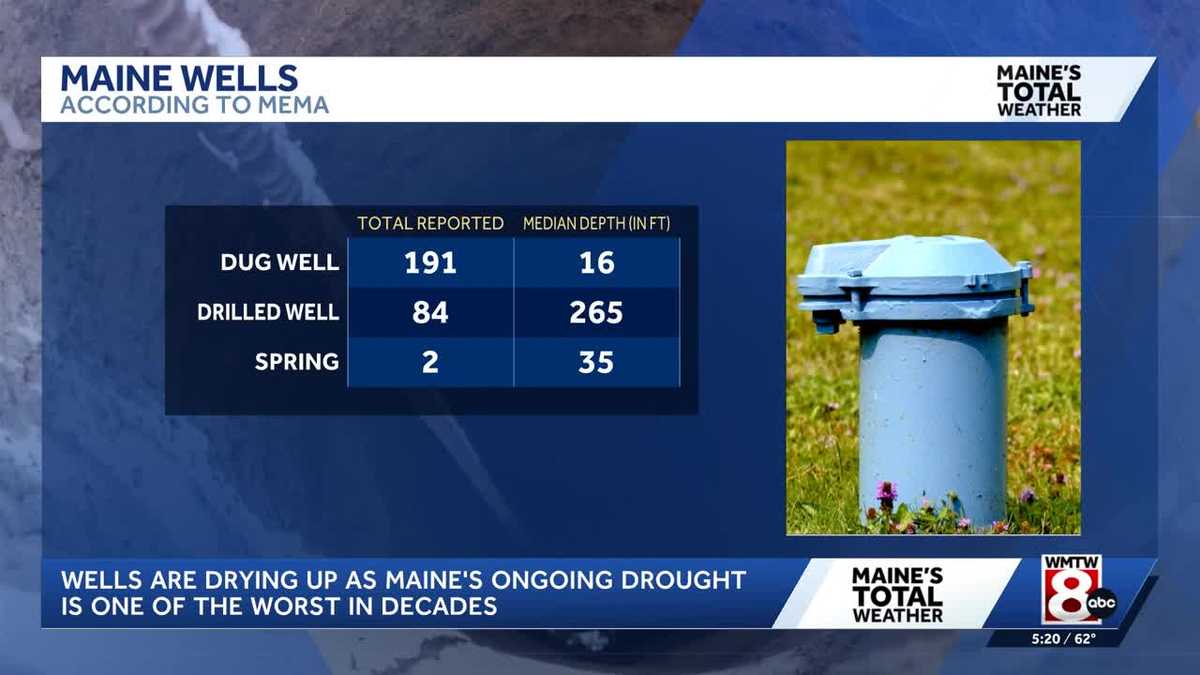
Per the latest data, dug wells are suffering most.
 MAINE —
Maine’s ongoing drought is shaping up to be one of the worst the state has experienced in more than two decades, with groundwater levels struggling to recover and rainfall deficits reaching up to two feet in parts of the state.
A new study examining 26 years of U.S. Drought Monitor data found that the 2000 to 2001 drought ranks as the worst in recent memory, based on the severity shown on historical drought maps. It was also the last time Maine declared a drought-related state of emergency.
Under the same comparison, the ongoing 2025 to 2026 drought ranks second, followed by the droughts of 2020, 2016 to 2017, and 2021 to 2022.
Although current drought conditions may not appear as severe on the map as they did last November, groundwater levels continue to struggle to recover. Rainfall deficits are also growing, raising concerns for Mainers who depend on private wells for their water supply.
According to data collected by the Maine Emergency Management Agency, 62 percent of self-reported dry wells between September 2025 and October 21, 2026, were dug wells.
Among those who reported their well depths, dug wells had a median depth of just 16 feet, compared with 265 feet for drilled wells.
However, depth alone does not determine whether a well will run dry. Even some wells deeper than 400 feet have experienced recovery issues during the ongoing drought.
Factors such as soil conditions, groundwater levels, and a well’s location on a hill can all affect its water supply.
For homeowners concerned about their wells, officials recommend spreading water use throughout the day and monitoring household consumption. Homeowners should also never pour outside water directly into a well.
Those experiencing problems with their water supply should contact a licensed well driller to discuss potential solutions.
Dozens of homeowners are already facing a growing waiting list for well digging and drilling services, as demand increases amid the prolonged drought. Some may have to wait until spring, with limited staffing and resources adding to the challenge of completing the work before the ground freezes for winter.
The outlook remains concerning, with drought conditions forecast to worsen into spring 2027 unless the state receives significant, beneficial precipitation.
Mainers experiencing dry wells can report their situation through the state’s Dry Well Survey. The information helps state officials track the drought’s impacts and better understand how communities across Maine are being affected.