
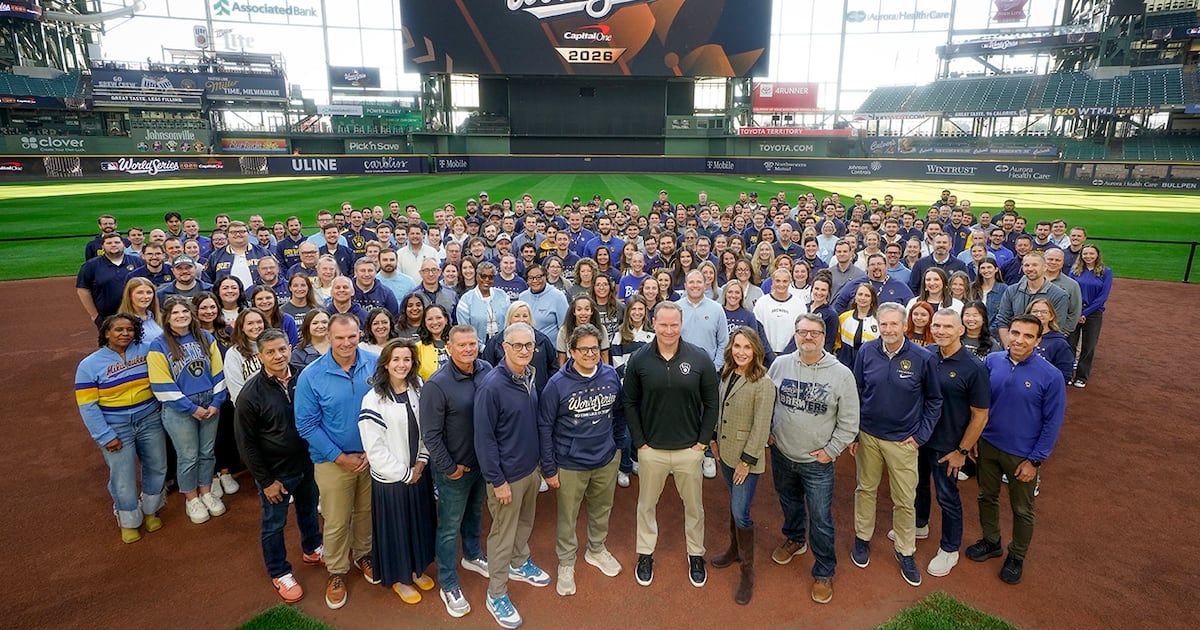
Jim Bathey is retiring after 35 years with the Milwaukee Brewers, and his colleagues are hoping he goes out on top.
Ahead of the team’s World Series run, Bathey, the team’s vice president of ticket sales, walked out of a meeting to find every member of Milwaukee’s business operations department wearing a “Win For Jim” T-shirt.
“I was speechless,” said Bathey, who was a high schooler selling popcorn at Milwaukee County Stadium during the Brewers’ last World Series appearance in 1982. “It was pretty special.”
The gesture reflected the front office culture that principal owner Mark Attanasio sought to build when he and his partners bought the team in 2005 — one where people wanted to work and stay. That continuity and institutional knowledge have helped Milwaukee navigate the economic disadvantages of operating in Major League Baseball’s smallest media market, even as the Brewers have reached the postseason in eight of the last nine years. Following a sweep of the two-time defending champion Los Angeles Dodgers in the National League Championship Series, Milwaukee stood four wins from its first World Series title.
“People don’t leave. They love to work here,” Bathey said. “I had a couple opportunities to leave, but I chose to stay because the way this organization treats its employees is over the top.”
The longevity extends throughout the organization, starting with Rick Schlesinger, president of business operations, now in his 24th year. Other executives include Chief Operating Officer Marti Wronski (23 years); Tyler Barnes, senior vice president of communications and affiliate operations (22); Tom Hecht, vice president of consumer experience (22); Steve Ethier, senior vice president of stadium operations (22); Katina Shaw, vice president of community relations (20); and Matt Lehmann, vice president of event operations (19).
Schlesinger pointed to Bathey’s ability to forecast ticket sales as an example of the value of that institutional knowledge.
“I’ve never seen somebody more accurate in terms of assessing ticket sales and ticket numbers,” Schlesinger said. “I would tell him in the offseason, ‘OK Jim, we’ve got a game on July 24 against the Pirates. How many people are going to be there?’ And he would know within six months before the season started, and these numbers are uncannily accurate.”
“We are a ‘no ego’ front office,” said Wronski, who will be elevated to Schlesinger’s role when he retires on Dec. 31, 2027 (Barnes and Ethier are also retiring that day). “It’s not all sunshine and rainbows every day, but because of the culture that has been developed and we are fierce in protecting, we’ve stayed because we believe in one another and we believe in exactly what we’re doing and why.”
Milwaukee’s executive team watches virtually every game together from a luxury box.
“While we do talk plenty of business in there, our families are there. We’re laughing and poking fun at each other,” Barnes said. “I mean, this place, it feels like a second home.”
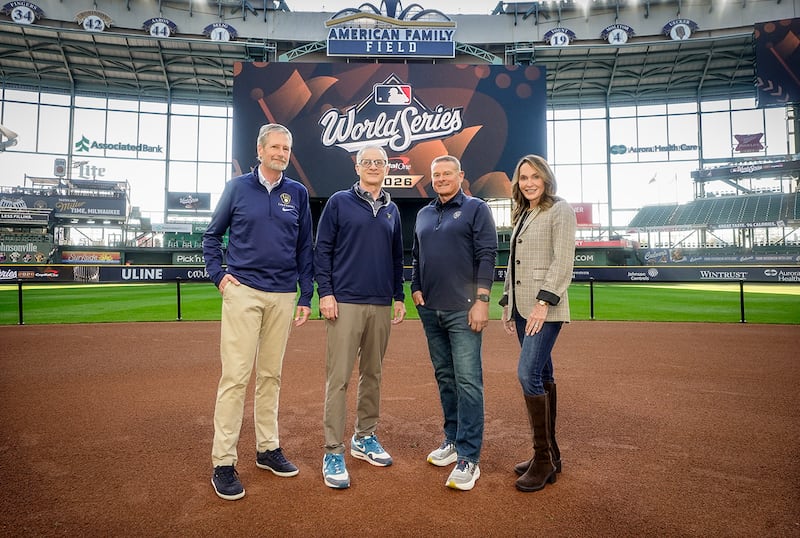 Longtime Brewers executives (L to R) Tyler Barnes, Rick Schlesinger and Jim Bathey are preparing to retire, with Marti Wronski (far right) set to succeed Schlesinger as president of business operations. Scott Paulus Closing the revenue gap
The Brewers continue to punch above their weight on the business side, helping support a baseball operation that has built its success around the draft, player development and shrewd signings and trades.
Milwaukee entered the season facing a projected $20 million revenue shortfall following its shift from FanDuel Sports Network (Main Street Sports Group) to MLB Media in February, Attanasio said.
The Brewers made up $11 million of the projected shortfall, sources said, through better-than-expected distributor rates negotiated by MLB, higher advertising revenue driven by the team’s success and more than 100,000 direct-to-consumer subscriptions — triple the initial projection. The team’s TV deal is worth $30 million this year, down from $35 million last year, Attanasio said.
Milwaukee’s payroll nevertheless rose to $155 million, ranking 19th in the majors, from $144 million and 22nd in 2025.
A 103-win regular season — Milwaukee’s second consecutive campaign with baseball’s best record — helped the team exceed its revenue projections. The Brewers drew 2.8 million fans at American Family Field, ranking 11th in the majors and posting their highest home attendance since 2019. Locally, they had baseball’s highest viewership share (6.27).
The October run pushed Milwaukee into positive book income, with 99.8% of season-ticket holders purchasing postseason tickets. The ultimate financial outcome will depend on the length of the World Series; participating teams receive the lion’s share of Games 5-7 gate revenue.
Standing-room-only tickets for Game 1 approached $3,000 on the secondary market.
“We could literally sell 100,000-plus tickets for each World Series game,” Bathey said of the Brewers’ 41,000-seat ballpark, which lost 1,700 right-field terrace seats last year to make room for a new baseball operations office. “But we don’t have that luxury.”
The bigger financial windfall could come in 2027 through increased ticket sales and sponsorships, providing additional revenue for payroll, ballpark infrastructure, technology and other resources. The Brewers are set to open the premium Truss Club, with a capacity for 400 ticket holders, on Opening Day next year, and complete the two-phase UW Credit Union Plaza, featuring a beer garden, food and beverage offerings and a six-hole mini-golf course.
Labor uncertainty looms, however. Schlesinger said the team is planning for a full season but is prepared to adjust its financial projections if a lockout leads to missed games.
“It’s just a great opportunity to take all the enthusiasm and convert it into revenue,” Schlesinger said. “We’re always going to be the team with affordable tickets that tries to be as fan-friendly and sponsor-friendly as possible. And I don’t think that will change because it’s part of the culture. But we can use this to drive ticket sales and fuel baseball operations.”
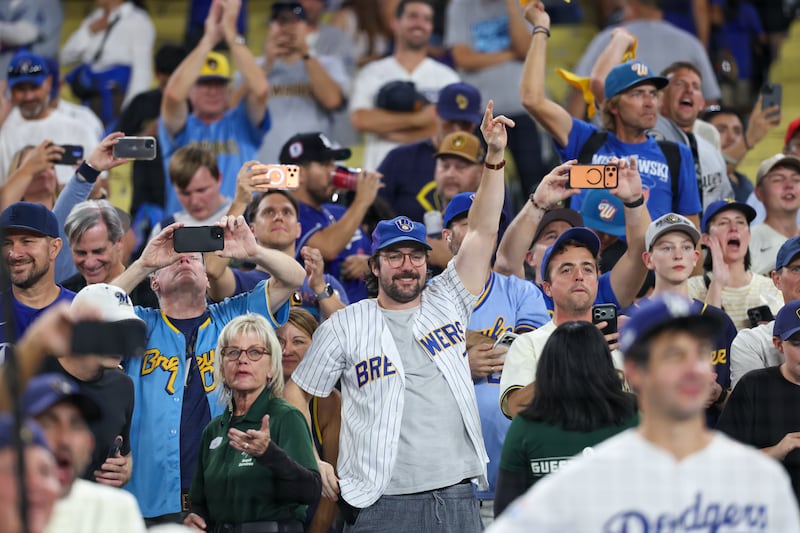 Brewers fans celebrate during a game at Dodger Stadium. Milwaukee drew 2.8 million fans during the regular season, its highest attendance since 2019, while 99.8% of season-ticket holders purchased postseason tickets. MLB Photos via Getty Images Passing the torch
As Schlesinger prepares to step aside, he likes to joke with Wronski: “Don’t fix all my mistakes in the first six months. I think she’ll at least take nine months.”
Both native Wisconsinites followed similar career paths, transitioning from legal to business roles. Schlesinger was part of the 2002 Anaheim Angels title team as VP of business and legal affairs before joining the Brewers the following year.
“I feel like after 25 years, it’s good to have a new voice, a new vision, somebody who looks at things differently,” said Schlesinger, who assumed his current role in 2019. “The business is changing quickly, with technology and AI and all the ways we look to engage the fans, and it’s perfectly aligned for somebody new to explore all those opportunities and lead the next generation. I’m very happy that we have such a qualified replacement. I’ll still have some involvement in the club, but Marti won’t need me to hold her hand.”
Wronski recalled conversations with Schlesinger a few years ago about the need to keep pace in business strategy and analytics, leading to the hiring of Mark Schlifske as vice president in 2023.
The expanded business strategy and analytics team has contributed to projects such as the UW Credit Union Plaza, which opened its first phase this season. Barnes said the project activated an area beyond the center-field wall that had gone largely unused during the ballpark’s first 25 years.
At the same time, Wronski wants to balance innovation with the team’s “Win Our Way” identity.
“This whole sentiment that it’s not good to have no changeover, I understand that entirely,” she said. “But at the same time, you don’t show the people the door just to show them the door. If people are performing at a high level, meeting expectations, you’ve just got to keep digging in and looking at where your own organizational weaknesses are.”
Schlesinger, Bathey and Barnes could remain involved as consultants on special projects after retiring.
For now, things seem to be falling into place.
Schlesinger faced the possibility of missing Game 5 of the NLCS to be at his son’s Southern California wedding, but the Brewers eliminated that conflict by sweeping the Dodgers. Meanwhile, a double rainbow appeared over American Family Field as the team charter returned from Los Angeles.
Wronski’s assistant joked: “The whole universe is cheering for the Milwaukee Brewers.”
Four more wins, and Bathey, a Brewer through and through, can go out on top.
“When you get to the doorstep of the World Series and you don’t quite open the door, there’s a lot of frustration and disappointment and thinking maybe you’re just never going to get there,” Schlesinger said. “But when we broke through to get there, the fan base has just exploded with enthusiasm and excitement. In the history of the franchise, we’ve never won the last game played in a baseball season. And we want to get there and do it.”