
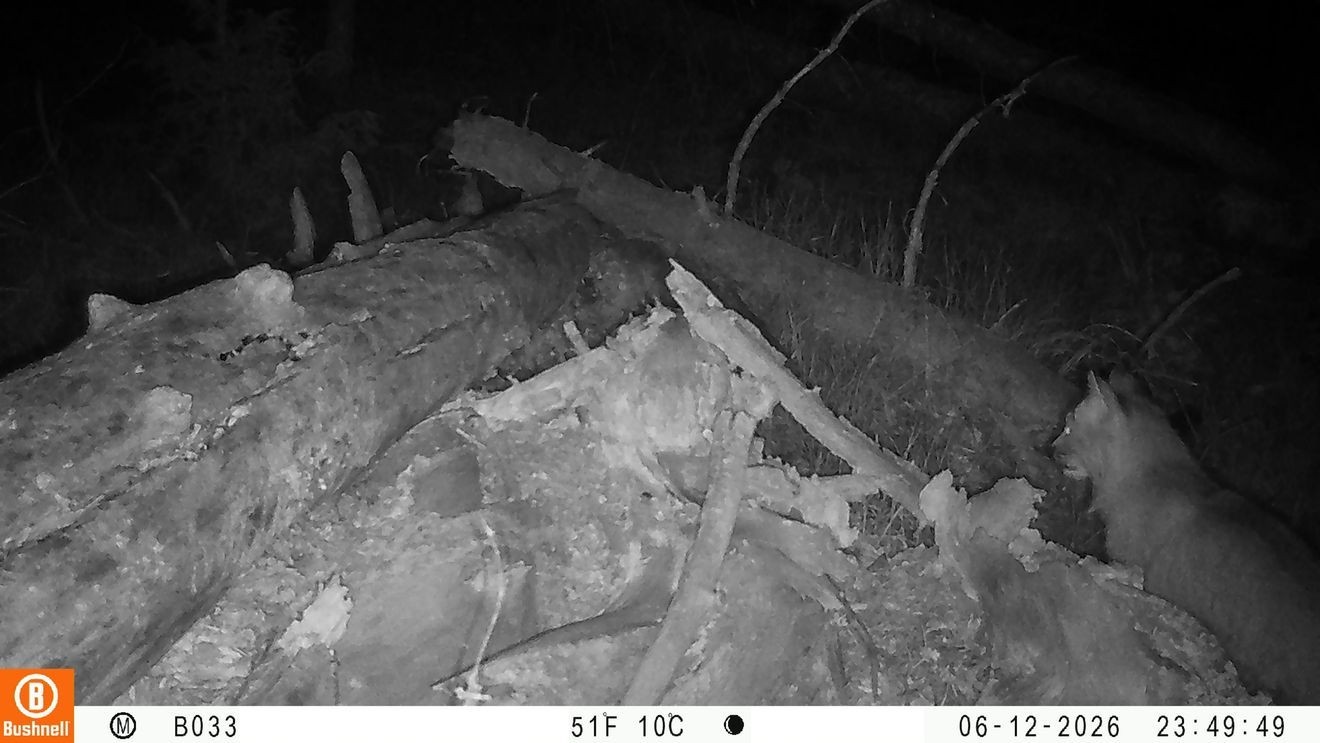
LAS CRUCES, N.M. (KFOX14/CBS4) — A New Mexico State University researcher documenting wildlife in the Carson National Forest this summer captured a rare wild cat last documented in the state over 25 years ago.
According to NMSU, while on an academic trip across the Carson National Forest in northern New Mexico, William Grooms, a Ph.D. student at the university, captured photographic evidence of a Canada lynx, a snow-adapted wild cat.
Grooms, who spent two years examining how forest structure influences biodiversity in the Southern Rocky Mountains, found the lynx images months later while reviewing photos taken in the San Juan Mountains, which straddle the New Mexico-Colorado border, among images of other wildlife known to roam the area, including squirrels, rabbits, bears and foxes.
“We’re just now starting to go through all the images that we captured, and we’re just really excited that, right off the bat, we identified something really exciting,” Grooms said. “We sent the photos to experts to confirm that it was indeed a lynx, and we’re confident it’s a lynx – no question about it.”
Jennifer Frey, a professor of mammalogy at NMSU and Grooms’ adviser, said Canada lynx broadly inhabit dense forests and woodlands across most of Canada and Alaska, adding that it’s rare to catch a glimpse of them, let alone to see them in the Land of Enchantment.
According to Frey, the animals closely resemble bobcats and can weigh up to 20 pounds, but have a grayish or yellowish-brown coat, wide fur-lined paws, and elongated legs suited for moving through deep snow and capturing snowshoe hares, their primary prey.
“It’s very rare for people to see them, and to know that they’re here, I think, provides something like an inner joy for people,” Frey said. “But there’s also real-world ramifications.”
According to Frey, despite reintroduction efforts in the San Juan Mountains between 1999 and 2006, Canada lynx populations have remained low throughout the United States, and the species is still considered threatened under the Endangered Species Act.
Frey said Grooms’s proof of at least one Canada lynx in northern New Mexico “may create additional considerations for how state and federal governments manage this species and its habitat.”
Grooms said Canada lynx and snowshoe hares depend on the same conditions, deep snow and spruce-fir forest environments, and described their connection as mutualistic. He said hares hide and live under downed trees, logs and dense vegetation in the forest understory, which draws lynx to those habitats.
“These types of forests and conditions are often targeted for hazardous fuel removals,” Grooms said, “because when they do catch on fire, they contribute to big fires. But these are the types of conditions, though, that really are important to both the Canada lynx and the snowshoe hare.”
The finding comes as forest managers across the state warn of an increased wildfire risk tied to warmer climates and drier conditions, creating tension between fuel-reduction work and maintaining habitat for species that rely on dense, closed-canopy forests.
Grooms said his project, a collaboration between NMSU and Wildlands Network, aims to help build resilience and maintain wildlife diversity in the Southern Rocky Mountains.
According to the university, Grooms is studying 10 species and measuring their preferred forest structure, the arrangement and composition of trees and other vegetation within the forest ecosystem.
Using motion-activated cameras, Grooms photographed wildlife at 120 sites across Carson National Forest this past summer and plans a second round of documentation next summer, before completing the project.
“Our study is dealing with how we manage forests to make sure that Canada lynx and other species are going to have a future here in New Mexico and the Southern Rocky Mountains.”
RECOMMENDED: NMSU researchers warn against eating campus mushrooms mistaken for store-bought caps
Sign up to receive the top interesting stories from in and around our community once daily in your inbox