
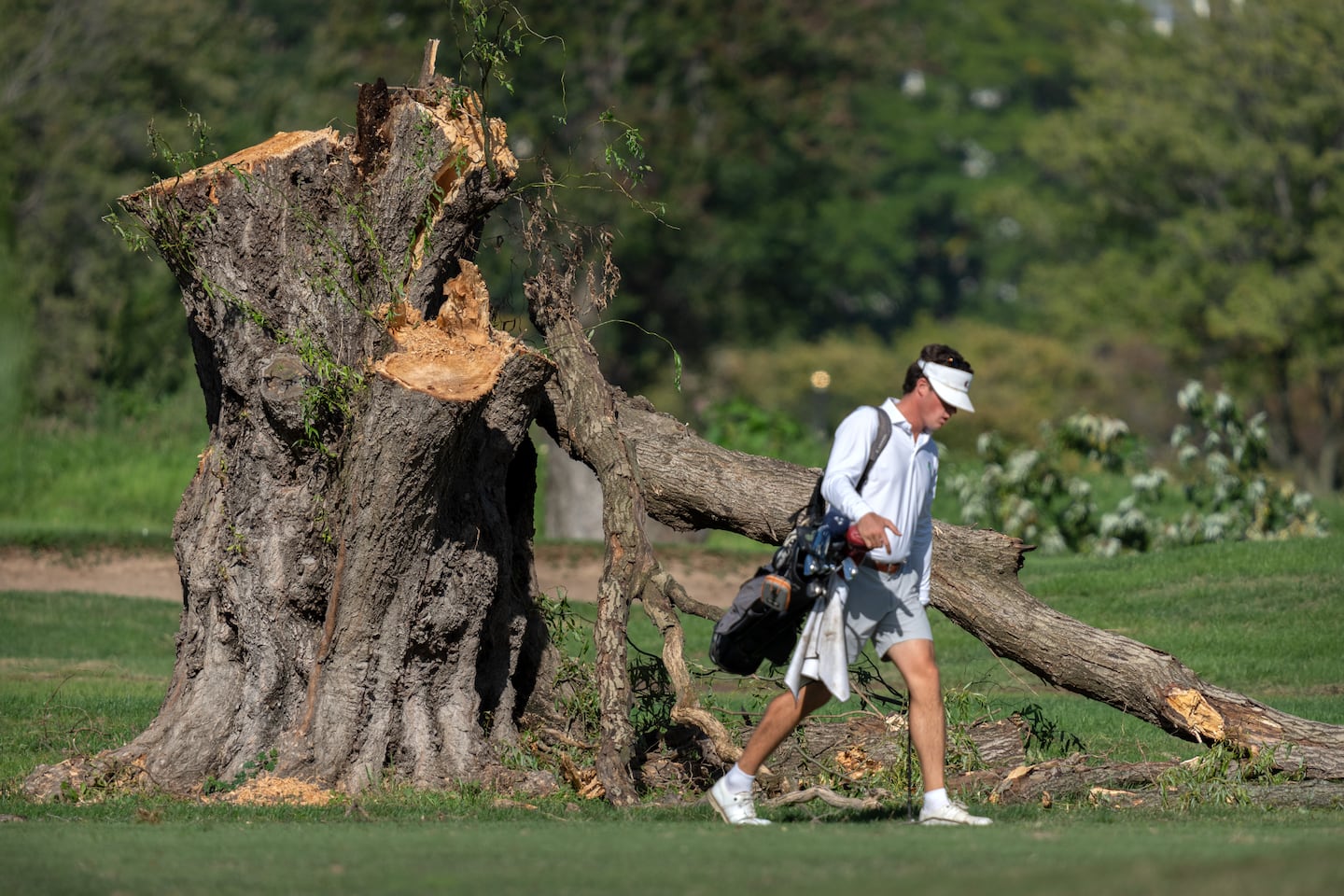
On a sunny, 70-degree Thursday in October, the strokes pile up for a retired pilot, a political consultant, and a recent college graduate who had never met before being paired with a Globe reporter. They laugh at their errant shots, reminding themselves that even a rough day on the golf course beats a day at work.
President Trump has derided East Potomac as “Trash Island” and proposed transforming it into a championship-caliber golf destination that could one day host a US Open or Ryder Cup. But to the golfers who play here regularly, it’s an oasis they don’t want to lose, where an 18-hole round still costs less than a box of balls.
“Between its proximity to the District and the vistas, the playability and the price, it’s one of the best deals in the country,” said John Campbell, 69, who retired as an airline pilot four years ago and plays nine holes for $21 a few times a week to stay in shape.
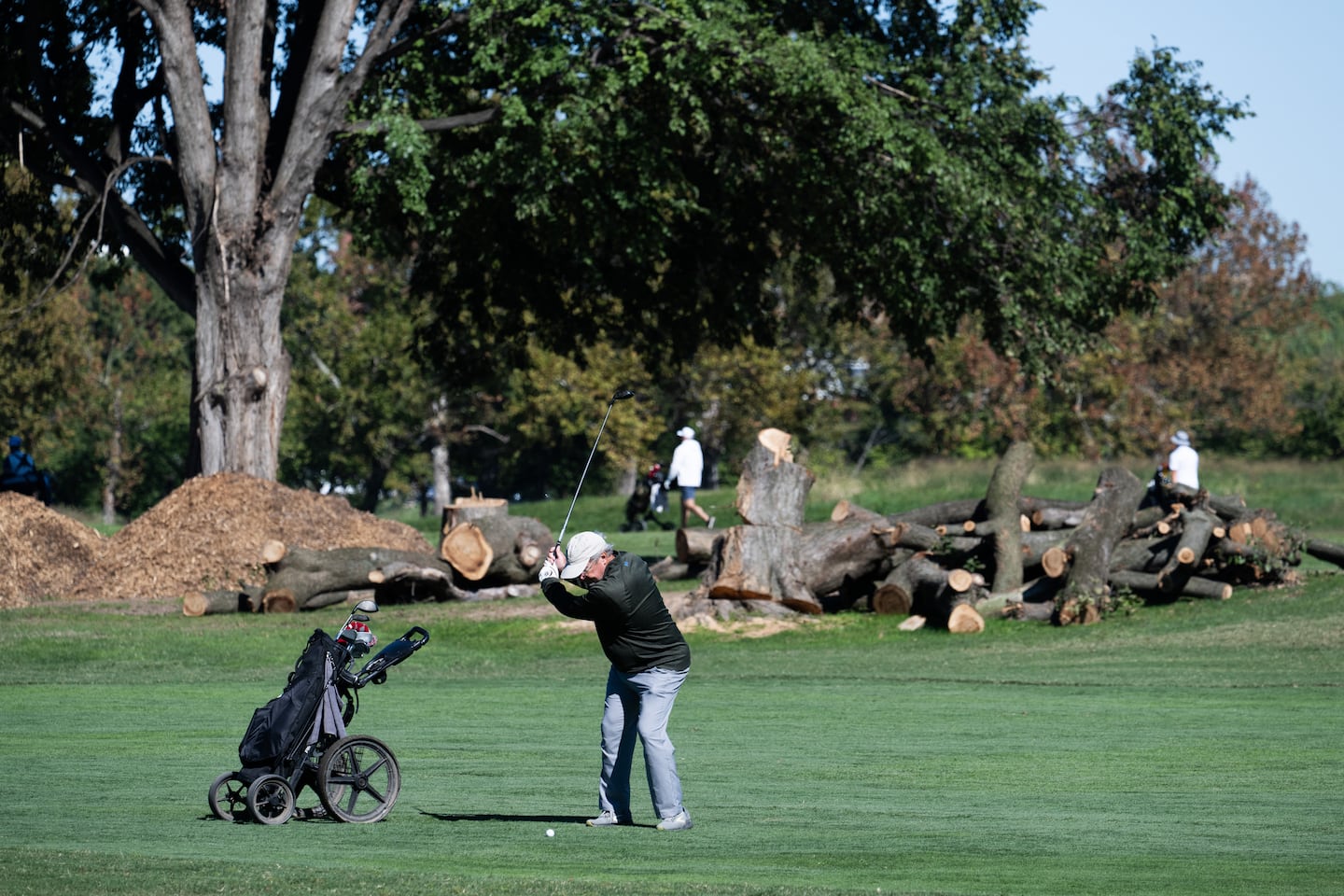 A golfer played on the course near cut down trees at East Potomac Golf Links near Hains Point in Washington, D.C., Oct. 19. SAUL LOEB/AFP via Getty Images
Trump has vowed to close East Potomac on Nov. 15 for about 15 months, but the plan is now entangled in a federal court fight. The National Park Service cut down hundreds of trees this month before a federal judge barred further tree removal through Oct. 26.
US District Judge Ana Reyes has questioned the administration’s rationale for cutting the trees before finalizing plans for the broader renovation. At a hearing this week, she scrutinized the timing and scope of the work but did not issue a new ruling on the project, leaving its future uncertain.
The president, whose affinity for golf is matched by his penchant for remaking the landscape around him, has taken to Truth Social to attack Reyes as a “crazed lunatic” and argue that the Department of the Interior does not need court approval to proceed with the renovation.
“Our Plan, developed to the Highest Levels and Standards of Golf, will turn Trash Island into an Island of Beauty and Success!” Trump posted Oct. 19. “It will be one of the Most Wonderful and Spectacular Golf Courses anywhere in the World.”
East Potomac occupies a narrow strip of land between the Potomac River and the Washington Channel, where the golf course is part of a larger public escape. On sunny days, families spread picnic blankets within an eight-iron shot of golfers on the course. The 36-hole complex also includes a double-decker driving range and a separate miniature golf course, offering ways into the game for everyone from beginners to regulars.
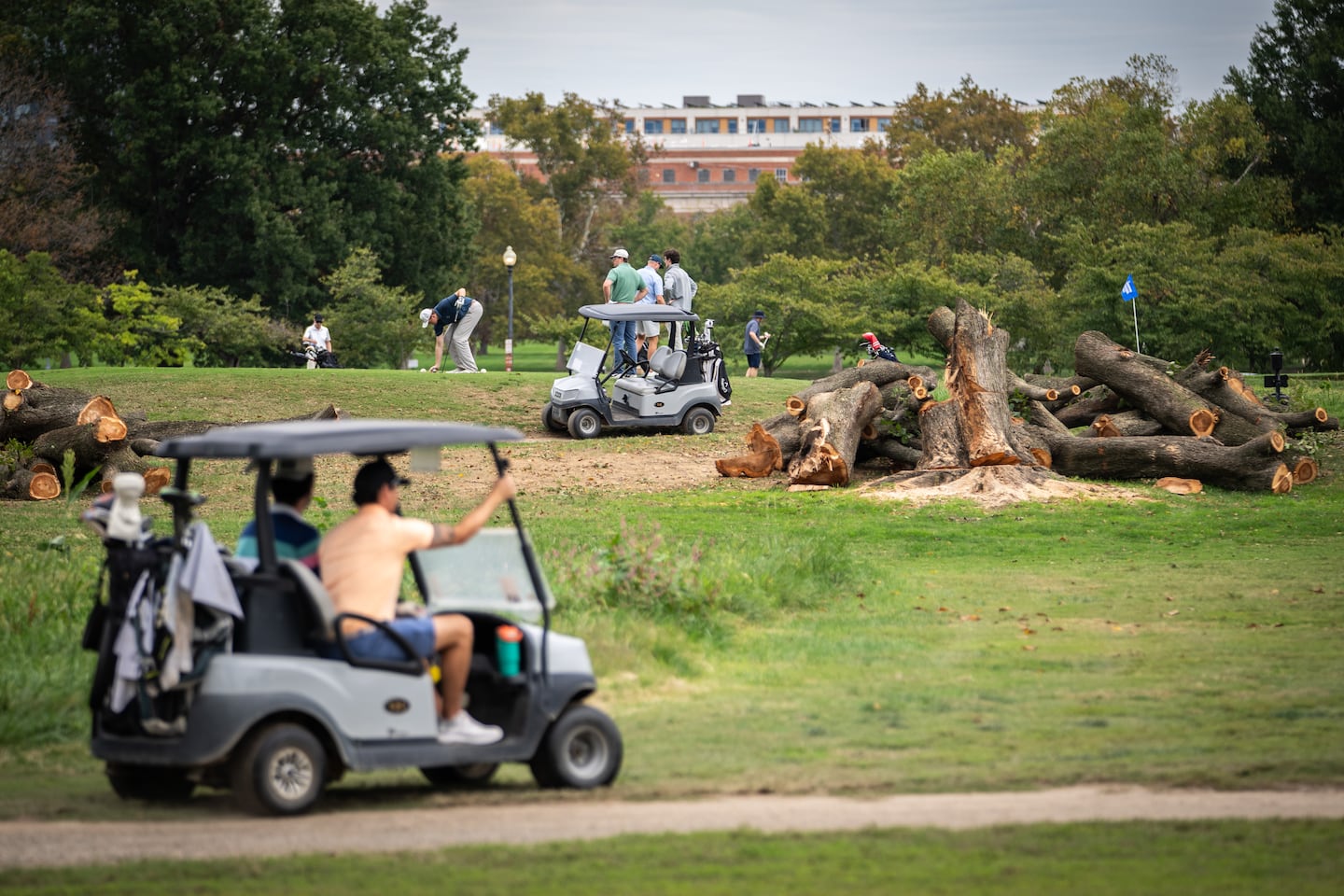 Golfers passed trees recently cut down by the National Park Service, at East Potomac Golf Links, Oct. 10 in Washington, D.C. Nathan Howard/AP Photo/Nathan Howard
Before each round, golfers check in with one of East Potomac’s starters, a cadre of older retirees who work a few hours a week, bantering with familiar faces before sending them to the first tee. These days, fielding questions about the course’s future is starting to feel like another job.
Over an hour Thursday morning, a dozen golfers peppered one starter with questions about what might happen, when it might happen and, perhaps most important, what it might eventually cost to play here.
The starters have few answers. The questions reflect a broader concern among regulars, who worry that a course rebuilt to attract major tournaments could become too expensive for them to play regularly. The turmoil has also affected the operation. Some employees have quit, and finding mechanics to maintain the golf carts has become more difficult. Last week, one golfer’s cart axle broke while he was driving down the fairway.
The regulars know East Potomac could use some work. The tee boxes are lumpy and worn down from so much play, drainage can be poor, and the bunkers need attention. But in their view, the course needs a tuneup, not a complete overhaul.
 People cheered as former Olympian David Hearn joined the protest against Trump’s redevelopment of East Potomac Golf Links at Hains Point on Oct. 4 in Washington, D.C. Finn Gomez/Getty
“You don’t want it to go from kind of like an affordable, every-week joy and turn it into an every-month or other-month joy,” said Pete, a retired Navy Department employee who asked to be identified only by his first name.
Pete has played East Potomac since moving to Washington in 1986. Three of his children learned the game here, starting on the miniature golf course and working their way up through the shorter courses before taking on the 18-hole Blue Course. He called the complex a kind of “people’s country club,” a place where families can build traditions without paying the prices charged at private clubs, where initiation fees can exceed six figures.
“There’s just a special feeling of walking the last hole with your kid, when the sun is going, you’re chasing the last of the light, maybe the flurries are coming down in the winter,” he said. “It’s just a special place that allows people of moderate means to play a lot of golf.”
For those who learned to play here, East Potomac holds an added meaning.
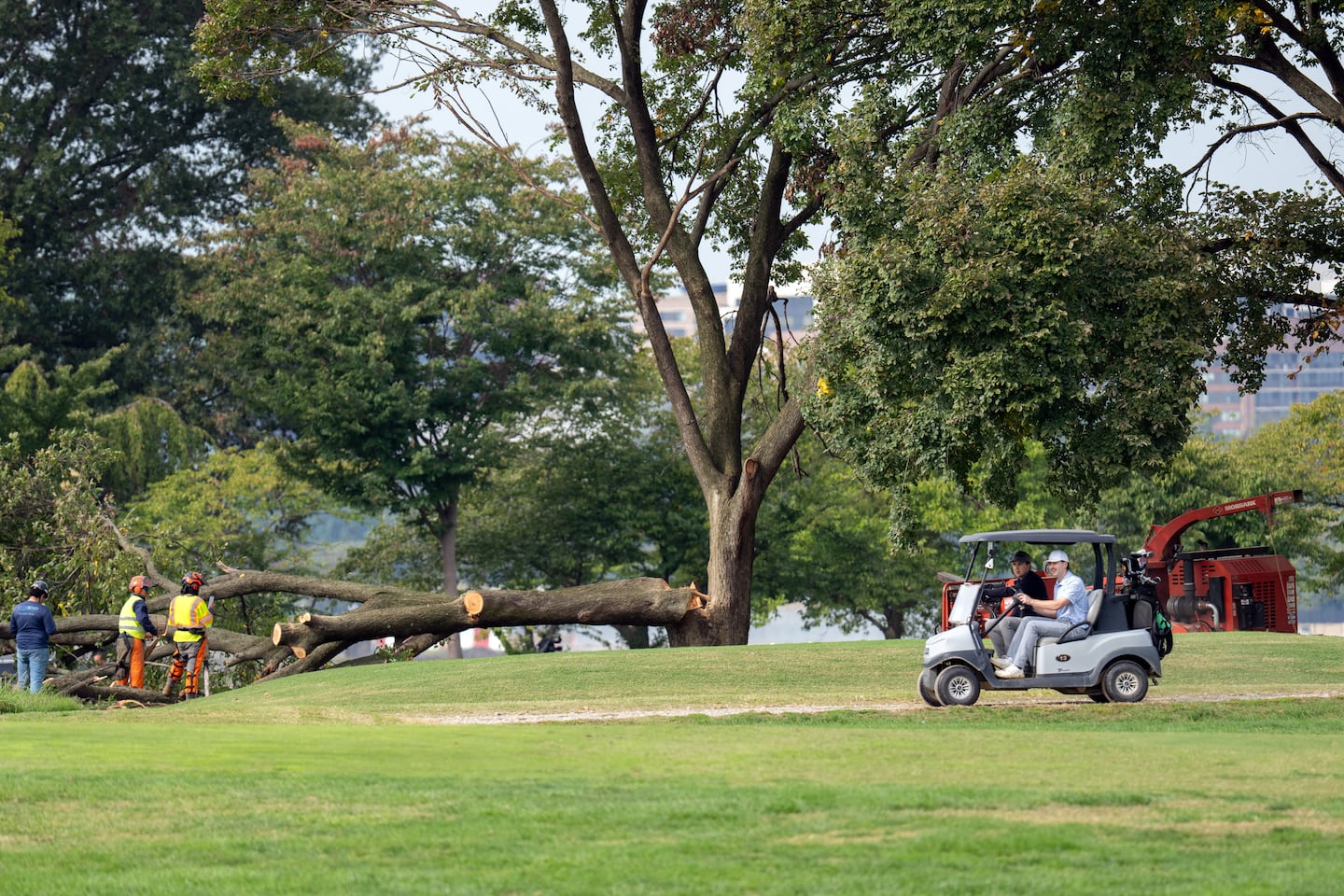 A tree is cut down at the East Potomac Golf Links in Washington, D.C., on Oct. 10. ANDREW LEYDEN/NYT
Tim Nourse, a 55-year-old consultant, joked that he paid $250 for lessons at East Potomac because he vacations with friends in Arizona each year, and “you can’t stink at golf in Scottsdale.”
“If I didn’t have this place, I don’t know if I would have kept playing” Nourse said.
US Representative Gabe Amo, a Rhode Island Democrat, said he had always wanted to learn golf but did not find the sport accessible until he moved to Washington as a young staffer in President Barack Obama’s administration.
The son of West African immigrants, Amo said he was drawn to East Potomac by the “deep roster of African-American men who had unlocked the door to fairways and greens for a generation of diverse players in one of America’s largest Black urban populations.”
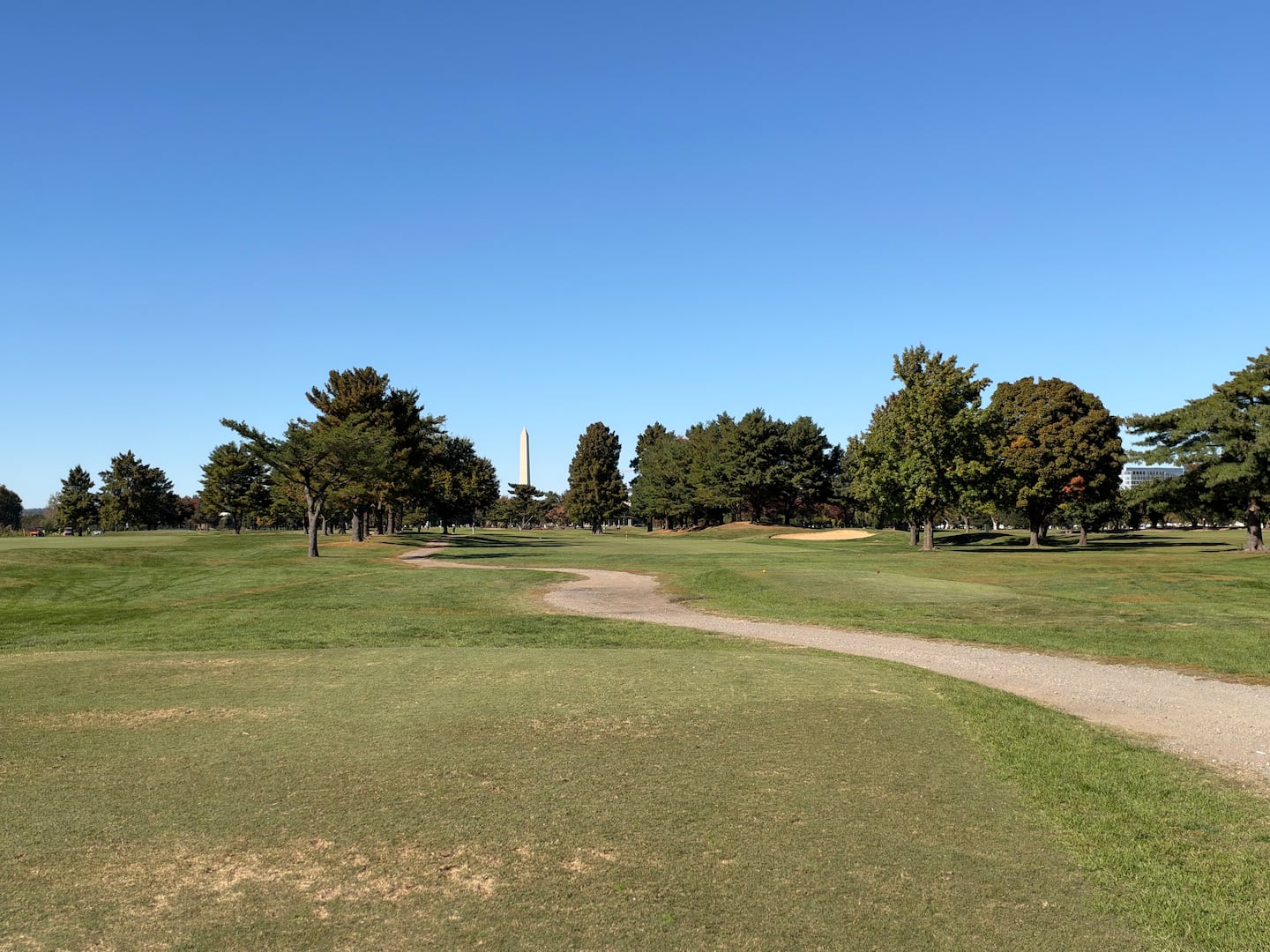 The tee box on the seventh hole at East Potomac Golf Links, with the Washington Monument in the distance.Dan McGowan
“As I took my first swings during my first round, it was very clear to me that it wasn’t just another golf course,” Amo said.
As the picturesque Thursday afternoon turned breezy, East Potomac’s appeal was on display beyond the fairways, too. Cyclists rested in Adirondack chairs near the clubhouse, sipping cold beers and looking out over the putting green. Golfers pored over their scorecards, searching for a stroke they might have missed. In the parking lot, a school bus waited to collect students after a round of their own.
Walking down the eighth fairway, Campbell, the retired pilot, reflected on what he stood to lose if East Potomac closed for an extended period. He could afford to play elsewhere, he said, but he would miss the chance to meet new people nearly every time he played. He especially enjoys seeing young professionals who have come to Washington hoping to make their mark on the world find a place to unwind between long workdays.
The rumble of construction vehicles carried across the park, a reminder of the changes already underway. Campbell approached his ball, still about 40 yards short of the green on the long par 3. He took out a wedge and sent the ball on a smooth arc toward the pin. It bounced three times, lingered at the edge of the cup, then dropped in for birdie.
The strangers he had been playing with erupted in cheers and high-fives, as if Campbell had just won the US Open. He retrieved his ball and pumped a fist before gazing at the Washington Monument ahead.
“At least that’s still standing,” he said.
 Golfers walked by piles of logs and debris on the course at East Potomac Golf Links on Oct. 18. Tasos Katopodis/Getty
Dan McGowan can be reached at dan.mcgowan@globe.com. Follow him @danmcgowan.