
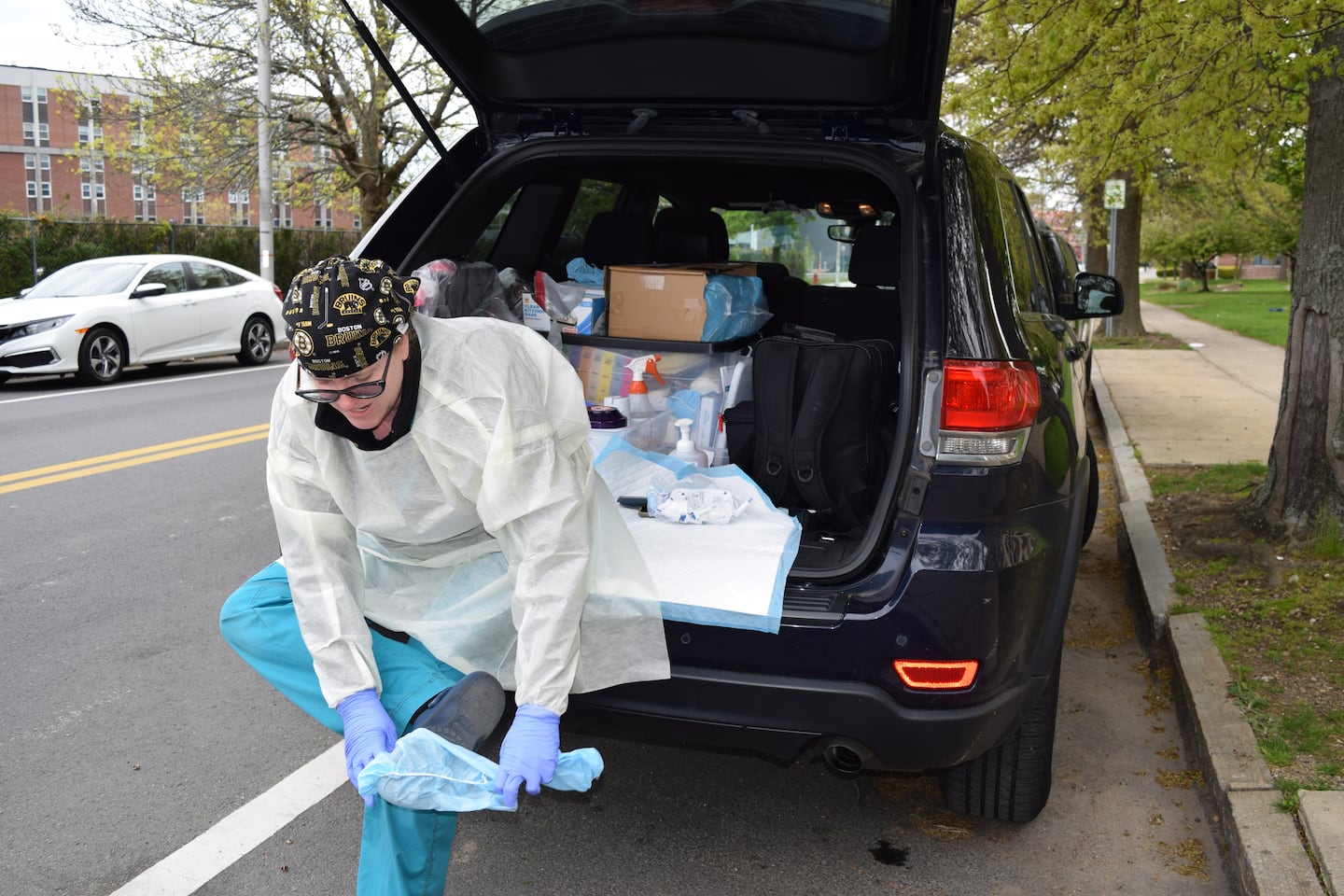
Mass General Brigham plans to sharply cut a program that enables patients to receive hospital-like care at home, according to an internal document obtained by the Globe on Friday.
The confidential memo to hospital leaders this month said that MGB’s nine-year-old Home Hospital program has been losing $30 million a year on average over the last three years, “reinforcing the need to evolve the model for greater financial sustainability.”
Next month, MGB plans to cut the program so that it will eventually treat no more than 30 patients, according to the document. In August 2024, the program had a capacity to treat 70 patients at home, making it the largest home hospital program in the country, according to a news release at the time.
The cuts to the program “will result in workforce reductions, and we are working to identify employment opportunities for impacted clinicians elsewhere in our system where possible,” said the document.
The program will be refocused to support Massachusetts General Hospital and Brigham, which need more bed capacity, while its clinical operations will be indefinitely paused at Salem Hospital, Newton-Wellesley Hospital, and Brigham and Women’s Faulkner Hospital, the memo said.
The memo was called “Project Keystone Leader Talking Points.” It did not specify an author.
An MGB spokesperson said on Friday the changes coming next month aim to create “a more focused, sustainable service” that prioritizes the sickest people and “continues to serve patients for years to come.”
“Home Hospital remains a proven care model that delivers excellent clinical outcomes, lower readmission rates, and an improved care experience,” the spokesperson added.
Reaction to cutting Home Hospital program
Dr. Michael Barnett, a primary care physician at Brigham and Women’s Hospital who helped organize a new union of such doctors at MGB, said his patients adore the program, and he advocates they use it whenever possible.
“It’s a no brainer that getting hospital care at home is a win-win for patients,” he said. “This should be another warning shot for anyone relying on MGB to invest in programs that support the public good. Anything that is not profitable in health care, like primary care, home hospital, or pediatrics, is on the chopping block.”
MGB, the state’s richest hospital system, has said it is cutting costs to become more financially sustainable.
The system had a total surplus of $2.38 billion in fiscal 2025, but that included money from its substantial investments that wouldn’t be prudent to use for operating expenses, MGB says.
The system says its problem is its small operating margin, or money made from its core work of taking care of patients, which in fiscal 2025, was 0.3 percent of operating revenue, or $59 million.
That margin should have been roughly five times as much, 1.5 percent, or about $300 million, MGB said, given where its peers are.
 The corporate offices of Massachusetts General Brigham hospitals in Somerville in 2022.Lane Turner/Globe Staff
The financial picture looks no better this year, MGB says. It was running over $300 million behind budget toward the end of fiscal 2026, which ended Sept. 30, according to an internal memo dated Sept. 17.
The layoffs, which began last week, come as hospitals face funding challenges. The number of uninsured patients is expected to balloon after new Medicaid work requirements take effect in January.
“These are difficult but necessary decisions to ensure we can continue providing exceptional care for patients, advancing research and education, and investing in the people and programs that are central to our mission,” a spokesperson said. “This work will be guided by our clinicians who are closest to patient care. By taking these steps now, we are strengthening Mass General Brigham for the future and ensuring we can continue to serve our patients and communities for generations to come.”
The system hasn’t detailed the scope of the layoffs or cost-cutting measures yet.
Among those also known to be affected by the cuts so far are some pediatricians at Mass Eye and Ear, although they have been offered positions elsewhere in the system, MGB said. Mass Eye and Ear will end general pediatric inpatient admissions to its 10th-floor unit by Jan. 1, and general pediatric inpatients will be treated at Newton-Wellesley Hospital, Wentworth-Douglass Hospital, Massachusetts General Hospital, and other Mass General Brigham for Children locations, according to an internal document obtained by the Globe.
Departments across the system have been asked to cut costs, MGB has said.
One MGB primary care physician, who requested not to be named out of fear of losing his job, said he worries that the cost cutting is going to strain a system that already doesn’t have “enough people to take care of patients.”
One of his patients recently suffered a stroke and needed a follow-up visit with neurology, he said. The earliest available appointment was over a year away.
“Morale is low. People feel demoralized, and each time the cuts come around, I think it makes people feel worse,” he said. “It makes a lot of people think, ‘Should I just start looking for a new job now?’”
MGB touted Home Hospital in past
The cuts to the Home Hospital program are ironic; for years, MGB has touted it as a way to help patients heal more effectively while simultaneously opening up badly needed hospital beds for more critical patients. Clinicians monitor patients remotely and typically visit them in person twice a day.
While at home, patients are able to move more, are exposed to fewer hospital-acquired infections, and they can receive hospital-level care for longer since no other patients are waiting for their beds. Clinicians also get a better look at a patient’s home environment, allowing them to address social needs that might not be evident during a hospital stay.
Early studies suggested better patient outcomes at home: A report from the Massachusetts Health Policy Commission found that home hospital patients were discharged to skilled nursing homes less than 1 percent of the time, while patients in traditional hospital settings were sent to nursing facilities 11 percent of the time.
The home hospital model became an important release valve for hospitals during the pandemic, when the Centers for Medicare and Medicaid Services permitted the practice as part of a five-year experiment.
But such programs have faced instability. The waiver that allowed the model expired in 2025 during the country’s longest-ever federal government shutdown, forcing home hospital programs to temporarily stop accepting patients. Lawmakers ultimately extended the waiver through 2030.
According to the system’s 2024 news release, the Home Hospital program was then “considered an essential offering to patients.” Between 2022 and 2024, the Home Hospital model served over 4,000 patients.
The Globe is looking to speak with people who are affected by or have knowledge of these cuts. If you’re willing to speak to a reporter, please email jonathan.saltzman@globe.com and/ or marin.wolf@globe.com.
Jonathan Saltzman can be reached at jonathan.saltzman@globe.com. Marin Wolf can be reached at marin.wolf@globe.com.