
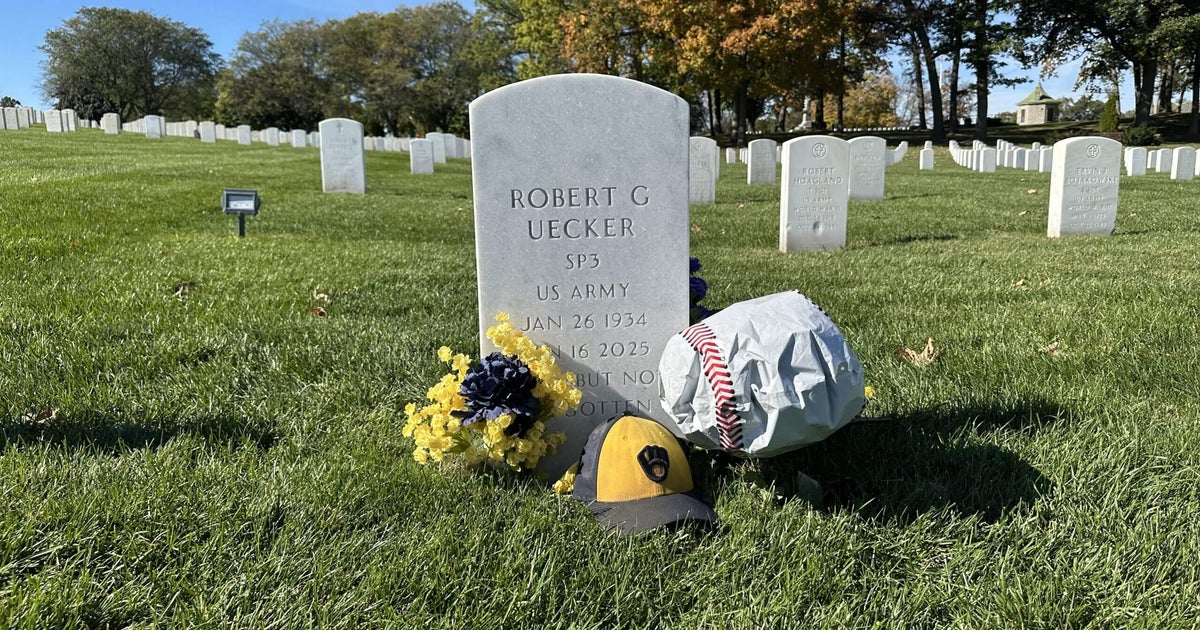
A few mornings after the Milwaukee Brewers advanced to the World Series, broadcaster Jeff Levering visited Bob Uecker’s grave.
A couple of nights before, Levering made a call — Oh my God, the Brewers win the pennant! — that unintentionally invoked Uecker’s legacy. Milwaukee is now in the midst of a baseball celebration unlike any in the past 44 years, not since the 1982 Brewers battled the St. Louis Cardinals to seven games in the franchise’s only other World Series appearance.
In the days leading up to this year’s Fall Classic, Levering was not alone in stopping at Uecker’s grave. This past week, Uecker’s tall, slim headstone was surrounded by an old Brewers hat, a deflated baseball balloon and yellow-and-blue flowers. He is buried in a military cemetery, a uniform setting with shining headstones and quiet surroundings. Per its policy, Wood National Cemetery discourages leaving items “inconsistent with the dignity” of the grounds, but many fans cannot resist paying homage.
“When you think about Milwaukee,” Levering said, “you immediately associate it with Bob Uecker. It’s the Brewers, and it’s Bob Uecker.”
Uecker’s grave is little more than a 20-minute walk from Milwaukee’s American Family Field. His headstone faces the ballpark, the stadium’s arched roof visible over the trees in the distance. Grave markers are a uniquely human way to honor those who are gone, a reflection of our uneasy struggle with grief and death. There is no one right way to remember those who are gone.
Levering, who has been on the Brewers radio call since 2015, has visited Uecker’s grave multiple times over the past two years. The whole broadcast crew went on Opening Day. Lane Grindle, another member of the Brewers radio team, stopped in again just before departing for Los Angeles to play in the National League Championship Series. He brought his daughter. On other occasions, he has brought his son.
Those quiet moments by the graveside usually result in small, internal conversations, a way of communicating with Uecker and feeling his vibrant spirit. Those who knew Uecker leave feeling centered, more at ease.
Now with the Brewers in the World Series, the emotions are more conflicted.
“There’s a peacefulness to it,” Grindle said. “It’s somber, and you still miss him. There’s this incredible run, and there’s a bittersweet aspect to it because he’s not with us in the booth.”
There on the ground, pinned beneath a fuzzy team-colored necklace, someone left a note.
Dear Mr. Baseball
Thank you,
Miss you,
Love you
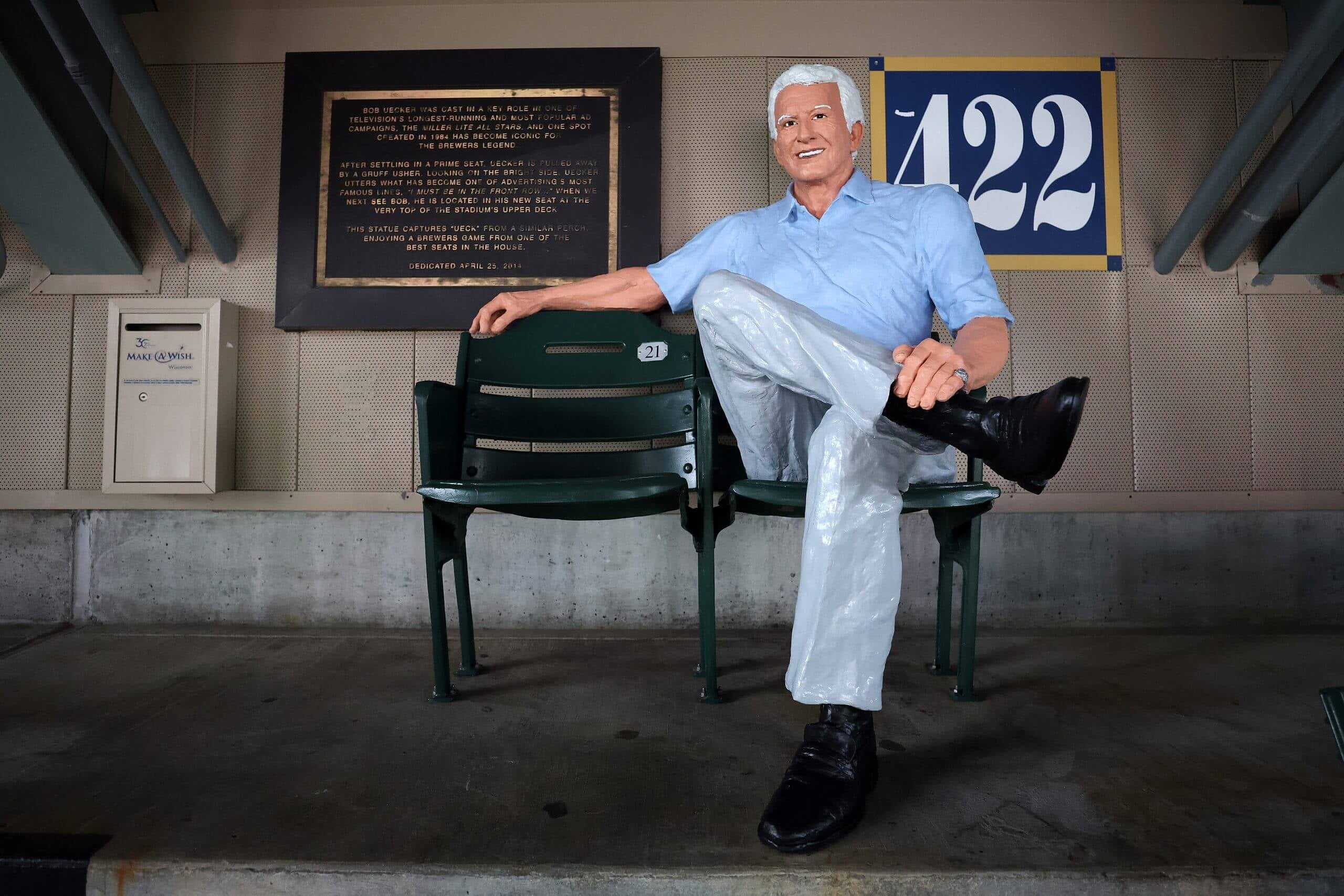
The famed Bob Uecker seat at American Family Field offers an empty chair next to the man who always felt like a friend. (Stacy Revere / Getty Images)
The strangest thing about Milwaukee’s return to the World Series is that the man most synonymous with Brewers baseball is not here to see it.
Uecker began calling Brewers games on the radio in 1971, the second year of the team’s existence in Milwaukee. For the next 54 years, his Midwestern voice served as the soundtrack to Wisconsin summers. He was an Army corporal turned athlete who started his career as a catcher with the old Milwaukee Braves and became a career .200 hitter in six MLB seasons. He homered off Sandy Koufax and tried his best to catch Phil Niekro’s knuckleball. He spent a short time working for a TV station in Atlanta but soon returned home to Milwaukee, the only place he ever really wanted to be.
Generations of fans grew up listening to Uecker’s calls. One of them was Tom Hamilton, a Wisconsin native who grew up to become a Hall of Fame baseball announcer himself.
When Hamilton’s Cleveland teams played in Milwaukee, Hamilton would bring his parents up to the booth to meet an icon.
“I don’t know which would have been the bigger deal,” Hamilton said. “Had they met the Pope, which they never did, or meeting Bob Uecker. That was the mountaintop for them.”
Over time, Uecker’s fame transcended sports. He made more than 100 appearances on “The Tonight Show” alongside Johnny Carson and once hosted “Saturday Night Live.”
He earned a role as a sitcom dad on the ABC show “Mr. Belvedere.” His starring role in Miller Lite commercials brought his face, his voice and his easy humor into living rooms across the country.
In the movie “Major League” and its sequels, he played drunken announcer Harry Doyle and made calls that are still repeated on Little League fields all over America: Juuuuust a bit outside.
When those fictional Cleveland Indians rallied around each other and made the postseason, Uecker — who was downstairs reporting when the ’82 Brewers clinched the pennant — made arguably the biggest call he would ever make. Oh my God, the Indians win it!
Now, Uecker’s spirit looms over this World Series between the Brewers and Tampa Bay Rays. There is a 7-foot-tall Uecker statue outside American Family Field, where fans leave dozens of Miller Lite cans in Uecker’s honor.
Before Game 1 on Friday night, Uecker’s widow, Judy, brought several of his patchwork blazers to members of the Brewers broadcast team. Levering wore a colorful jacket Uecker wore on “The Tonight Show.” Grindle, broadcaster Josh Maurer and producer Kent Sommerfeld each donned other blazers Uecker wore for various commercials or events.
Before the first pitch, Hall of Fame shortstop Robin Yount strode out to the mound wearing another mismatched, plaid Uecker blazer. Yount acknowledged the Milwaukee crowd, then removed the garment to reveal a jersey with a name printed on the back: Ueck.
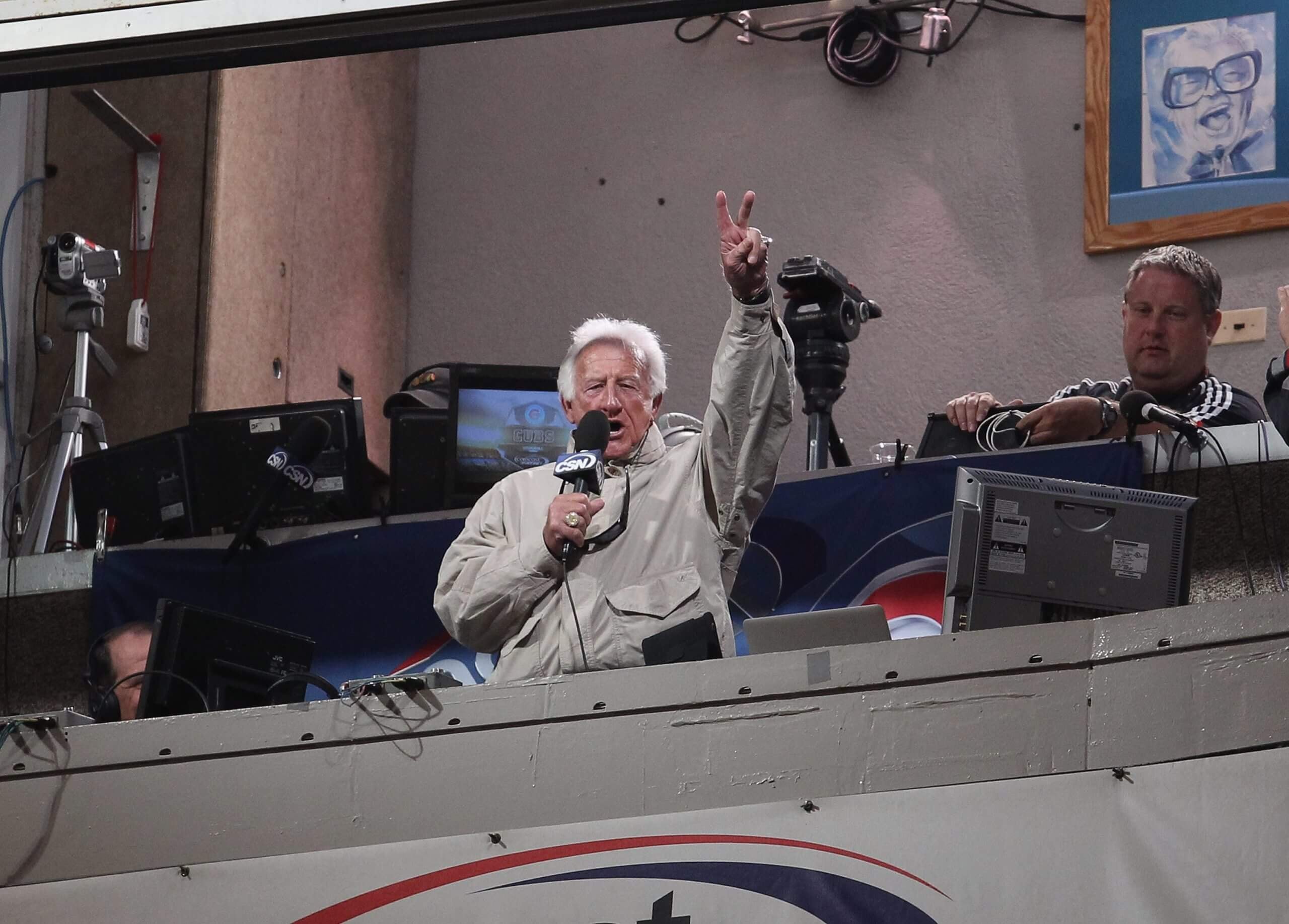
Bob Uecker sings “Take Me Out to the Ballgame” at Wrigley Field in 2011. (Jonathan Daniel / Getty Images)
Although his diagnosis was not yet public, Uecker was in the throes of his bout with small-cell lung cancer the night of his final broadcast — Oct. 3, 2024.
He was supposed to work Game 1 of the Wild Card Series but was too ill. He returned to the field the next day, did the pregame manager’s interview, but sat in the back of the booth while Levering and Grindle handled the call. He left in the seventh inning and listened on his drive home as the Brewers rallied in the eighth inning to extend their season. Later, Uecker left Levering a voice message: Great call, kid. I’ll see you tomorrow.
Then came Game 3. Uecker went on the air. There was hope the Brewers could advance, and Uecker would keep working. But Pete Alonso flipped the game with a three-run home run in the ninth, and the Mets ended Milwaukee’s season. Those around the team knew Uecker’s health was declining fast. Levering could sense this was going to be his final game.
“I’m telling you,” Uecker said in the waning moments of his last broadcast, “that one had some sting on it.”
That night, Levering was on the headset in the penultimate segment of the postgame show. He noticed Uecker lingering around the booth longer than usual. Levering was still on air. A highlight was playing when Uecker came down, tapped him on the shoulder and shook his hand.
Part of Levering wanted to stop Uecker and say: Can I just have a second with you? But when Ueck was ready to go, he was ready to go.
Levering’s relationship with Uecker started in his final job interview with the Brewers, when he had dinner with Uecker and his wife.
“I was scared to death because I was so nervous,” Levering said. “I’m pretty sure I sweat through my shirt within five minutes.”
They soon settled into an easy conversation.
Yes, Uecker could command a room, and yes, he had a way of making people laugh. He was such a comic that his skills as a craftsman were almost underappreciated. As a broadcaster, he also had a feel for the rhythms of the game. Despite his legendary wit, he believed in silence and understood pacing. He could meet the moment in the heat of thrilling victories. His storytelling could also shine in the slogs of blowout losses.
Most of all, he understood what the game meant to so many who crowded in the stands or listened along on back-porch radios.
“I’m just eternally grateful,” Hamilton said, fighting back tears on the phone. “Not only for how good he was to me, but how good he was to my mom and dad. That’s a gift you can never repay.”
To some, Uecker’s force of personality could cast an intimidating aura, particularly to those not in his closest circles. Yet in ways big and small, Uecker also had a way of making everyone feel like his best friend.
Brian Anderson, the Brewers TV voice who also does national broadcasts on TBS, remembers his first spring training, when he introduced himself to Uecker but otherwise kept his distance for nearly six weeks. As a TV broadcaster, Anderson felt he was on the other side of the fence. “I didn’t bother him,” Anderson said.
Then one day, during an early-season road trip in Miami, Uecker grabbed Anderson by the pant leg as he walked down the bus aisle. He asked if he played golf, told him to set up a tee time.
Anderson arranged a favor and had a course open on a day it was supposed to be closed. They played a round, going toe-to-toe with the head pro and the club champion. Uecker moved up tees midway through the round, and they won by a stroke. On the course, Uecker initiated Anderson into the Brewers, giving him a full download on the organization and its hierarchy, its characters and its dynamics.
“He did all the talking,” Anderson said. “I barely said anything.”
Anderson marveled most when a young man rode by a tee box just outside the club on a bike. He looked over and yelled a line from one of Uecker’s commercials.
“I thought, ‘How famous is this guy?’” Anderson said.
So many had those experiences. Grindle recalls his first breakfast with Uecker, starstruck as the legend climbed out of his Corvette. A few weeks later, sensing Grindle’s nervousness, Uecker pulled him aside and said: Grinny, you got to start treating me like a normal person. You don’t need to be on eggshells.
“It was the most empowering thing anybody could have said to me,” Grindle said.
Grindle says he spent much of his career broadcasting for an audience of one, trying to earn Uecker’s approval. Meanwhile, fans in Milwaukee felt like they knew him. Asked about the connection with the city, all the broadcasters mentioned the same thing: Uecker was a Milwaukee guy who could have gone elsewhere but never did. He instilled in his proteges the importance of being the broadcaster for a city, and for a state, and for a community.
Even for a man who could seem larger than life, the Brewers meant being part of something larger than yourself.
“A lot of us through the years were first-time Milwaukeeans when we got these jobs,” Anderson said. “From Bill Schroeder to me to Levering to Lane, none of us are from Milwaukee, but it is home now. And I think Bob had a big part in that. He was able to make clear what the important things are.”
On the night of the last broadcast, Levering wrapped up the postgame show as Uecker and his wife exited the booth alongside Robin and Michele Yount. Grindle accompanied Uecker as he went to the clubhouse to say goodbye to Christian Yelich and other players.
Eventually, Levering signed off for the night and for the year.
And then the silence took hold.
The season was over. Uecker was gone from the booth.
Levering lowered his head to his desk. He broke down in tears.
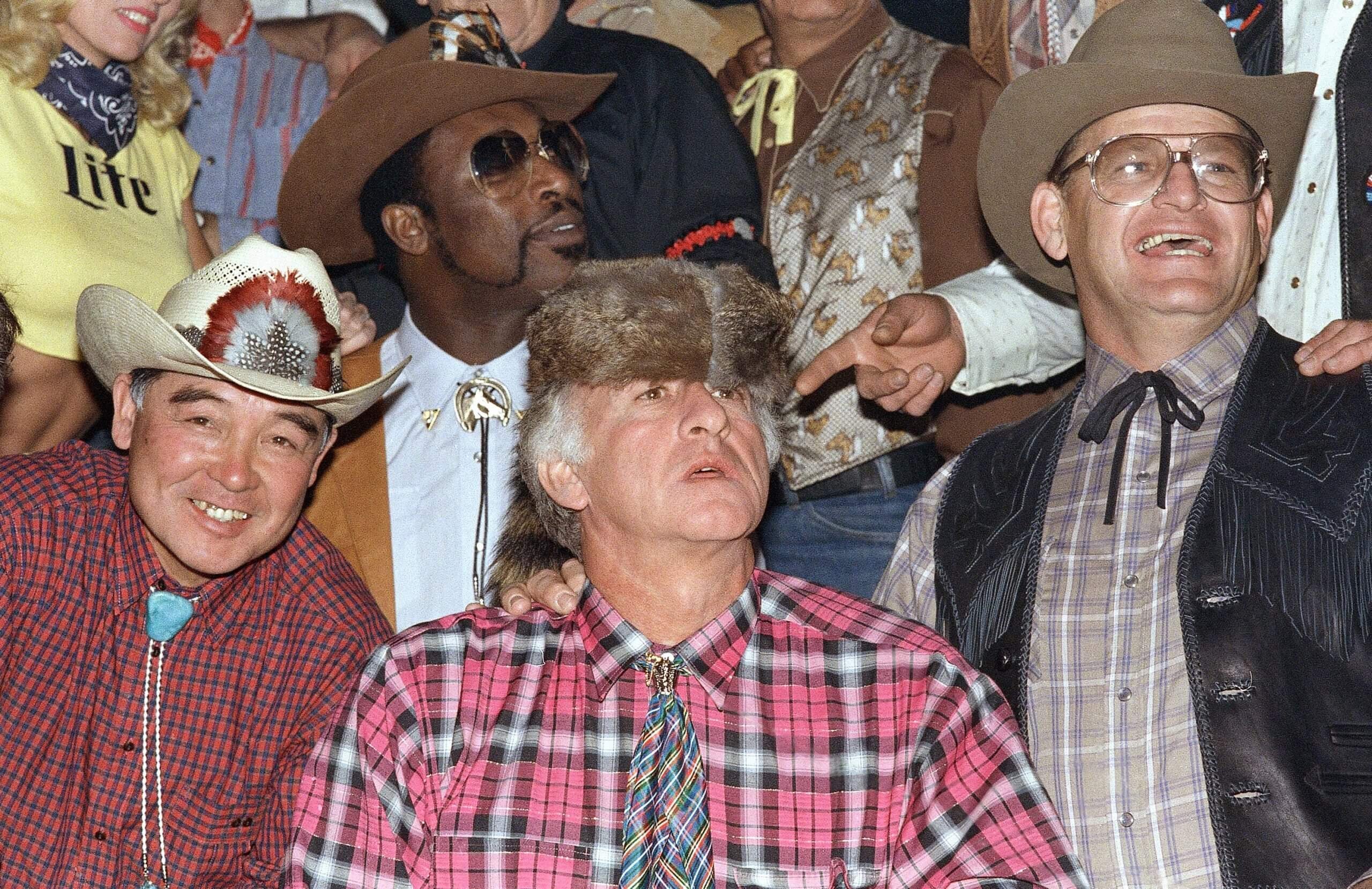
Bob Uecker dons a Daniel Boone hat during a group picture before taping the 11th annual Miller Lite commercial, in 1987. (Alison Wise / Associated Press)
On Jan. 16, 2025, Uecker died at 90 years old. Almost two years later, something about a crisp October, something about the magic of the postseason, has that potent cycle of grief starting all over again.
In the days ahead of the World Series, Uecker’s family released a statement to the people of Brewers Nation. It read more like a love letter.
“To Brewers fans – You’ve kept Bob’s spirit alive – through a laugh, a story, a cold beer, or a favorite call,” the statement read in part. “We feel your love for him every day, and our family is forever grateful.
“So to everyone who kept waiting, hoping, and showing up: This is our moment.”
After clinching victories, gregarious Brewers manager Pat Murphy has read letters to his team, written in Uecker’s voice, based on what Murphy thinks he would say. Comical as the Brewers manager can come across, he’s also a deeply emotional man, known to spend hours talking with Uecker behind closed doors.
In Game 1 of the Division Series, Ty France hit a towering fly ball that threatened to upend the game. The ball instead struck a roof cable at American Family Field and, technically still in play, fell harmlessly into the glove of left fielder Jackson Chourio. Murphy said in his postgame press conference, “Ueck decided to put his hand on it and swat it down.”
On Oct. 15, when the small-market Brewers completed their four-game sweep of the titanic Los Angeles Dodgers, Levering yelled out his exuberant call. He did not realize what he said in the moment and how it mirrored both Uecker’s “Oh my God!” outcry from “Major League” and Russ Hodges’ famous call when the 1951 Giants won the pennant.
It was in the seconds after the call, as Levering let the broadcast breathe, when the parallel dawned on him. Uecker was his mentor and his dear friend. Levering also grew up a Giants fan and had the Hodges call ingrained in his memory, a picture of Bobby Thomson’s shot hanging in his office.
Levering had intended to talk about the World Series running through Milwaukee. The rest was unscripted.
“Ninety-nine percent of it is what just came out,” Levering said.
Like those who have left tokens on Uecker’s grave, Levering clings to small reminders of the man who left shoes far too large for anyone else to fill. He still has the scorebooks he would share with Uecker. Scoring a game is an intimate language, and learning Uecker’s style was one of Levering’s first tasks on the job. Some pages have food stains.
Others have blood spots from when Uecker, who had diabetes, would inject himself when his blood sugar was running low.
Today, there are photos of Uecker in the broadcast booth. Murals of him on the streets. Touchstones all around American Family Field. There have been times this postseason, in the midst of all the chaotic thrills, when Grindle has stopped to think about Uecker and what he might say, what he might feel. There is a moment of sadness, and then a reminder that Uecker would want everyone to embrace the joy around them. After Uecker’s death, Judy Uecker made coins for his broadcast comrades. One side features Uecker’s image. During every game, Grindle keeps that coin in his pocket. In the biggest moments, Grindle finds himself sliding his arm down, grasping that coin and rubbing it between his index finger and thumb.
He is honoring the one thing missing from this World Series as best he knows how.
“I’m not really superstitious,” Grindle said. “I think it just helps calm me down.”
On the coin, Uecker’s signature sign-off is inscribed: So long everybody! You’ve been listening to Brewers Radio Network.