
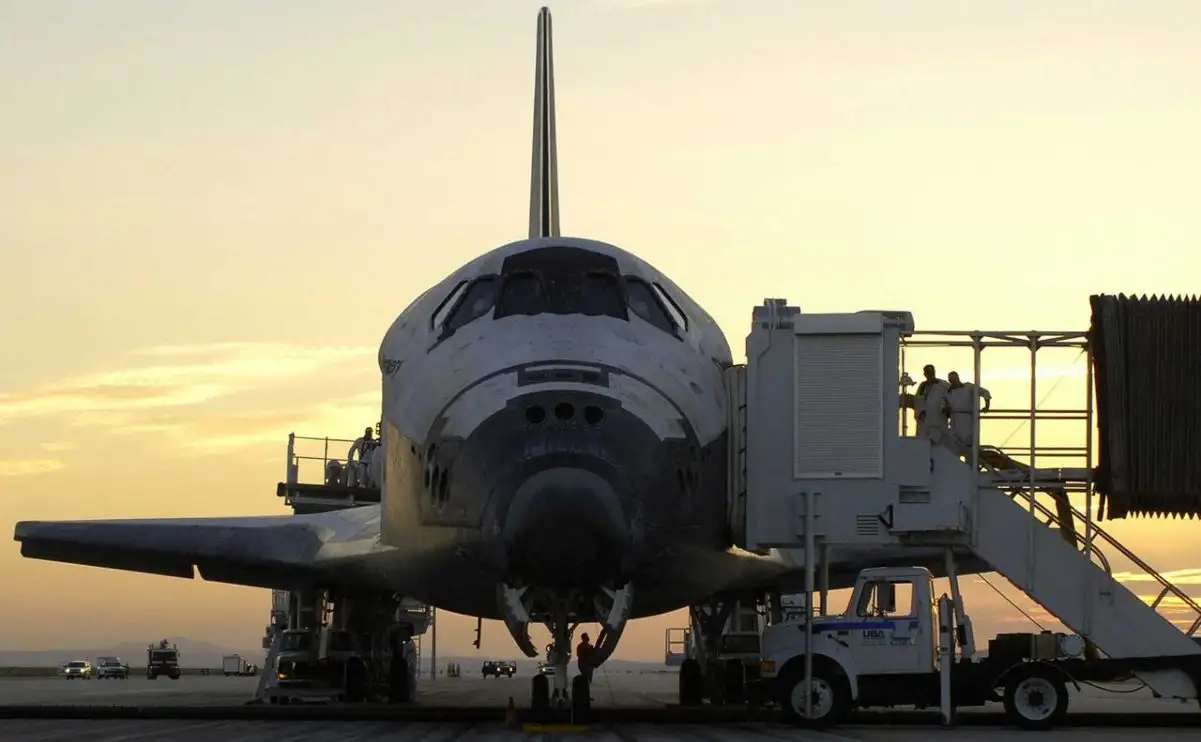
The stack
The Space Transportation System (STS) is the formal name of NASA’s Space Shuttle, consisting of an aircraft-like orbiter, two boosters and a huge external tank.
The stack, as the composite of orbiter, tank and boosters is called, has a gross liftoff weight of 2000 tonnes. Its height is 56 m and the boosters with the three Space Shuttle Main Engines generate 30.16 MN of thrust.
Columbia was the first Space Shuttle orbiter to be delivered to NASA’s Kennedy Space Center, Fla., in March 1979. Columbia and the STS-107 crew were lost Feb. 1, 2003, during re-entry. The Orbiter Challenger was delivered to KSC in July 1982 and was destroyed in an explosion during ascent in January 1986. Discovery was delivered in November 1983. Atlantis was delivered in April 1985. Endeavour was built as a replacement following the Challenger accident and was delivered to Florida in May 1991. An early Space Shuttle Orbiter, the Enterprise, never flew in space but was used for approach and landing tests at the Dryden Flight Research Center and several launch pad studies in the late 1970s.
The Space Shuttle smelled bad
The Space Shuttle consisted of three major components: the Orbiter which housed the crew; a large External Tank that held fuel for the main engines; and two Solid Rocket Boosters which provided most of the Shuttle’s lift during the first two minutes of flight. All of the components were reused except for the external fuel tank, which burnt up in the atmosphere after each launch.
But is true that the Space Shuttle smelled quite bad when ground crews got aboard after a flight to clean and unload?
‘The answer to this question is a ‘YES!’ in all capital letters!’ Explains Dave Mohr, a NASA contractor, on Quora.
 Huge selection of Space & Spacecraft models to choose from – get yours here.
‘After landing, the operating capacity of the Environmental Control System was somewhat reduced by virtue of the vehicle no longer being in a vacuum. This reduced the effectiveness of the conditioning (and odor removal) of the cabin air.
Stagnant air in the crew module
‘All ‘fresh food’ and ‘wet trash’ stored in the vehicle (as well as other things) began to get pretty rank after a while.
‘In the cases that I am aware of the vehicle was completely powered down somewhere between 45 min and 1 hour after landing, due to exhaustion of the onboard coolant working fluid (ammonia). [The environmental system was run until ammonia was depleted. It did not interfere with the ability to detect hydrazine, as this detection was done by inserting a probe up into the throat of each thruster. The ammonia boiler would not have interfered with that. Having said that, the vehicle only had something like 1/2 hour of Ammonia remaining after coming to a stop on a typical landing.]’
Mohr concludes;
‘The stagnant air in the crew module was in really bad shape before very long.’
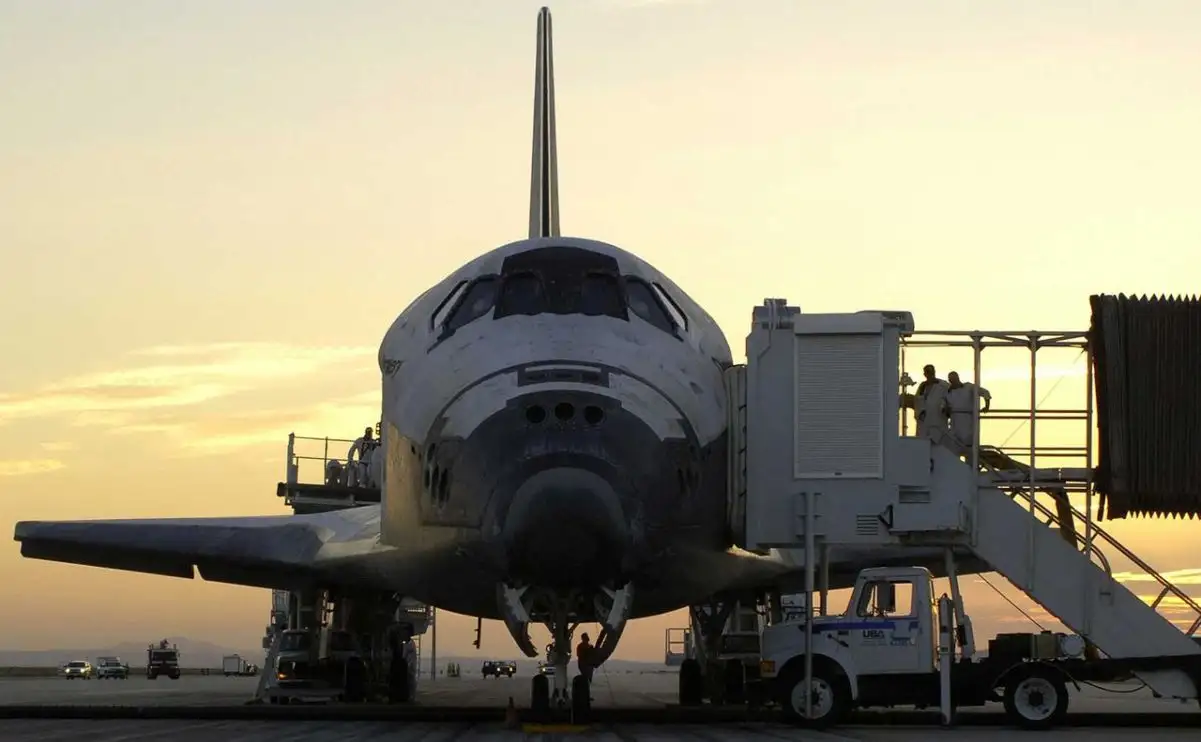 Space Shuttle Discovery being prepared after landing for crew disembarkment
Photo credit: Carla Thomas, NASA