
Law-school applications are rising just as the market confronting new graduates is showing signs of strain. The Law School Admission Council reported 82,487 applicants in the 2026 admissions cycle, up 7.9% from the previous year. Yet the National Association for Law Placement’s October employment report found that, although the Class of 2025 recorded the second-highest employment rate in its reporting history, the market produced roughly 2,700 fewer jobs than for the preceding class. Firms with more than 500 lawyers hired approximately 540 fewer graduates. They nevertheless remained the largest single employer category.
Those figures sharpen a familiar question for prospective students: how far can a law school’s professional network take its graduates? Geographic placement would seem one way to find out. A school whose graduates work across many states might appear to have greater reach than one whose graduates overwhelmingly remain in the same state. But the most substantial legal employment markets are not distributed evenly across the country, and schools can connect graduates to nationally prominent employers without sending them far from campus.
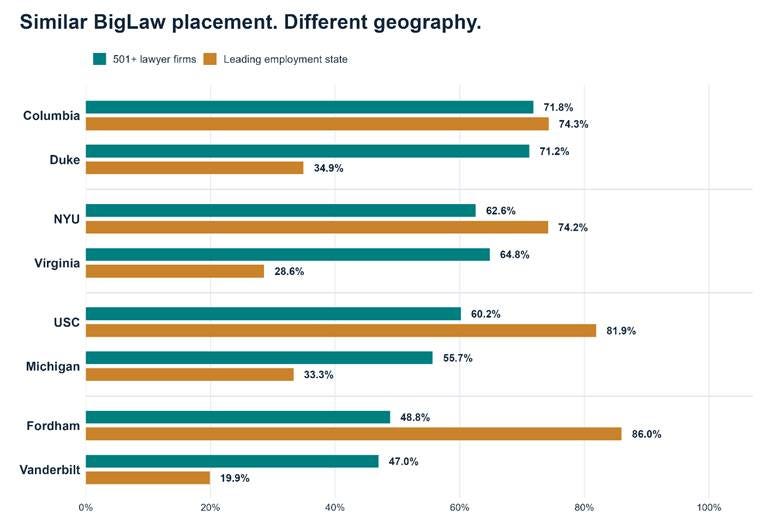
Consider Columbia and Duke. According to the ABA’s Class of 2025 disclosures, 71.8% of Columbia’s employed graduates and 71.2% of Duke’s entered firms with more than 500 lawyers. Yet 74.3% of Columbia’s employed graduates worked in New York, compared with only 34.9% of Duke’s, even though New York was also Duke’s leading destination. Columbia’s three largest destination states accounted for 88.6% of its employed graduates; Duke’s accounted for 57.2%.
The disparity is not unique. NYU placed 62.6% of employed graduates in the largest firms and 74.2% in New York. Virginia’s large-firm share was a comparable 64.8%, but its leading destination, Washington, D.C., accounted for only 28.6%. USC and Michigan likewise had relatively similar large-firm shares—60.2% and 55.7%—while 81.9% of USC graduates worked in California, compared with 33.3% of Michigan graduates in New York. Fordham’s 86.0% New York concentration contrasts with Vanderbilt’s 19.9% in Tennessee, despite large-firm placement rates of 48.8% and 47.0%.
The difference also appears in the top-three-state figures, which help guard against reading more than needed into any one leading destination. Columbia’s 88.6% top-three-state concentration means that relatively few of its employed graduates fell outside those states. Duke’s 57.2% leaves a far larger share elsewhere. Those totals establish the degree of concentration, although they cannot tell us whether the remaining graduates spread across dozens of jurisdictions or clustered in a handful of additional markets.
This distinction becomes more telling when we look beyond institutions routinely described as national. For students comparing Fordham with Cornell, or SMU with the University of Texas, proximity to a major hiring market may be a professional asset even if it reduces interstate movement. For students seeking a specific region, concentrated placement may also be an affirmative outcome. The question is what the employment pattern reveals about the schools’ relationships with different segments of the profession.
These are different measures of what law schools accomplish. Geographic dispersion records where graduates actually work; placement at very large firms identifies one kind of professional destination. Neither tells us what offers graduates received, where they would have preferred to work, or how many offices of a national firm recruited from a particular school. To understand their relationship, we need to look beyond familiar rankings and examine the geography of legal opportunity itself.