
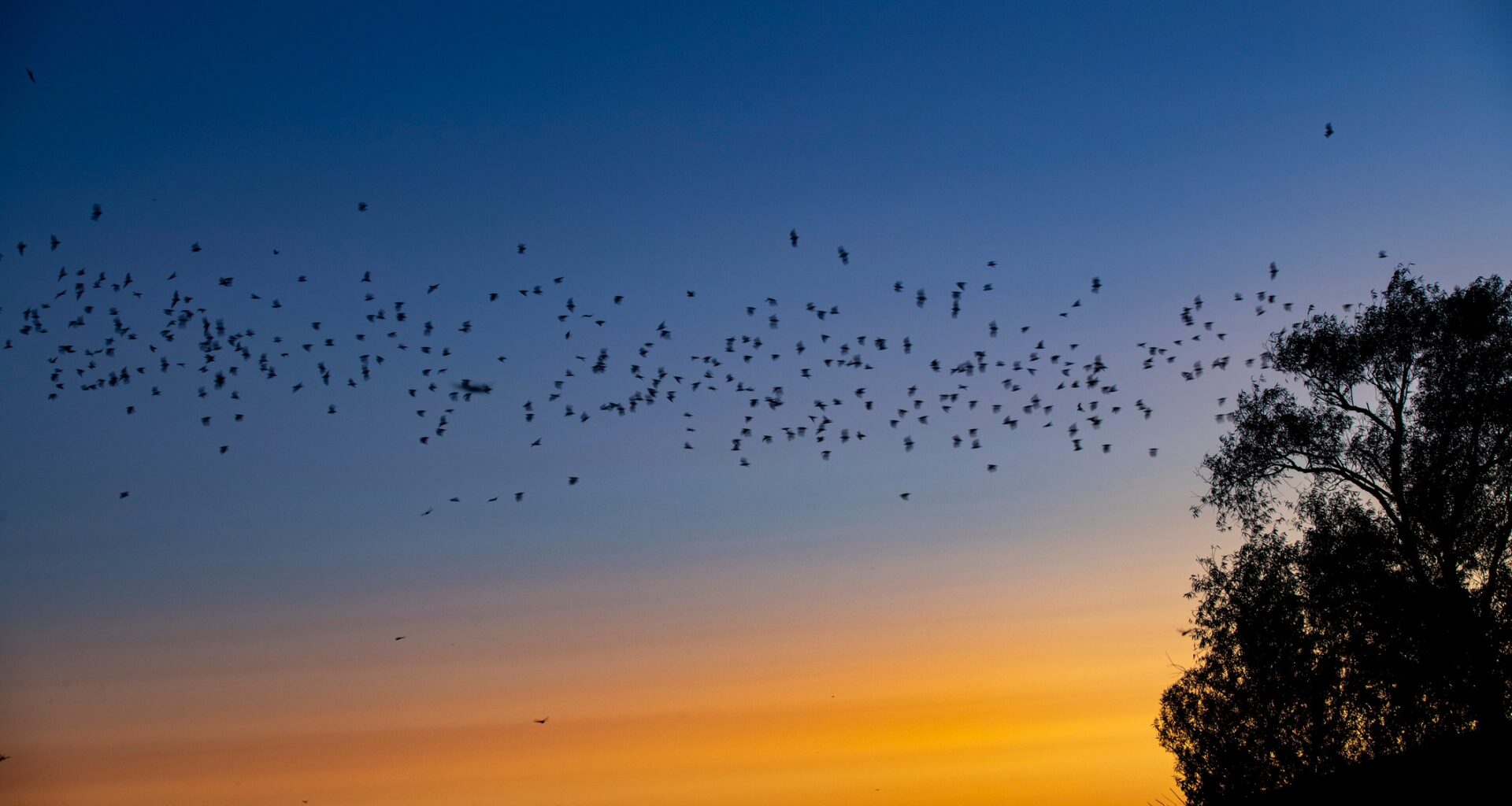
While bat season in Sonoma County is starting to wrap up, Petaluma residents say they are still encountering the winged mammals in barns, backyards and swooping overhead while paddling the Petaluma River.
They’ve also seen them in movie theaters — or at least in downtown Petaluma’s Boulevard 14 Cinemas — with several locals saying they saw bats lending some seasonal atmosphere to a September screening of the witchy “Practical Magic 2.” Theater management did not respond to Argus-Courier queries about the sightings.
Dominique Hecker, who lives on the rural edge of town, said it is not unusual to find a bat in her house once or twice a year on a hot summer day, noting that the critters can sometimes crawl under the corrugated tin roof and “pop in” where the skylights are.
“This year, more concerned about rabies than I ever have been, I agitated every skylight I heard them in with a broom and popped up a bed tent,” she said. “My husband put in some foam between the roofing, and the bed tent is still up. I hear them outside at night. Much happier to hear them there than inside.”
As Hecker noted, concern about rabies in bats has risen this year, with the Sonoma County Department of Public Health Services sharing a Sept. 10 CDC health advisory describing “a nationwide increase in human rabies exposures” in 2026. The CDC received 17% more rabies-related inquiries this year than during the same period in 2025.
In Sonoma County, however, where rabies cases tend to number between three and seven per year, six bats have tested positive for rabies out of 129 tested.
“Over the past 10 years, 48 animals have tested positive for rabies, 94% of which were bats,” states the report. “Additionally, Public Health Disease Control has managed 341 reports of animal bites to date in 2026 to counsel residents on the need for post-exposure prophylaxis, an increase from 267 reports in 2025.”
Kim Schwarzenberg, also concerned about infection, says she’s had several bats in her house over the years.
“My poor dogs freak with them flying around and me chasing the bats with a broom,” she said, noting that when dead bats appear, she always gets them tested. “We believe they were coming in through the woodstove pipe where it was on the roof. They crawled in under the plate. My son came in contact with bat waste several years ago and had the treatment. Nothing to mess around with.”
Other locals described encounters with bats that may not have involved fear of rabies, but were still a little creepy.
“I won’t say that I love bats, however I am intrigued by them, enjoy seeing them, and greatly respect them and their contributions to our environment,” said Petaluma resident Kate Bolton, relating a story involving several local bats and the family cat at the time, Kika.
Even as a kitten, Bolton said, Kika seemed eager to provide food for her human family. “Or maybe she wanted to show off her hunting trophies,” she said. “Or possibly just give us a present.”
One evening, as the family was watching TV, Kika entered the house through the cat door with “a peculiar cry and a mouthful of bat,” which the cat proudly presented at her humans’ feet.
“Not knowing quite what to do, I placed a tissue over the small quiescent creature as one might do with a stunned bird to help it recover,” Bolton wrote to the Argus-Courier. “In less than a minute, I lifted the tissue to check on it and found it breathing hard and fast.”
After it had recovered a bit, “I gently lifted the small animal and quickly took it upstairs to a bedroom with a window close to the front porch roof, which sloped down and toward the window. I figured that the roof was the only place that was cool and dark and out of reach of a cat.”
The porch roof was just out of Bolton’s reach.
“So, with hopeful heart and an apology to the bat, I tossed it as gently as I could and managed to land it on the roof, although a bit close to the lower edge,” she said. “I waited a few minutes, watching to see if the bat would … could … resuscitate in the cool darkness.”
It did, initially flopping about on the roof before spreading its wings and launching into the night.
“I was pleased with my rescue effort, which I proceeded to use for the following eight or nine evenings as Kika practiced her hunting prowess and continued to bestow her gifts on us,” Bolton said, noting that of all the bats delivered by Kika, only one was ever wounded.
“Despite her array of sharp teeth,’” she said, “Kika had a very soft mouth.”
Although Bolton was not infected, experts advise people to never touch a bat, living or dead, due to the possibility of contracting rabies or other diseases.
“Bats are very good vectors for viruses, and rabies in particular,” said Dr. Patrick O’Conner, Sonoma County’s deputy health officer, in an interview with The Press Democrat. “They do fly, which makes them a little more prolific. And they do like to be in places that people are in, roosting in barns or cabins or out in nature.”
For those needing help managing bats on their property, Sonoma County Wildlife Rescue recommends Happy Bat Solutions, a Santa Rosa-based business that can remove bats from homes, bat-proof residences, and install special “bat houses” giving the beneficial, bug-eating creatures a nearby habitat to live in.