
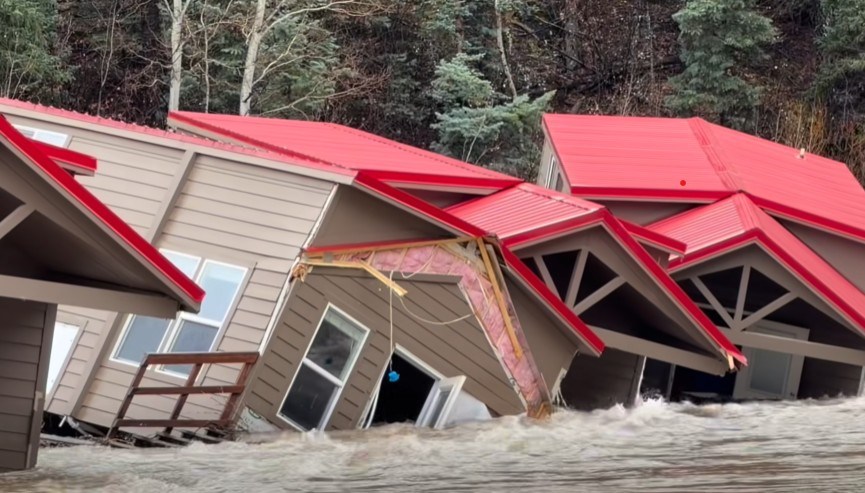
As the floodwaters recede in southwestern Colorado, response teams are just starting to gauge the extent of devastation .
“It’s not going to be fixed immediately,” Southwest Incident Management Team Commander Doug Fritz told residents gathered for a Monday night community meeting in South Fork. “It’s going to take awhile. That’s the bad news.”
Severe flooding swept across at least 12 Colorado counties last week, prompting Gov. Jared Polis to issue a disaster emergency declaration. That includes Alamosa, Archuleta, Conejos, Dolores, Hinsdale, La Plata, Mineral, Montezuma, Ouray, Rio Grande, San Juan and San Miguel counties.
The declaration activated the Colorado National Guard to support areas impacted by flooding, including evacuation and search-and-rescue efforts. As of Tuesday morning, the Guard had helped rescue 33 stranded residents and more than a dozen pets, mostly in Archuleta County spokesperson Staff Sgt. Patrick Crosley said.
“We don’t know the condition of all the roads,” U.S. Forest Service District Ranger Patrick Moran said during the South Fork community meeting. “We have hundreds and hundreds of miles out there, and we have people getting stuck and needing rescue.”
Those rescue efforts are pulling resources from the local damage assessments and repairs in Rio Grande County “because the sheriff and her team are having to break off to assist with that,” he said.
With snow on the ground in some parts of the high country and more in the forecast, the full extent of the forest damage may not be visible until the spring, Moran said.
As of Tuesday morning, most counties had switched to recovery mode and were working to assess damage.
About 800 structures, including 540 homes, in Archuleta County were affected by the floods, Archuleta County Commissioner Warren Brown told a crowd gathered in Pagosa Springs on Tuesday night. About a quarter of the county’s roads remained impassable, and hunters were stuck behind at least four impassable Forest Service Roads, officials said.
“We sustained the Rio Blanco Fire, then 12 weeks later we have these October floods. As a county, we have certainly endured some major incidents in the last year,” Sheriff Mike Le Roux said Tuesday night. “We truly are, I believe, a resilient community.”
South Fork Fire Rescue officials said several homes and businesses in Del Norte and Monte Vista had been affected, but the exact number was not available. The Colorado Division of Fire Prevention and Control estimated Tuesday that the number of homes impacted was in the hundreds. Numerous local roads and state highways remained closed, and several bridges had been washed away.
A video posted by Fun Family Valley Resort, which sits about 5 miles outside of South Fork, appeared to show tipped recreational vehicles, flooded campgrounds, an underwater minigolf course and cabins partially submerged in the flooded Rio Grande River.
Last week’s storm, fueled by tropical moisture from the Pacific Ocean, dropped more than 5 inches of rain on the San Juan Mountains and surrounding areas in southwest Colorado. In Pagosa Springs, the San Juan River rose from 5 feet to more than 15 feet, the river’s highest crest in 115 years and higher than last year’s “100-year flood,” town leaders said.
The National Weather Service initially expected rivers to reach similar levels to last year, rushing about 3,000 cubic feet per second, South Fork Fire Rescue Cpt. Tyler Schmidt said Monday.
“Being familiar with those flood levels and what the river did last year, we were pretty confident in our ability to mitigate that effectively,” Schmidt said. “Most of our sandbagging from last time was already in place; we sent out some recon teams … looking at those old roads and assessing the further needs of those areas.”
By Thursday night, the rivers’ forecast flow had more than doubled, and first responders “had no idea what the impact was going to be,” he said.
The first mandatory evacuations were issued that night when a rising river took out the Park Creek Bridge, sending a large debris flow down the river, Schmidt said. At least two other nearby bridges and several local roads were damaged, Moran said.
“The water levels were way more intense than anyone anticipated,” Rio Grande County Administrator William “Skip” Schoen said. “The weather forecast didn’t quite get it right.”
No injuries or fatalities have been reported in Mineral or Rio Grande counties, a fact that Rio Grande County Sheriff Anne Robinson called “miraculous.”
As of Tuesday, mandatory evacuation orders remained in effect for:
The following roads remained closed, according to the Colorado Department of Transportation:
Colorado 151 is closed in both directions between Forest Service Road 613 and U.S. 160, where floodwaters damaged and washed away parts of the highway, according to the Colorado Department of Transportation.
U.S. 160 reopened to traffic Tuesday afternoon, but drivers should prepare for single-lane alternating traffic at multiple spots along the route where damaged parts of the road are being repaired.
This is a developing story and may be updated.
Get more Colorado news by signing up for our daily Your Morning Dozen email newsletter.