
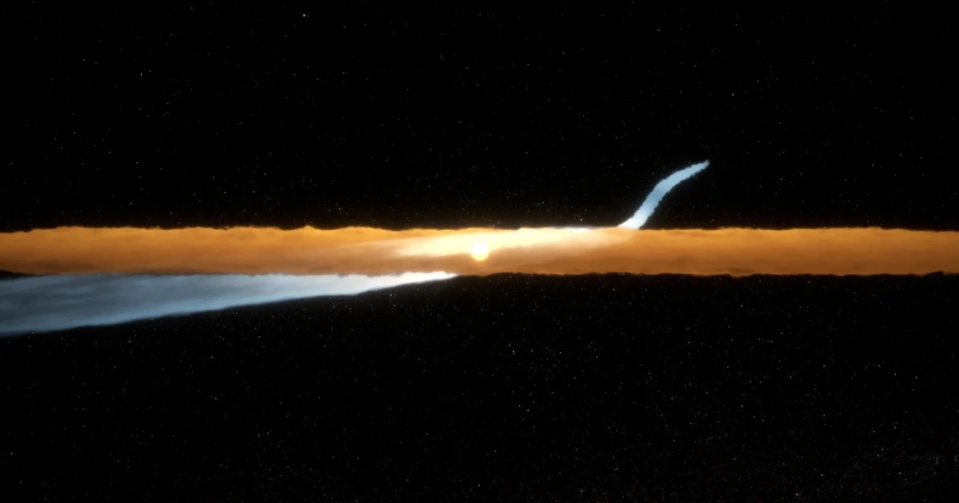
TUCSON, Ariz. (KVOA) — A massive, mysterious space structure nicknamed the “Cat’s Tail” is providing new clues about a violent cosmic collision 63 light-years away.
Astronomers with the University of Arizona captured previously unseen details of the dark feature in visible light using the Hubble Space Telescope.
Led by University of Arizona planetary scientist Arin Avsar, the research team analyzed the structure within a young solar system’s debris disk known as Beta Pictoris, according to a study published in The Astrophysical Journal Letters. The “Cat’s Tail” stretches across an abyss of space about 1,000 times the average distance between the Earth and the sun, which is equivalent to about 200 trillion house cats lined up tail to snout.
Arin Avsar, a University of Arizona doctoral student who works in the university’s Lunar and Planetary Laboratory and Steward Observatory, explained the significance of the discovery.
“The Cat’s Tail is thought to be the aftermath of a collision between large bodies – think something like Pluto,” Avsar said. “Oddly, this feature had previously only been seen with the James Webb Space Telescope, which detects infrared light, but remained invisible at shorter wavelengths, which has puzzled the community for a while.”
Researchers believe the structure eluded visible light observations because it consists almost entirely of heavily carbon-based organic refractory material, according to university officials. This material absorbs visible light, making it appear black. The dust grains are also extremely porous and fluffy.
“How you can get dust grains that small that are as porous as we see here, no one really understands, and that’s part of why we study this feature,” Avsar said.
The team used computer modeling to determine the structure extends straight sideways relative to Earth. They also identified a strange warp in the surrounding dust halo, likely caused by a gas giant planet 10 times the mass of Jupiter.
According to Avsar, these findings offer another clue to the processes that likely shaped the early solar system, showing how massive planets influence surrounding dust and icy bodies.