
Halloween gives us plenty of imaginary threats to fear: ghouls, goblins, your neighbor trying to dress like Kid Rock, and the monster under the bed (which, admittedly, makes a compelling case for keeping your feet under the covers).
Infectious disease experts have a more consequential list, but what tops it isn’t usually what scares people most. Headlines about rare infections and unfamiliar diseases tend to ratchet up anxiety, but, say experts, some of the greatest dangers have become so familiar that we underestimate them.
There are big gaps between what the public most fears and the threats that actually cause the most harm, says Director of the Center for Infectious Disease Research and Policy (CIDRAP) Michael Osterholm, PhD, MPH. “There’s often a lot of confusion between what kills you versus what hurts you versus what concerns you versus what panics you.”
This Halloween, we asked Dr. Osterholm to outline the top three infectious disease threats that concern him the most and what people can do reduce their risk. And, in true Osterholm fashion, he provided four bonus scares.
Threat #1: Respiratory diseases
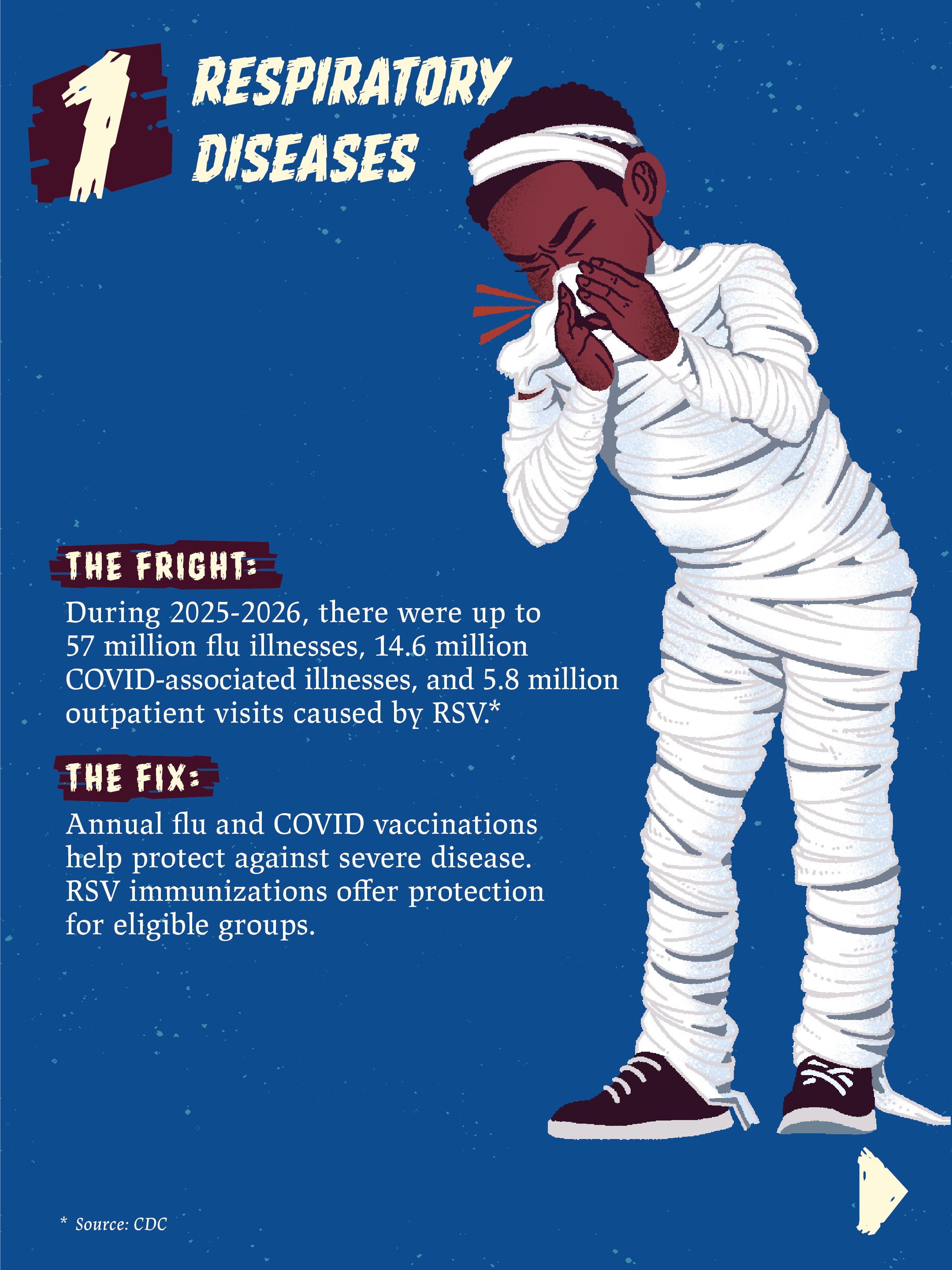 Influenza is so much a part of the fabric of fall and winter that most people barely register it as a threat. COVID-19, too, has receded in the public imagination, becoming just another illness we hope to avoid. And respiratory syncytial virus (RSV) often resembles a common cold, making it easy to overlook, despite it being the leading cause of hospitalization among infants in the United States and hitting older people hard as well.
But familiarity doesn’t make these diseases innocuous. During the 2025–26 respiratory virus season, the CDC estimates there were up to 57 million flu illnesses, 390,000 flu-related hospitalizations, and 81,000 deaths. Before that, the 2024–25 flu season was the highest-severity flu season in more than a decade, with hospitalization rates up to 2.8 times higher than the historical median and 280 pediatric deaths—the most in any non-pandemic flu season since pediatric flu deaths became reportable in 2004.
COVID’s toll has declined considerably since the height of the pandemic, but the virus remains a substantial public health threat, especially for older adults, infants, pregnant women, and people with compromised immune systems. During the 2025–26 respiratory virus season, COVID was associated with an estimated 5.2 million to 14.6 million illnesses and as many as 2.7 million outpatient visits, 270,000 hospitalizations, and 48,000 deaths nationwide.
Infants and older adults are at the greatest risk for severe RSV-related disease. During the 2025–26 season, RSV caused an estimated 2.8 million to 5.8 million outpatient visits, 170,000 to 340,000 hospitalizations, and as many as 25,000 deaths.
“When you look at the morbidity and mortality each year in this country from respiratory diseases, it’s remarkable,” says Osterholm. The toll is particularly striking, he says, given the resources available in the United States.
“When we see several hundred children dying in a year from an infectious disease in this country, we have to ask ourselves, ‘How could that happen?’” he says. “We’re not living in a country that has unsafe water supplies or lack of medical care.”
Getting annual vaccinations against flu and COVID remain the best way to protect against severe disease. RSV immunizations offer protection for eligible groups. For guidance on who should receive immunizations and when, Osterholm directs people to the American Medical Association’s website, which compiles recommendations by age, medical status, and vaccine.
One thing to remember, says Osterholm, is that the protection provided by different vaccines varies. For respiratory infections, for example, vaccines help protect against severe disease more than against infection itself.
“When you get to COVID and the flu in particular, you’re talking about not necessarily protecting against infection. You get relatively low protection from those vaccines,” says Osterholm. “What’s really important is that they are very effective at reducing serious illnesses, hospitalizations, and deaths, and if you could have an infection that lays you up for a few days but doesn’t send you to the hospital or the ICU [intensive care unit], that’s really worth it. And that’s what those vaccines do.”
Threat #2: Antibiotic resistance
 “If you were to do a quiz on antibiotic resistance [AMR] and offer $1 million to people who get all the answers right,” says Osterholm, “you could probably keep your million dollars.”
The problem of bacteria changing in ways that allow them to survive the medication designed to kill them doesn’t grab a lot of headlines. And it can feel like a diffuse, distant problem—something happening to other people or gathering momentum for a future catastrophe, rather than a threat that deserves attention now.
“People forget how many people die every day in this country from antimicrobial-resistant infections,” says Osterholm. And mortality isn’t the only concern. Resistant infections make treatment more difficult, while the development of new antibiotics struggles to keep pace.
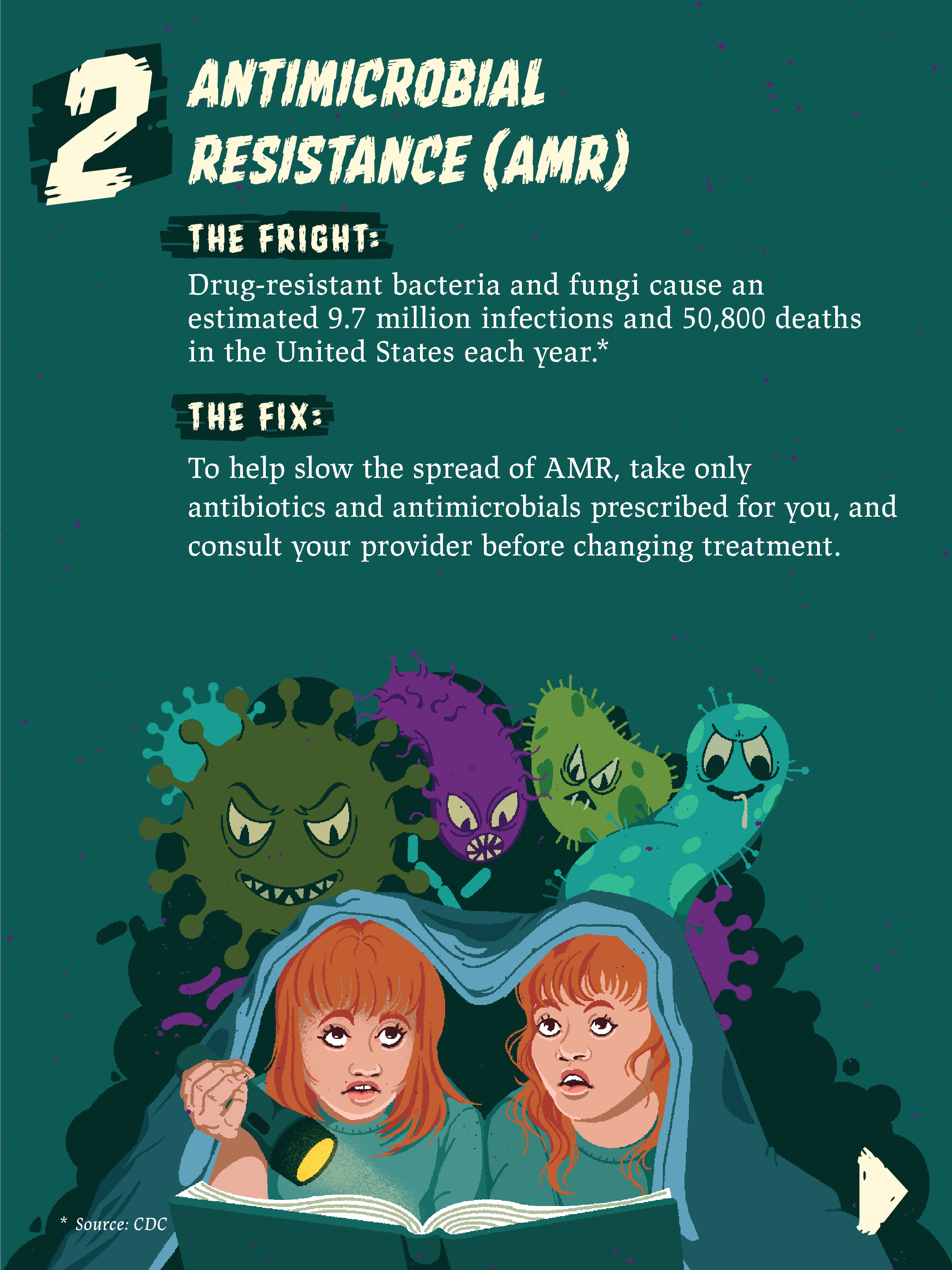
According to the CDC’s Antimicrobial Resistance Threats Report, drug-resistant bacteria and fungi cause an estimated 9.7 million infections in the United States each year, up from an estimated 2.8 million in 2019. A 2022 study estimated that AMR directly caused 1.27 million deaths worldwide in 2019 and was broadly associated with 4.95 million deaths.
More recent research, drawing on data submitted by more than 100 countries, found that one in six laboratory-confirmed bacterial infections were resistant to antibiotics in 2023.
As resistance spreads, treatment often requires more antibiotics. Yet antibiotic overuse can perpetuate the problem, creating conditions that favor resistant bacteria. For example, antibiotic overuse can disrupt the protective microbes in the gut, which makes the gut more susceptible to serious infections with pathogens like Clostridioides difficile (C diff), a potentially life-threatening infection of the colon.
“It causes severe diarrhea and even potentially fatal diarrhea,” says Osterholm. C diffis estimated to cause half a million infections annually in the United States.
Most cases of C diff happen while or shortly after taking antibiotics, notes the CDC—and most cases require treatment with specific antibiotics. It’s a cycle that illustrates the tricky balance in working responsibly with antibiotics.
“This is a slow-motion crisis,” says Osterholm.