
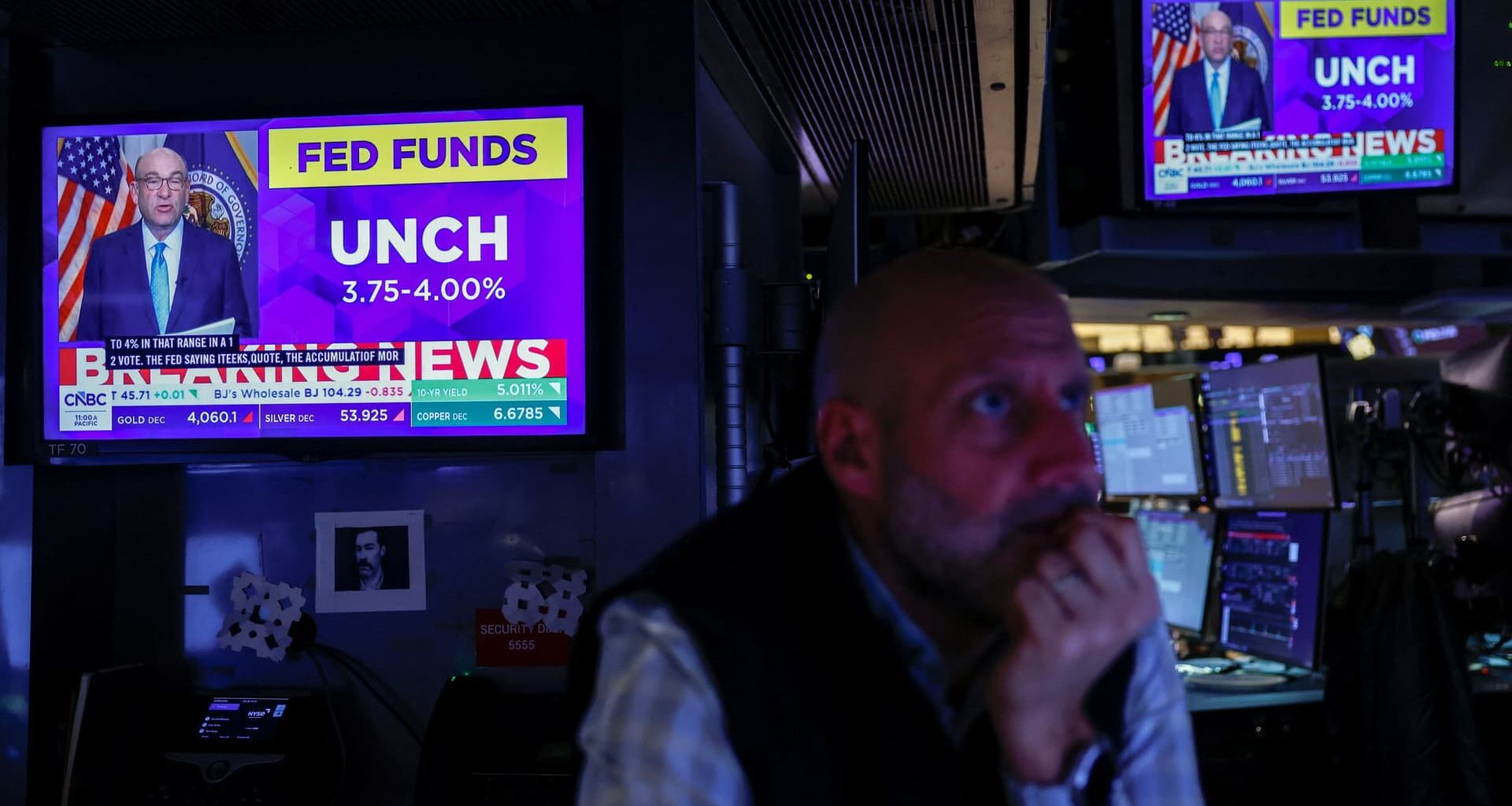
Screens display the Fed rate announcement as traders work on the floor of the NYSE in New York City, US, Oct. 28, 2026.
Jeenah Moon | Reuters
Stock futures were under pressure Thursday, weighed by the latest batch of corporate earnings.
Nasdaq-100 futures shed 1%, while futures tied to the S&P 500 slipped 0.2%. Dow Jones Industrial Average futures hovered around the flatline.
Alphabet lost 10% in premarket trading after it missed expectations on adjusted earnings per share and revenue in the third quarter. The Google parent posted negative free cash flow of $9.07 billion. The company kept its full-year capital expenditures forecast at $195 billion to $205 billion.
Caterpillar shares slid 9%. While the industrial giant reported better-than-expected revenue and earnings for the third quarter, sales for its construction industries business came in slightly below estimates.
In contrast, Microsoft was up 2.6% in premarket trade, after growth in the software giant’s Azure cloud infrastructure business helped it post beats on the top and bottom lines in the fiscal first quarter, per LSEG.
Neoclouds fell as Microsoft’s lower-than-expected capital expenditures figure pointed to infrastructure partners taking longer to deliver data center capacity.
The results come as the artificial intelligence trade is in focus. AI stocks, such as the iShares Semiconductor ETF (SOXX) and the Roundhill Memory ETF (DRAM), have been through a rough patch for most of October, only to perk up in recent days.
On Wednesday, the Federal Reserve decided to hold steady on rates, leaving the central bank’s benchmark interest rate in a range between 3.75% and 4%. The decision to hold was widely expected as the Federal Open Market Committee issued a quarter-percentage-point hike in September.
This time, central bank policymakers pointed out that inflation “remains elevated,” but also said that it was awaiting the “accumulation of more information” before it takes further steps.
The Fed’s decision “can be interpreted as mildly dovish at the margin, but we think it is better viewed as an expression of patience rather than a shift away from a tightening bias,” said Daniel Siluk, head of global short duration and liquidity at Janus Henderson Investors. “The door remains open to further tightening, but the Committee appears willing to wait for incoming data to validate the need for additional action.”