
The clinical application of a high-precision gene-editing technique opens new perspectives for treating hereditary diseases, although important questions remain about its safety, efficacy, and ethical implications.
The scientific journal Nature recently published a news item by Heidi Ledford entitled “A first for CRISPR: powerful prime editing alters DNA directly in the human body,” in which she reports an important advance in the field of gene therapy: the first known clinical application of a technique called prime editing (precision gene editing) to directly modify a person’s DNA within their own body.
The procedure is part of a clinical trial aimed at treating Wilson’s disease, an inherited disorder that causes an abnormal accumulation of copper and can lead to severe liver and neurological damage. Although clinical results confirming its effectiveness are not yet available, the start of this treatment represents a significant step toward medicine capable of correcting certain genetic alterations at their source.
What does the new gene-editing technique involve?
Since the advent of CRISPR-Cas9, the possibility of modifying the DNA of human cells has generated enormous expectations. This technology allows scientists to locate specific sequences in the genome and make modifications that can be useful for correcting inherited diseases.
However, the first CRISPR techniques had some limitations. The best known, CRISPR-Cas9, uses an enzyme capable of cutting both strands of DNA at a specific position. Subsequently, cellular repair mechanisms act upon this break, allowing for modifications, but this can also produce unwanted alterations.
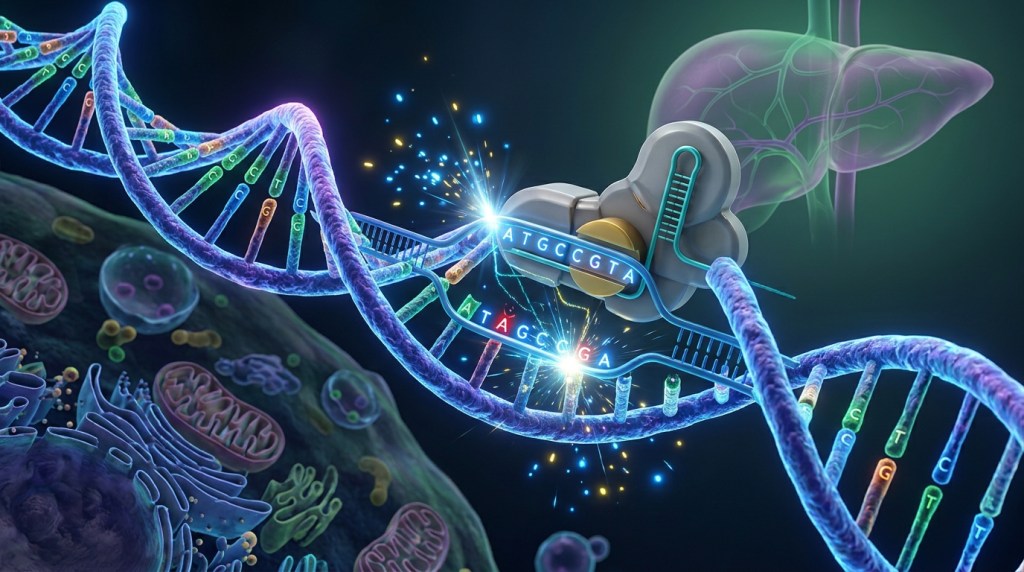
Prime editing represents a significant improvement to this procedure. Instead of relying on a complete break of both DNA strands, it uses a modified version of Cas9, combined with a reverse transcriptase and a specially designed guide RNA.
This system allows you to locate a genetic sequence and write the desired modification into it, in a way that could be compared to the find and replace function of a word processor.
Its main advantage is that it can perform different types of corrections: replacing specific DNA bases, introducing new sequences, or removing small fragments. Furthermore, by avoiding the double-strand breaks that characterize the conventional CRISPR-Cas9 system, it can reduce some risks associated with DNA repair, although it does not completely eliminate the possibility of errors.
Wilson’s disease: a genetic disorder that prevents the elimination of copper
Wilson’s disease is a hereditary condition caused by mutations in the ATP7B gene, which is responsible for producing a protein involved in copper metabolism and elimination.
Copper is an essential element for the normal functioning of the body. However, when it accumulates in excessive amounts, it can be toxic. Under normal conditions, the liver helps regulate its concentration and facilitates its elimination through bile.
In people with Wilson’s disease, the genetic alteration prevents this function from being performed properly. As a result, copper progressively accumulates in the liver and can also be deposited in the brain and other organs.
Currently available treatments, such as chelating agents and zinc salts, can control the disease in many patients, but generally require prolonged administration. In cases of severe liver failure, a liver transplant may be necessary.
The possibility of correcting the genetic alteration in the liver cells themselves offers a different perspective: instead of just controlling the consequences of the disease, the aim is to act on its molecular cause.
A treatment performed directly on the body
One of the most novel aspects of this clinical trial is that the genetic modification is performed in vivo, that is, directly inside the organism.
Until now, some of the most advanced clinical applications of gene editing have been performed using ex vivo procedures. In these cases, cells are extracted from the patient, genetically modified in the laboratory, and then reintroduced into their body.
In vivo editing eliminates the need to extract and manipulate cells beforehand. However, it presents an additional challenge: ensuring that the components responsible for the genetic modification reach the appropriate cells, act effectively, and do not cause harmful effects in other tissues.
The trial announced by Prime Medicine aims to correct the alteration of the ATP7B gene in liver cells. If the modification proves effective and sufficiently restores the function of the affected protein, it could reduce copper accumulation and improve the course of the disease.
It is important to note that treating the first patient does not yet prove that the technique is effective or safe in the long term. It will be necessary to determine what proportion of cells are corrected, how long the therapeutic effect lasts, and whether any unwanted genetic modifications appear.
The company expects to announce the first results of the trial during 2027.
What results have been obtained so far?
Preclinical studies conducted by Prime Medicine have shown promising results. In mouse models carrying the human H1069Q mutation, a high proportion of liver cells were corrected, and copper accumulation was reduced. Genetic modifications were also observed in hepatocytes from non-human primates.
These results provide a scientific justification for starting trials in people, but do not guarantee that the same effects will be reproduced in humans.
The experimental product, called PM577a, is administered via a single intravenous infusion. Lipid nanoparticles, small structures that protect the material needed for gene editing and facilitate its entry into cells, are used to transport its components to the liver.
The clinical trial, identified as NCT07748403, is in phase 1/2. It initially includes adults with Wilson’s disease who have the H1069Q variant and are clinically stable on standard treatments. It may later be expanded to include adolescents.
The researchers will evaluate the safety, tolerability, and potential effects on copper metabolism.
Ethical implications of gene editing
The development of this technology raises bioethical issues that deserve special consideration.
First, it is important to distinguish between gene editing for therapeutic purposes and interventions aimed at modifying or enhancing certain human characteristics.
In the case of Wilson’s disease, the objective is to correct a genetic alteration responsible for a serious illness. It is, therefore, a therapeutic intervention aimed at restoring a impaired physiological function. From a bioethical perspective centered on respect for human dignity, this aim can be considered morally legitimate, provided that the means employed are also legitimate and the requirements of safety and proportionality are respected.
Furthermore, the modification is performed on the patient’s somatic cells, specifically liver cells. It does not aim to alter reproductive cells or introduce genetic modifications transmissible to future generations. This distinction is crucial because human germline editing raises additional ethical issues related to its hereditary consequences and the impossibility of obtaining consent from future generations.
A second issue is safety. Although prime editing offers potential advantages over other gene-editing techniques, it is still necessary to determine whether it can cause unintended modifications in other regions of the genome, persistent cellular alterations, or adverse effects that may appear after several years.
Therefore, the principle of non-maleficence requires a rigorous risk assessment. It is not enough to demonstrate that a technology is capable of correcting a mutation: it is necessary to verify that the expected clinical benefit justifies the risks assumed.
Informed consent is also essential. Participants must understand that they are receiving an experimental treatment, the benefits of which have not yet been demonstrated and whose long-term consequences are not fully known. The severity of the disease should not be used to generate expectations of a cure that the available evidence does not yet support.
Finally, the issue of distributive justice arises. Advanced gene therapies are often expensive, both due to their development and the complexity of their manufacture and administration. If these interventions prove effective, it will be necessary to find mechanisms to ensure access for patients who need them, preventing scientific advances from exclusively benefiting those with greater financial resources.
A new stage in genetic medicine
The first administration of a prime editing-based therapy directly into the human body constitutes an important, but still initial, advance in the history of gene editing.
Their interest is not limited to Wilson’s disease. If it can demonstrate a favorable safety and efficacy profile, this technology could open new possibilities for treating other inherited diseases caused by specific mutations.
However, it is necessary to maintain a clear distinction between the technological capacity to modify DNA and the clinical demonstration that this modification produces a real and lasting benefit.
Medicine does not progress only when it manages to develop increasingly sophisticated procedures, but when these effectively improve people’s health without subjecting them to disproportionate risks.
From this perspective, the advance reported by Nature represents a reasonable hope for the treatment of certain genetic diseases. Its true impact will depend on the results of clinical trials and the ability to integrate scientific innovation with the ethical requirements that must guide all medical intervention.
The goal of therapeutic gene editing should not be to arbitrarily transform human nature, but to correct alterations that compromise its functioning and contribute, through proportionate procedures that respect the dignity of the person, to restoring health.