
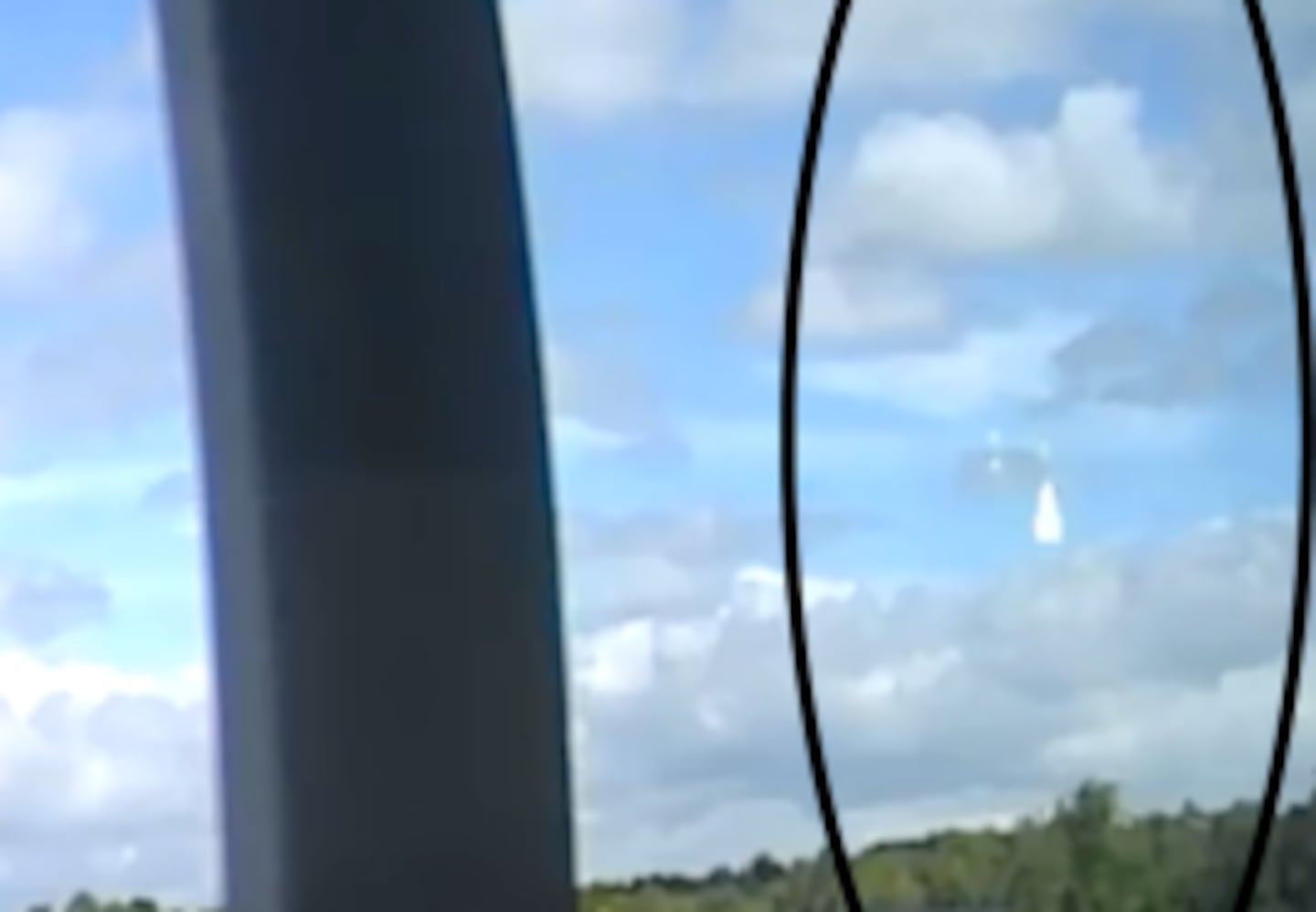
Remember that spectacular meteor that lit up the blue skies over Massachusetts on May 30, crashing into Cape Cod Bay and sending a sonic boom across the region?
A group of scientists and researchers from around the globe has pieced together the meteor’s origins — culling an extraordinary amount of information about not only the space rock, but its path before it slammed into Earth’s atmosphere.
Researchers combined meteor radar, conventional weather radar, satellite observations, and atmospheric pressure sensors to reconstruct its journey, and the results were astonishing.
For starters, this wasn’t just your average shooting star. This meteor was classified as a “superbolide,” meaning it was exceptionally bright and was roughly 12,000 pounds and about 5 feet wide before entering our atmosphere.
 Video of the meteor crashing to Earth on Saturday afternoon off the coast of Massachusetts, into Cape Cod Bay.Dan Wilcox
Where did the meteor come from?
By reconstructing the meteor’s trajectory and running its path backward through space, researchers determined that this space rock had traveled quite far. The meteor’s farthest point was positioned roughly 4 times Earth’s distance from the Sun, placing the Cape Cod meteor in the region of Jupiter’s orbit. That would mean this space rock likely traveled all the way from our solar system’s main asteroid belt between Mars and Jupiter, or from a comet near Jupiter.
Its orbit had an average distance from the Sun of around 227 million miles. Earth’s average distance from the Sun is 94 million miles.
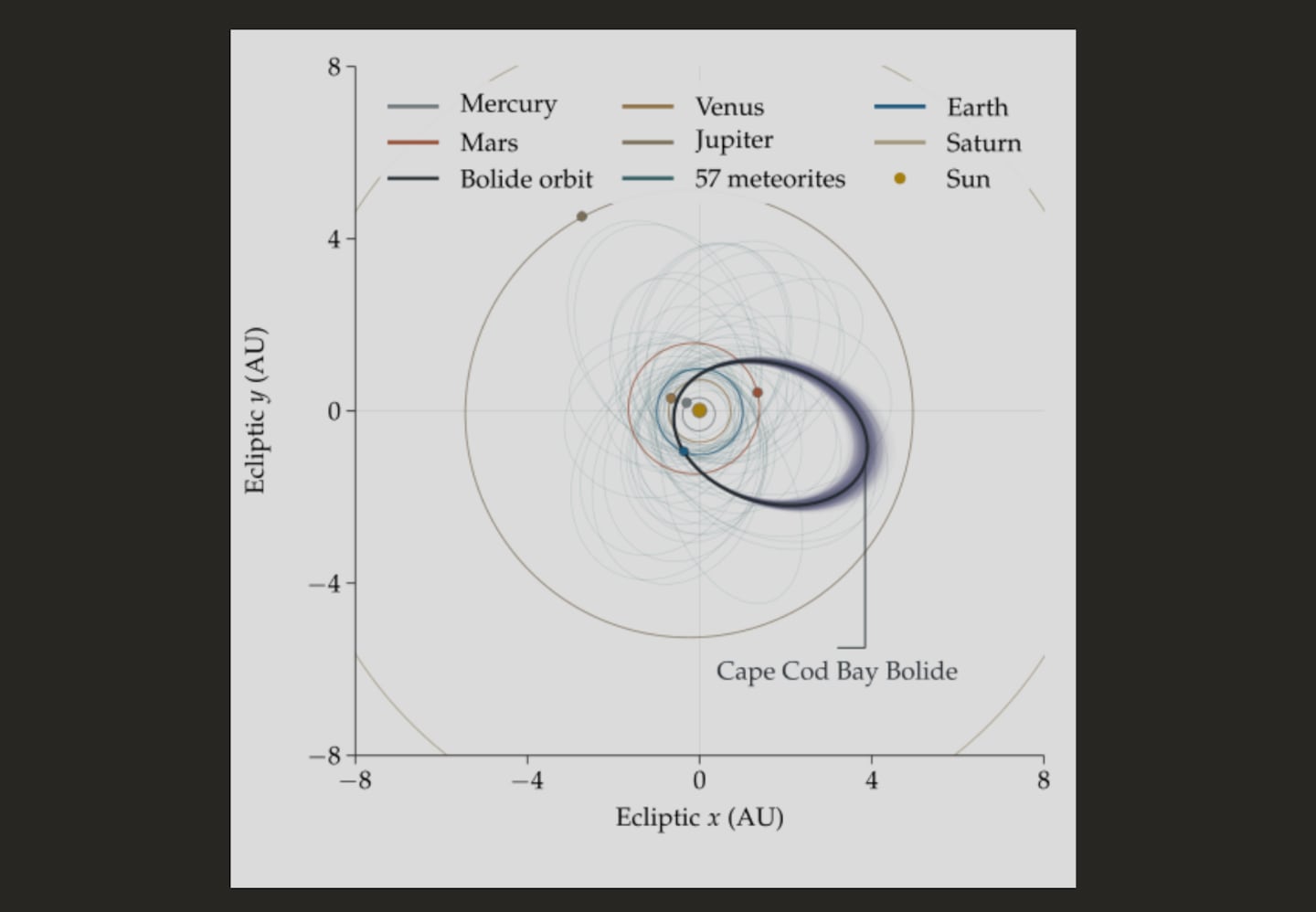 The solid dark curve shows the general superbolide orbit, intersecting with Earth.The Astronomical Journal
A 58,000-mph arrival at Earth
This meteor was moving at nearly 58,000 miles per hour when it blasted through Earth’s atmosphere, becoming a meteorite, according to the research findings published in The Astronomical Journal. At that speed, it could essentially travel from Boston to New York City in under 25 seconds.
As the meteor burned up in our atmosphere, NASA estimated its energy release at around 1.1 kilotons or 1,100 tons of dynamite. The findings suggest a less intense but still highly dcharged energy release closer to 0.5 kilotons (500 tons) of dynamite.
Leveraging nearly 200 atmospheric pressure sensors, scientists were able to track the shock waves generated by the meteor across Massachusetts and other parts of New England. That’s an enormous amount of energy that many of us heard released from high above Cape Cod Bay.
Rare meteor explosion shakes homes across New England on May 30, 2026
A loud “boom” was heard across New England as a 3-foot meteor entered the atmosphere on May 30, 2026.
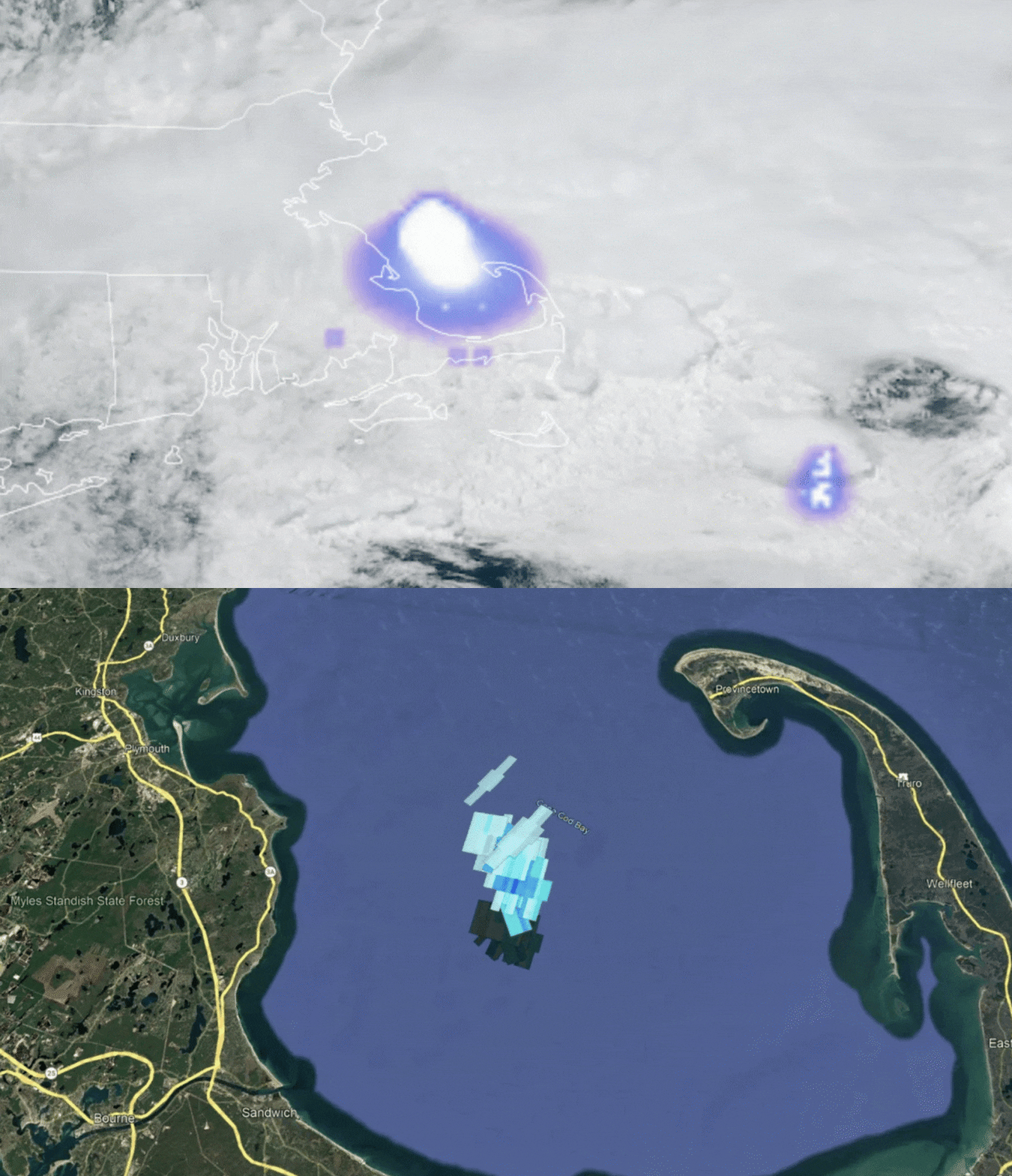 Satellite and radar imagery capturing the meteor crashing into Cape Cod Bay.NOAA
The researchers also noted that the meteor was unusually dense and mechanically strong — meaning it was most likely rich in iron, with fragments likely surviving the fiery trip through the atmosphere and landing into the bay. Some models suggest pieces may range from just a few ounces to around 3 pounds.
For those interested in going for a little boat ride, fragments are estimated to be within a 1.9-by-2.3-mile area near the center of Cape Cod Bay. The maximum depth of water in Cape Cod Bay is around 200 feet.
This was an exceptionally rare event, and we may never experience something this so close to home again.
Ken Mahan can be reached at ken.mahan@globe.com. Follow him on Instagram @kenmahantheweatherman.