
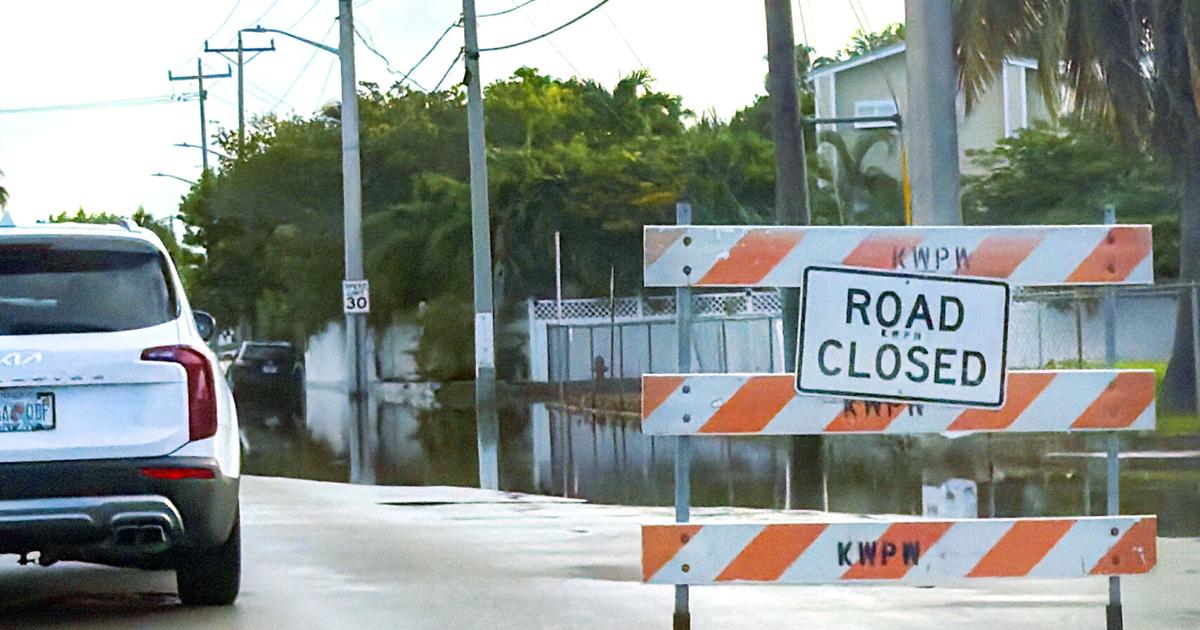
The National Weather Service on Thursday said Coastal Flood Warnings remain in effect for the entire Florida Keys through at least Friday, Oct. 30, as high tides are from 2 to 3 feet above normal, and saltwater flooding threatens property and impacts travel.
Prolonged strong, north-northeasterly winds off the Atlantic shores of Florida and the Southeastern U.S. earlier this week, combined with the recent full moon phase tide cycle, have combined to maintain unusually high water levels through the end of the week, according to agency’s latest daily briefing.
Multiple Florida cities this week have recorded their highest non-tropical water levels in decades, excluding from hurricanes, from Key West to Miami to Cape Canaveral.
Key West experienced its highest non-tropical water levels (MHHW) since 1913 this week, per NWS.
On Wednesday night, in a span of three hours, the high tide in the Atlantic Ocean surged across the street of Atlantic Boulevard in Key West and permeated the grounds and parking lots near the bocce ball courts and Indigenous Park.
Vehicles traveling on Atlantic Boulevard in this area near White Street were forced to turn around and head back in the other direction to find drier roads.
Many roads, such as Atlantic Boulevard, have been impassable at times. Low-elevation residences and businesses where access and parking are frequently impacted by annual king tide flooding have also experienced water intrusion and several inches of flooding.
Continuation of periodic major saltwater flooding of low elevation streets, parking lots, yards, and the overtopping of docks and piers will likely occur during the next few tide cycles, according to NWS.
Middle and Lower Keys residents should plan for higher-than-usual water levels during tide cycles through early Friday morning.
While peak overnight high tides will begin to lower at least 2 or 3 inches each late night, predawn hours beginning Friday night, the afternoon, evening high tide will gradually rise approaching the quarter-moon phase. This will likely continue the temporary mid-to-late afternoon flooding observed in the Middle and Lower Keys, repeating through the weekend.
Motorists are strongly encouraged to avoid driving through standing water whenever possible and, if available, seek alternate routes, Monroe County spokeswoman Kristen Livengood said.
The floodwater is saltwater, which can damage vehicles, particularly their electrical and mechanical components. If you must drive through standing water, Livengood said, proceed slowly to minimize wake that could push saltwater into nearby yards, homes, and businesses.
For additional information on saltwater flooding in the Florida Keys, visit https://www.weather.gov/key/coastal_flooding.