
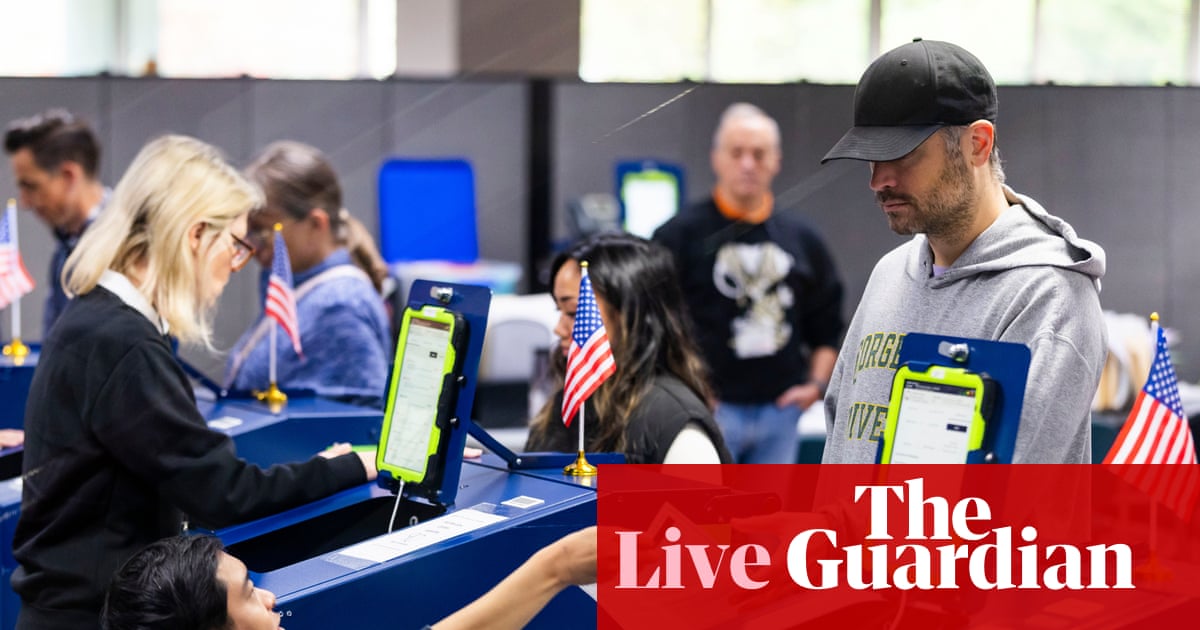
More than 50.5m early votes have been cast, far outpacing 2022 numbers Oliver Milman
There has been a surge of early voting for the US midterm elections, with millions more Americans going to the polls compared with the last such election amid a series of tight contests that will determine control of Congress.
More than 50.5m early votes have been cast across the US as of Saturday morning, according to an analysis by the University of Florida. This is already nearly 5m more votes than the total number of early votes made in the last midterm elections, in 2022.
Voter enthusiasm for Tuesday’s election appears to be strongest among Democrats, with 10.7 million registered Democrats voting so far, according to the states that collate such information, compared with 7.8 million registered Republicans.
These party affiliations are not indicative of actual votes cast but polling has shown widespread unhappiness with the presidency of Donald Trump and unusually close races in states usually won comfortably by Republicans.
Republicans are defending a 53-47 Senate majority in a midterm election in which the battleground map has expanded significantly, with Democrats aiming to pull off victories in traditionally conservative-leaning states such as Texas, Alaska and even Kansas that will allow them to take control of the Senate.
Updated at 12.38 EDT
Key events
A remote Alaskan town and major seafood producer reels from Trump’s policies Chris Stein
Located further west than the Hawaiian islands, Unalaska is closer to Beijing, Tokyo and Seoul than Washington DC. Most visitors arrive on flights from Anchorage, which cost at least $1,600 round trip and are prone to cancellation, due to the region’s unpredictable storms and fog.
But Unalaska is by no means a backwater. It has been the country’s most productive seafood port by volume for more than two and a half decades, and when its crab and pollock seasons are open, thousands of deckhands and processors arrive from elsewhere to work tough but well-paying jobs on boats offshore and in seafood plants crowded in the city.
Even here, the impacts of Donald Trump’s efforts to remake the US government in his image can be felt. Since Trump returned to the White House, the library, museum, public radio station and local government have had funding they relied on disrupted or canceled altogether. Longshoremen have been tasked with loading empty containers on to ships to avoid tariffs. And the soaring price for diesel has squeezed not just the seafood industry, but all of the nearly 4,300 residents of the city, who rely on the fuel for electricity.
“This whole town runs on diesel,” said Daneen Looby, a longtime Unalaska resident who sits on the city council and owns the Norwegian Rat Saloon. With distributors upping the fuel surcharges she pays for food and alcohol shipments, Looby is thinking of raising her menu prices. “I didn’t want to, but I kind of have to, otherwise I’m going to become a charity.”
Chris Stein reports from Unalaska:
ShareEl-Sayed, Stevens joint campaign event in doubt after renewed schism, Stevens’ fiance says
A planned campaign event between Abdul El-Sayed, Michigan’s Democratic nominee for Senate, and Haley Stevens, his erstwhile primary opponent, appears in jeopardy after a renewed feud between the two.
Jason Turkish, Stevens’ fiancé, was asked on Fox News on Saturday morning whether Stevens would go ahead with the appearance tomorrow.
“I don’t know where that stands,” Turkish replied.
El-Sayed and Stevens’ joint appearance – brokered as a sign of unity between two bitter Democratic primary foes in the final days of the midterm election – has started to unravel over an issue that fiercely divided the two during the primary: US support for Israel.
Stevens has indicated that she believed her appearance at the event was contingent on El-Sayed disavowing a campaign ad put out by an outside group, which attributed the rising cost of living in the US to American military support for Israel.
Haley Stevens and Abdul El-Sayed. Photograph: Getty Images
“Her only ask, small ask, was that we not blame all of society’s high cost on one group of people,” Turkish said on Fox News, explaining his fiance’s rationale. He added: “It puts Jews at risk.”
El-Sayed fired back on Saturday, accusing Stevens of “relitigating a primary that ended three months ago”.
El-Sayed has been an outspoken critic of Israel, and has said he would seek to end US military aid to the country. Stevens, meanwhile, was about as staunch a supporter of Israel as is likely to be found in the Democratic party.
Their primary contest in many ways encapsulated the growing rift between the pro- and anti-Israel wings of the Democratic party, amid a groundswell of voters increasingly displeased about the country’s ruthless campaign against Gaza and its escalation of wider conflict in the Middle East.
Updated at 12.35 EDT
More than 50.5m early votes have been cast, far outpacing 2022 numbersOliver Milman
There has been a surge of early voting for the US midterm elections, with millions more Americans going to the polls compared with the last such election amid a series of tight contests that will determine control of Congress.
More than 50.5m early votes have been cast across the US as of Saturday morning, according to an analysis by the University of Florida. This is already nearly 5m more votes than the total number of early votes made in the last midterm elections, in 2022.
Voter enthusiasm for Tuesday’s election appears to be strongest among Democrats, with 10.7 million registered Democrats voting so far, according to the states that collate such information, compared with 7.8 million registered Republicans.
These party affiliations are not indicative of actual votes cast but polling has shown widespread unhappiness with the presidency of Donald Trump and unusually close races in states usually won comfortably by Republicans.
Republicans are defending a 53-47 Senate majority in a midterm election in which the battleground map has expanded significantly, with Democrats aiming to pull off victories in traditionally conservative-leaning states such as Texas, Alaska and even Kansas that will allow them to take control of the Senate.
Updated at 12.38 EDT
Ads hammer Republican candidates on Epstein in final days before midterms
In races across the country, Democratic candidates or groups that support them have released ads accusing Republicans of protecting pedophiles by voting against legislation to release files related to Jeffrey Epstein.
The ads appear intended to evoke an emotional response by accusing candidates of “protecting” Epstein, a notorious pedophile accused of running a sex-trafficking ring involving minors.
An analysis from CNN found that candidates and outside groups have spent more than $35m on Epstein-related ads. Another from the Washington Post found that Democrats spent more than $40m on Epstein-related ads across six key Senate races.
In Colorado, ads targeting Republican Jeff Crank note that the lawmaker voted against releasing the Epstein files. In one, the family members of Virginia Giuffre, a woman who survived abuse at the hands of Epstein and died by suicide last year, claim Crank “covered up Epstein’s crimes to protect Donald Trump”.
Ashley Hinson, a Senate candidate in Iowa, was accused of voting to “protect her donors” by refusing to vote to release the Epstein files.
“This week I had to explain to my boys, ‘No, Mom does not protect pedophiles,’” Hinson said in a campaign ad responding to attacks over the Epstein files.
My colleague Ariana Baio has the story:
Updated at 11.25 EDT
DC, Virginia sue to halt construction of Trump’s monumental arch
Washington DC and the state of Virginia jointly filed a lawsuit on Saturday to prevent the Trump administration from moving ahead with plans for a 250ft arch the president envisions in the nation’s capital.
“This project is flagrantly unlawful,” the two plaintiffs said in their complaint, accusing the administration of trying to skirt around laws requiring them to consult and gain the consent of other parties before enacting a plan that would “transform the District’s physical landscape”.
It also alleged that the arch’s construction would place an exceptional burden on both Washington and Virginia, for which they would have to foot the bill.
“As soon as Defendants break ground on this project, they will inflict irreparable harm on both the District and Virginia,” the lawsuit read.
An artist’s rendering of Trump’s proposed arch. Illustration: US Commission on Fine Arts/Reuters
It continued: “During the three year period of construction, the Arch project will inevitably snarl traffic between the jurisdictions, produce pollution and stormwater runoff in the Potomac, interfere with emergency services, and pose numerous other challenges.”
The Trump administration has been undertaking something of a remodeling blitz in the nation’s capital (see: the demolished east wing of the White House) at the president’s behest, and at breakneck speed.
The lawsuit accuses the Trump administration of knowingly overstepping its bounds, and simply trying to move ahead with construction before the courts can catch up.
“This Court should not allow this effort to escape judicial scrutiny,” the lawsuit read. “It should declare the Arch unlawful, enjoin its construction, and ensure that Congress – and the people it represents – have the final say in any new monuments constructed in the Nation’s capital.”
Updated at 12.41 EDT
How Trump and his allies seek to interfere the US midterm elections Sam Levine
Donald Trump is waging a brazen effort to interfere with voting in this year’s midterm elections, escalating concerns that the federal government will try to slow down certification of election results – a strategy that could create chaos when the new Congress is seated next year.
Experts are certain the administration’s efforts to subvert America’s elections will not work. And some have bemoaned “fearmongering” about far-fetched scenarios that are unlikely to go anywhere in court.
But after the attack on the Capitol on 6 January 2021, voting lawyers and other democracy groups aren’t dismissing the possibility of anything.
The potential for interference is related to how close the contest winds up being, said Ned Foley, a professor at the Ohio State University and an expert on disputed elections.
“The more it looks like a blowout or a ‘blue tsunami’, the harder it’s going to be for any attempt to make mischief to get any traction,” he said.
“I put the probability of these impactful nightmare scenarios materializing at under 50%, so I’m not expecting them to make a difference,” he added. But he said there are “risks of weird things happening, and you need to pay attention to them even if the risk is rather low”.
The Guardian’s Sam Levine has the full story:
Updated at 12.41 EDT
At campaign stop, Peltola again denies recruiting second Dan Sullivan into Alaska Senate race
During a rally in Anchorage yesterday evening, Democratic candidate Mary Peltola denied she was aware of an alleged effort to stack the ballot in her Alaska Senate race.
Reporting from the New York Times last week indicated that top members of Peltola’s campaign staff were involved in an effort to recruit individuals with the same name as her main opponent, Republican incumbent Dan Sullivan, to join the race. One of those other Dan Sullivans ultimately wound up on the ballot.
“I am so deeply offended by these accusations about having any involvement with anyone else’s candidacy,” Peltola told the campaign crowd.
She added: “I’m not out soliciting more competition.”
Prior to the revelations of the Peltola campaign’s possible involvement, the Trump administration had moved to try to have the election results in Alaska blocked if the second, non-incumbent Dan Sullivan peeled away enough votes to change the outcome.
Since then, the president and other top Republicans have called for Peltola’s disqualification from the race and possible criminal prosecution. The governor of Alaska has announced the launch of a probe into the matter. (The tactic Peltola’s campaign allegedly employed, while underhanded, has been used elsewhere, and is not clearly illegal.)
Updated at 10.13 EDT
Affordability, AI and Iran: survey indicates key issues steering midterm voters
Maya Yang
Millions of Americans will head to the polls on 3 November in elections that will determine control of the Republican-held House of Representatives and Senate, as well as the governorships of 36 states.
The midterms come amid mounting public frustration over issues ranging from the rising cost of living and immigration to the climate crisis, artificial intelligence, big tech and the US’s overseas wars. Donald Trump’s approval rating has fallen to 36%, according to a New York Times/Siena poll conducted this month.
Voters across the US described to the Guardian their concerns and disillusionment with the current political climate, with one characterizing the country under the Trump administration as a “rogue nation, ungoverned by the rule of law”. (Some respondents only shared their first name or declined to share their name for privacy reasons.)
For many, the cost of living is a central concern ahead of the midterms, particularly as inflation reaches 3.7%.
Kathryn Warren, a retired staff member from Dare county schools who lives on Hatteras Island, North Carolina, said she and her husband had already voted early.
“We are dying on the vine in this economy. We live in a remote area and the cost of gas is taking a big chunk of our social security. Groceries and medicine are outrageous. The medicine that keeps me alive costs $7,000 a month before insurance. In what world is that reasonable?” Warren said.
My colleague Maya Yang has the full story:
ShareTrump boosted US coal plants with taxpayer dollars and ‘passes to pollute’
Hilary Beaumont
It’s a good time to be a coal plant in the US. The Trump administration has given support to almost half of the nation’s coal plants, helping them to continue operating despite economic and regulatory headwinds, according to a new analysis by the Environmental Defense Fund.
The analysis, which looked at the 184 operating coal plants that are connected to the grid, found that 90 received support from the Trump administration through “cash handouts, free passes to pollute, and requirements to stay online past their retirement dates”.
The administration provided $950m in taxpayer dollars to 24 coal plants and handed Clean Air Act exemptions from toxic pollution limits to 70 coal plants, according to the EDF analysis.
“It’s extending the life of these coal plants,” said Surbhi Sarang, director and senior attorney at the Environmental Defense Fund. “The administration has leveraged a multitude of tools to prop up coal plants, and ultimately all of that is harming Americans even more by increasing electricity costs, by increasing pollution – it’s like Americans are getting hit twice.”
My colleague Hilary Beaumont has the full story here:
ShareJudge bars DoJ from threats to election workers as Trump to hold tele-rallies
Hello and welcome to the US politics live blog.
Donald Trump is tele-rallying from Mar-a-Lago with just three days to go before the midterm elections. On Sunday, he will make appearances at rallies in Iowa in Kansas in a reversal after he initially backed out.
With control of the US Congress on the line, next week’s midterm elections amount to a referendum on Trump, who has repeatedly urged voters to pretend he is himself on the ballot, as his approval ratings continue to decline.
Late on Friday, a federal judge barred Trump’s justice department from threatening or coercing election workers to stop processing ballots, the Associated Press reported. The decision also bars the department from demanding local election officials segregate or not count ballots that the federal government deems may have been cast by ineligible voters.
It marked another blow to the Trump administration’s efforts to assert control over local elections, after a federal appeals court on Friday rejected the Department of Justice’s request for California to sequester 20,000 disputed ballots.
In other developments:
The top federal prosecutor in Alaska confirmed on Friday the existence of a criminal and a civil investigation into an alleged scheme by Mary Peltola’s campaign and national Democrats to confuse voters in the closely watched Senate race by recruiting a spoiler candidate who shares a name with the Republican incumbent, Dan Sullivan.
Michigan Democratic Senate candidate Abdul El-Sayed resisted a demand from his defeated primary rival, congresswoman Haley Stevens, that he apologize for criticism of US military aid to Israel on Friday – two days before they were scheduled to campaign together in Detroit.
Early voting this cycle has set a record. More than 49 million Americans have already cast ballots, either in person or by mail, the Associated Press reported.
Stick with us for more updates throughout the day.
Updated at 09.04 EDT