
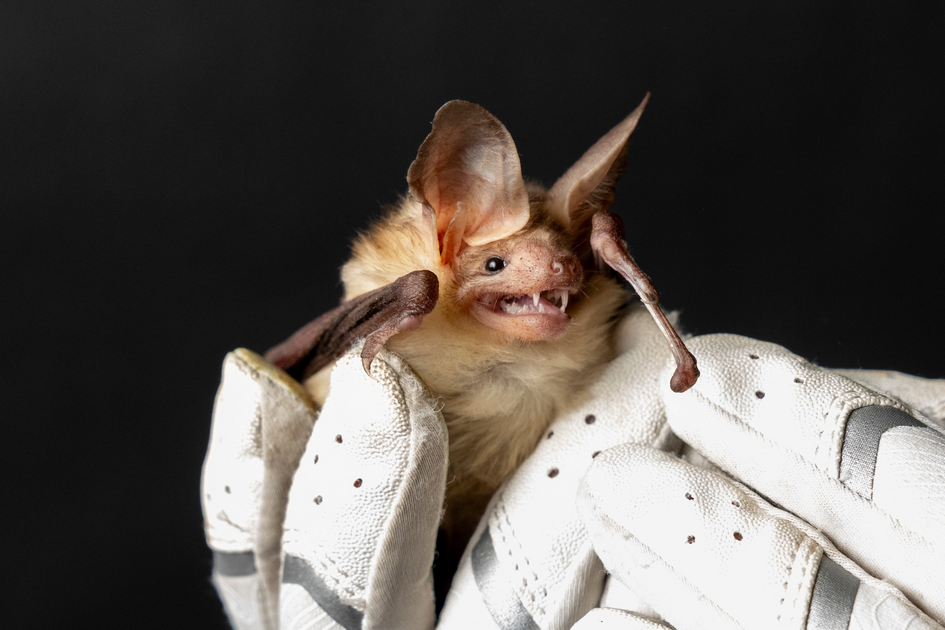
Unless you go out of your way to look for them, you’d never know there are bats in Golden Gate Park. By day, they’re hidden, sleeping upside down in the branches, hollows, and bark of old cypresses and eucalyptuses. When they emerge at night, they’re like flying shadows you can scarcely hear or see. They’re so elusive that even longtime park gardeners say they’ve never seen them.
But “they’re there, and there’s a lot of them,” said Kristin Tièche, a San Francisco filmmaker whose recent documentary is aptly titled “The Invisible Mammal (opens in new tab).” Every so often, she heads to the park in search of these symbols of Halloween, a practice she calls “batting.”
It’s hard to say how big the park’s bat population is, because no one is keeping track, and even if they were, bats are notoriously difficult to count. Since some species migrate, numbers may vary by season. But the park is likely home to many of the 12 species native to the Bay Area, according to Winifred Frick, chief scientist at Bat Conservation International (opens in new tab).
 Kristin Tièche uses a bat detector at Blue Heron Lake in Golden Gate Park in San Francisco on October 7.
Peak batting season is summer and early fall, when the weather is warm, bugs are plentiful, and the pups are starting to fly. On an evening in late August, I joined Tièche at Blue Heron Lake. The park’s lakes are the best batting spots because the water attracts the insects bats feed on, such as midges, mayflies, moths, mosquitos, caddisflies, and beetles.
As we sat at a picnic table waiting for dark, Tièche set up her Echo Meter “bat detector” — a red plastic device about the size of a Zippo lighter that can be plugged into a phone or iPad. It picks up the ultrasonic sounds bats use to echolocate and communicate with one another. Companion software then processes the sounds to identify the type of bat.
Acoustic monitoring technology has “really revolutionized the field of bat studies,” said Jessie Bunkley, community science and engagement manager at Bat Conservation International. High-end acoustic monitors are helping scientists gain insights into bat behavior and track movements and migration patterns without having to trap the tiny creatures. Meanwhile, inexpensive devices like the $179 Echo Meter Touch 2 that Tièche uses are a boon for the merely curious. Just as Merlin and other bird-ID apps allow amateur birders to better experience the species around them, “this technology is opening a window into the world of bats for everybody,” said Bunkley.

Bats are not to be feared, Quirk tells people. They play vital and underappreciated roles in the ecosystem.

Devices like the $179 Echo Meter Touch 2 are a boon for the bat-curious.
About 10 minutes after sunset, Tièche’s iPad lit up with little chirps and a series of bright red and green lines, evidence that a bat was present. A moment later, we saw the creature animating her screen: a small figure skimming fast and low, just above the water. The detector identified it as a hoary bat. “But it might not be,” Tièche said. The Echo Meter is not as precise as research-grade acoustic monitors and can confuse calls from different species that use similar frequencies. The sounds could have come from a Mexican free-tailed bat, common in the Bay Area.
A minute later, the iPad lit up again with higher-pitched chirps: the sounds of a pair of little brown bats flying in circles around the edge of the lake before disappearing into the darkness.
Soon, the detector was a jukebox of chirps, some squeaky and high, others low and hollow-sounding, like the noise of a suction cup. A scrawl of red and green lines zigzagged across the iPad screen, following the frequencies emitted by the various species. Lots of bats, it seemed, were out cruising for dinner, though few were visible. The detector picked up calls from big brown, silver-haired, and little brown bats — and, depending on its accuracy, possibly hoary or Mexican free-tailed bats. “It’s a bat party,” Tièche said gleefully.
But it’s a party most park visitors miss. Evening strollers passed without so much as a glance in our direction or up to the sky. Tieche nodded toward one couple as they walked by. “They have no idea that there are bats, right?” she said.
 Peak batting season in San Francisco is summer and early fall, when the weather is warm, bugs are plentiful, and the pups are starting to fly. | Source: Amanda Andrade-Rhoades/The Standard
The bats’ nighttime behavior is all about finding food. After sleeping all day, they wake up hungry and desperate to fill their bellies with insects. They can eat their body weight in bugs every night.
“I call these guys the farmer’s best friend,” said Corky Quirk, executive director of Northern California Bats (opens in new tab), a Davis-based volunteer organization that rescues and rehabilitates injured and orphaned bats. Quirk also gives public education programs throughout the region, toting her “ambassadors” — rescued bats that can no longer fly — and a wealth of information to dispel fears about these often-misunderstood mammals. Bats, she tells people, play vital and underappreciated roles in the ecosystem. They’re pest controllers, pollinators, and, in the case of species that feed on fruit, seed dispersers. (Carry rabies? Yes, but only in tiny population.)
And these days, they need protection, Quirk says. Their populations are under threat from habitat loss, pesticides, climate change, wind farms, wildfires and, over the last two decades, a disease called white nose syndrome (opens in new tab). It’s caused by a fungus that grows a snowy fuzz on bats’ noses, skin, and wings while they’re hibernating. The disease disrupts the bats’ sleep, causing them to wake too often and burn through fat reserves they need to make it through the winter. WNS can wipe out an entire colony of hibernating bats.
The fungus was detected in California in 2018 (opens in new tab) and has since been confirmed in Humboldt, Sutter, Placer, Amador, and Inyo counties. As yet, there’s no evidence that it’s present in the Bay Area. But it has had a devastating impact elsewhere on at least one native species, the little brown bat, and has been found to infect or be carried by several others.

Bat populations are under threat from habitat loss, pesticides, climate change, wind farms, wildfires and, over the last two decades, a disease called white nose syndrome.

When Golden Gate Park’s resident bats emerge at night, they’re like flying shadows you can scarcely hear or see.
Experts hope Bay Area bats will be spared because the region lacks the cold, humid conditions in which WNS flourishes, and most of its bat populations don’t cluster in large colonies. “It’s something that researchers and conservation groups are tracking,” said Frick.
As cool as it is to see bats in the park, there’s an even better place to view them. Just outside Sacramento, a colony of some 250,000 Mexican free-tailed bats lives beneath a raised stretch of highway known as the Yolo Causeway. In summer, as dusk descends, bats come streaming out from under the causeway (opens in new tab) in a spiraling ribbon that’s been called a “batnado.” Quirk leads tours (opens in new tab) there during the season.
Needless to say, Tièche has visited. “It’s a stunning sight to see,” she said.