

Want to bookmark your favourite articles and stories to read or reference later? Start your Independent Membership today.
Already a member?
Log in
Smoke from Indonesia’s wildfires killed an estimated 3,560 people in September alone – twice the estimate for August – according to a new report.
The deaths from fire smoke made up about two thirds of the 5,310 deaths from all air pollution in Indonesia in September.
This marked a rise of 42 per cent from 3,740 in August, in a country of about 278 million people.
A further 1,750 deaths came from urban and industrial pollution.
The Centre for Research on Energy and Clean Air (CREA), a Helsinki-based think tank, estimated the deaths from short-term exposure to fine particle pollution, known as PM2.5, in the days after exposure, and gave a range of 4,610 to 6,080 for the total. The figures are estimates and not a count of recorded deaths.
Worsening air quality due to forest and land fires in Indonesia pushed the estimated death toll to 3,560 cases in September 2026, a twofold increase from the August estimate,” CREA said in a statement on Thursday.
A record 57.8 million people breathed air classed as unhealthy to hazardous in September, 40 per cent more than at the August peak of 41.3 million, CREA found. The number breathing hazardous-level air in Kalimantan, the Indonesian part of Borneo, nearly tripled from 2.8 million to 6.4 million on the worst days of the month.
Fire smoke accounted for between 94 and 99 per cent of air pollution deaths in four Kalimantan provinces and more than 80 per cent in several on Sumatra, the regions worst affected by the fires, CREA found.
Central Kalimantan had the highest death rate, at 14.1 deaths per 100,000 people in September, more than double the August rate.
On Java, the most populous island, between 73 and 80 per cent of air pollution deaths, or 1,530 in September, were attributed to non-fire sources such as industry, vehicle exhaust and waste burning.
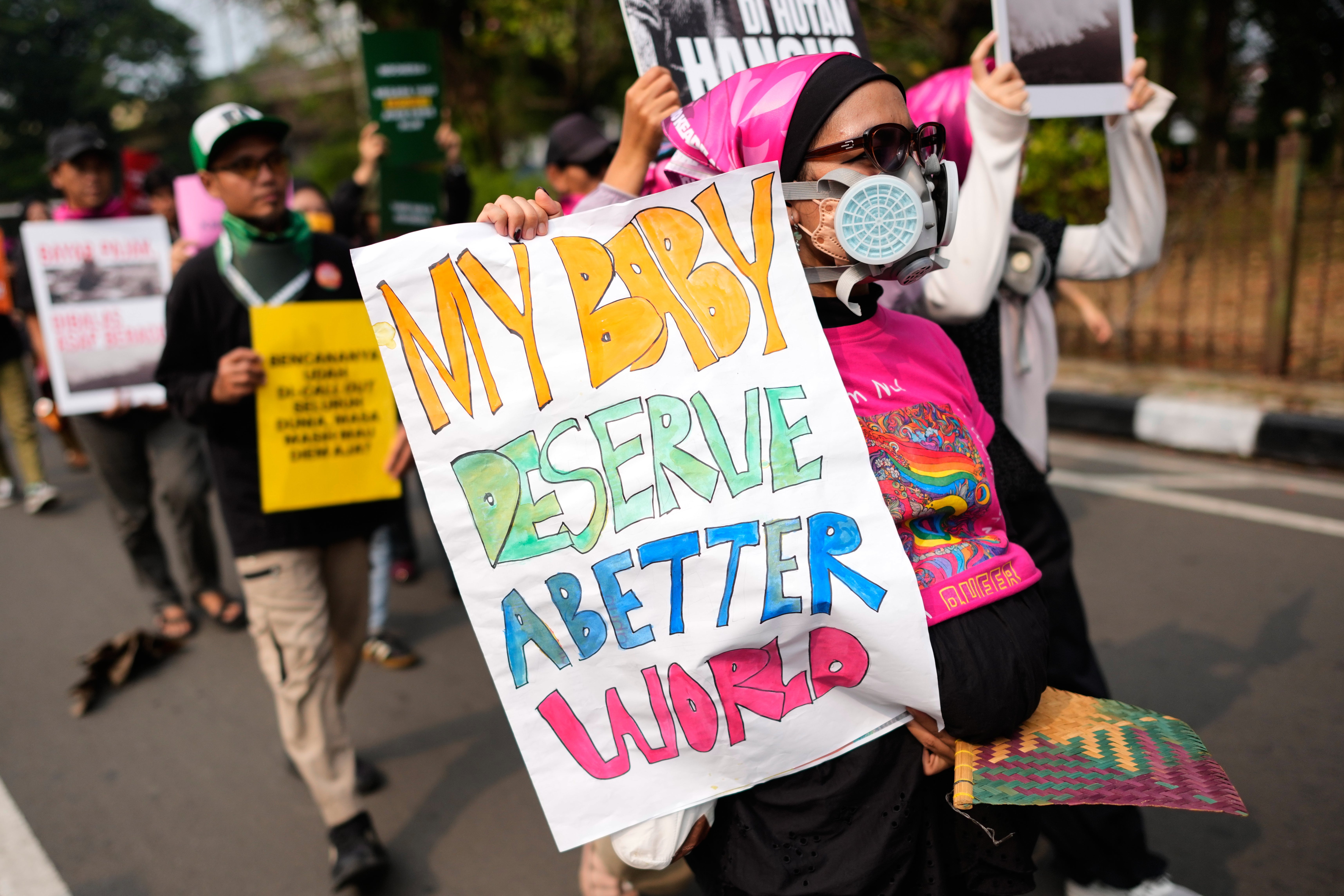 Activists display posters during a rally against Indonesian government’s policies that they claim have caused climate and ecological disasters across the country, in Jakarta, Indonesia (AP)
The air in the worst-hit cities was far above safe levels.
Average daily PM2.5 in September reached 372 micrograms per cubic metre of air in Palangka Raya in Central Kalimantan and 327 in Pontianak in West Kalimantan, above the 300 mark that Indonesia classes as hazardous and 22 to 25 times the World Health Organization’s 24-hour limit of 15.
The fires are also more intense than in 2015, the year of Indonesia’s worst haze crisis.
Satellite readings of fire activity in Kalimantan, Sulawesi and Papua passed the 2015 records in September, according to CREA. The national disaster agency recorded 1,024 hectares of land burning in a single 24-hour period on 19 October.
The haze has also made many people ill. Indonesia’s health ministry recorded 333,470 acute respiratory infections across seven provinces by 21 October, up from 283,270 on 13 October and more than six times the 50,891 recorded in July and August. Children under five account for 75,172 of the cases, nearly a quarter.
Jakarta defended its response on Wednesday, saying it has deployed more than 72,000 people for cloud seeding and firefighting, activated more than 2,100 doctors and health workers in hard-hit areas and distributed 5.3 million masks.
CREA said the national disaster agency’s budget was cut by 75 per cent for 2026, from 2 trillion rupiah (about £90m) to 491 billion rupiah (about £22m), which it said left the agency’s operations severely underfunded.
President Prabowo Subianto has so far refused to declare the fires a national emergency despite calls from parliament, environmental groups and student protesters. Officials argue that regional capacity has not “completely collapsed” and that task forces are working on the ground.
CREA said a national declaration would make Indonesia a state liable for transboundary haze, which it said would damage confidence in palm oil and pulp and paper exports, and would push the financial burden onto the central treasury, with provinces now managing on limited budgets.
It said the government should shift from responding to fires to restoring peatlands, which have been drained and are now prone to burning.
The fires, started by farmers and plantation workers clearing land and worsened by drought and an El Nino weather pattern, have burned more than 1.9 million hectares in the nine months to September, according to the deforestation monitor Nusantara Atlas, and the smoke has spread to Malaysia, Singapore, the Philippines and East Timor.
The haze has strained relations with neighbours. Indonesia cut gas exports to Singapore last Saturday, and Singapore has served legal notices on Indonesian companies it blames for the fires.