
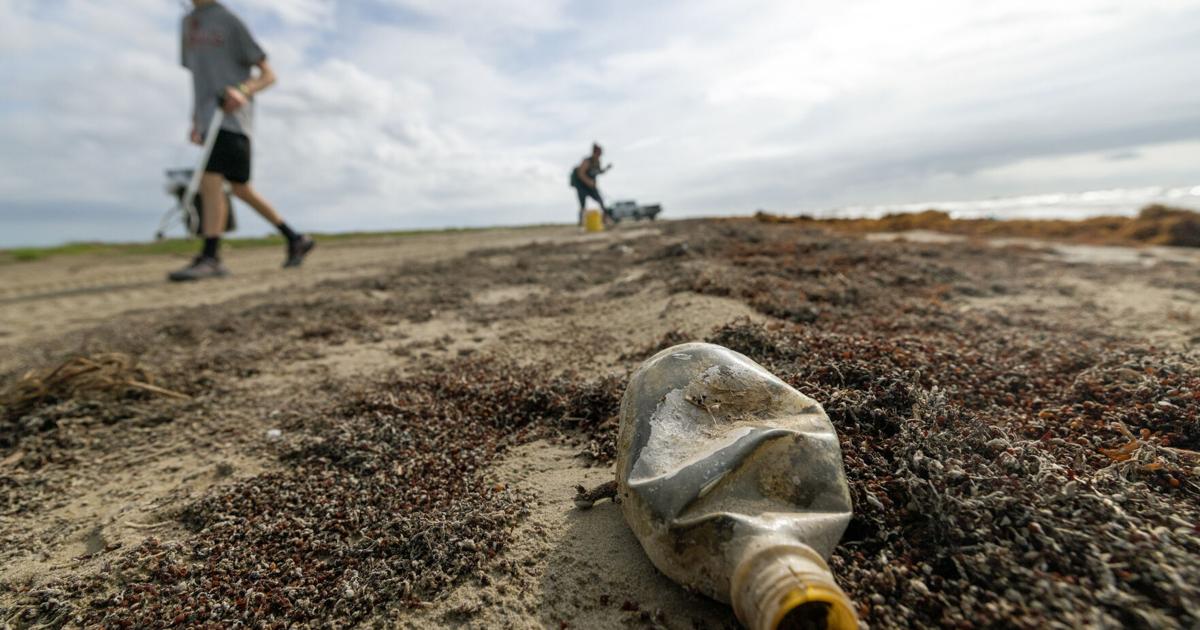
A small band of workers combed the sand at a popular spot along Louisiana’s coast, and it didn’t take them long to find what they were seeking.
Beyond the shallow marshes plied by egrets and just over the dunes at Elmer’s Island Wildlife Refuge, the crew scooped up plastic tubing, plastic bags, plastic utensils and plastic bottles.
They weren’t only seeking plastic trash. But for a long time now, plastic garbage has accounted for the vast majority of what they find — pointing to the slowly accumulating crisis of microplastics, the leftover, tiny bits of broken-down plastic trash.
“The tide rises again tomorrow morning, the same amount of trash is back,” said Emily Braud, a volunteer and marine debris coordinator for the Barataria-Terrebonne National Estuary Program.
“You have to think of it on the positive side, as we’re making a difference. We’re stopping these big plastics from becoming microplastics.”
Her crews have collected 1,124 bags of trash so far this year, but the total amounts to a drop in the ocean — in a very real sense.
Just beyond the sandy shores of Elmer’s Island, the Gulf of Mexico has become an epicenter of microplastics and nanoplastics pollution, infecting everything from oysters and shrimp to sensitive coral reefs and the sediments of Louisiana coastal bays.
The tiny bits come from the slow degradation of plastic bottles, bags and other items that underpin modern life. Also in the mix are paint flecks, tire particles and nurdles, a lightweight intermediate product made by many facilities along the Gulf Coast and Mississippi River. They form the raw material for many plastic objects.
The consequences on human and ecological health of all those tiny particles are not yet clear. Concerning evidence is emerging, however, and scientists are warning that more study is needed to gauge the severity of the problem.
Fed by the Mississippi and other rivers that course through urban and industrial areas, the Gulf acts as a sink for microplastics and nanoplastics, their smaller cousin. A team led by an LSU researcher found nearly a decade ago that microplastics concentrations in the Gulf were among the highest in the world.
The mounting problem is among a list of perils facing the Gulf, which President Donald Trump has renamed the Gulf of America. The states along its shores are confronting challenges ranging from rapidly warming waters to pollution and the effects of industrialization.

From left, Nicole Prejean, Dylan Biffle and Jarred Whitrack collect litter on Elmer’s Island near Grand Isle during a Barataria-Terrebonne National Estuary Program beach cleanup on Friday, May 29, 2026.
STAFF PHOTO BY BRETT DUKE
Microplastics have received less attention than many of those issues and remain an unregulated pollutant. Awareness is growing of their potential public health implications.
Researchers are also understanding that with so much plastic already loose in the environment and continuing to break down into ever smaller particles, microplastics could have a long tail of impacts extending for years, even if all pollution were to stop today.
“The more we keep polluting the environment with plastics, the more these smaller sizes are going to accumulate,” said University of Southern Mississippi researcher Kristina Mojica, a marine microbial ecologist studying nanoplastics in the Gulf. “They aren’t going to just disappear. They last for thousands of years.”
The ‘Plastic Age?’
Located about 100 miles off the coast of Galveston, Texas, Flower Garden Banks National Marine Sanctuary is supposed to protect sensitive and ecologically important coral reefs in the northern Gulf. But recent findings show marine life there is sharing space with plastic trash.
In mid-2025, a cleanup of just one of the sanctuary’s remote coral communities, known as Stetson Bank, pulled in about 2,000 pounds of trash, said Michelle Johnston, the sanctuary’s superintendent.
Microplastics have been found in the reefs’ lionfish and embedded in the coral themselves.
She described the impact of marine debris, including plastic fishing gear and lost nets, on the Gulf coral reefs and other sites in the U.S. marine sanctuary system.
“So this isn’t just an aesthetic issue. It’s a fundamental threat to the integrity of our ecosystems,” Johnston said at a recent conference in Galveston.
Believed to be entering the environment in a significant way for around 80 years, microplastics have even started to leave their own fossil record, a 2019 study found.
They’re in the snows of Antarctica, near the peak of Mount Everest and in the dung of its rambling yaks. Closer to home, they’ve been found in Gulf oysters and shrimp, in Florida manatees in Tampa Bay, and 1,300 other creatures of the sea, land and air.
They are in humans and their unborn children.
Jennifer Brandon, an oceanographer who led the study that found fossilized microplastics in sediment off the southern California coast, said the current era may become known as the “Plastic Age” — referring to previous prehistoric ages of copper and iron.
Exactly how much plastic enters the oceans each year is the subject of varying estimates. Totals range between 11 and 23 million metric tons, according to estimates from the United Nations, Pew Charitable Trusts and Ocean Conservancy. Those totals are expected to double or more by 2040.
That is the weight of roughly 110 to 230 Nimitz-class aircraft carriers, according to NASA.
A 2020 study by Ole Miss researchers found the Mississippi was carrying 87 to 129 trillion microplastic particles per day by the time its waters passed near New Orleans.
Other work through a NOAA survey in 2019 found microplastics in fish, shrimp and other crustaceans living almost a mile under the Gulf off the coasts of Louisiana, Mississippi and Alabama.
Former Ole Miss researcher Kendall Wontor and others working with her are believed to be the first to document microplastics in oysters off the coast of Mississippi.
Wontor said Gulf oysters are seen as “keystone” species, building up reefs that create undersea communities, breaking up storm surge and cleaning seawater through their filter feeding.
In Wontor’s 2023 study, the greatest concentrations of microplastics were tightly stuck to outer portions of the oyster meat. Smaller amounts were also inside the digestive system.
The sampled oyster meat had between 13 to 302 microplastic particles per shucked oyster, mostly in sizes that were smaller than a grain of salt and a bit bigger than a white blood cell.
Shown set against the black backdrop are microscopic plastic fibers and particles found on the gills of an oyster pulled from Grand Bay near Moss Point, Miss. Researchers measured the levels of microplastics in oysters on Mississippi Sound reefs and found plastics deep in their digestive systems.
Photo provided by Kendall Wontor
Tests included reefs as far west as Bay St. Louis, Mississippi. The highest concentrations were found in oysters inside bays versus farther out, as well as south of Biloxi, the most urbanized area draining toward the sampled reefs, her paper found.
“The most common plastics are so widespread that I think if they’re affecting Mississippi oysters, they’re probably affecting Louisiana ones as well,” Wontor said.
It’s not clear that a study of microplastic concentrations in Louisiana oysters has been published. LSU officials, including through the SeaGrant program and AgCenter, were unable to point to any by university researchers.
A year before Wontor’s research was published, an analysis of 29 other studies that documented microplastic contamination worldwide found 94% of the oysters sampled, whether wild-caught or grown through aquaculture, contained microplastics. Aquaculture oysters had lower concentrations.
Mojica, the USM researcher looking at nanoplastics, has a study pending publication that has looked again at Mississippi Sound oysters, using a newer, more sensitive detection method than Wontor applied.
Early results of the water surrounding those reefs have found micro- and nanoplastic concentrations much higher than what Ole Miss researchers had found a few years ago.
Mojica said her paper will also reveal elevated levels in the oysters themselves. Given her pending results, she was asked if she would eat raw oysters.
“Oh, hell no,” she said with a laugh.
Plastics in breaded shrimp, fishsticks, nuggets?
What it all means for human health is only beginning to be unveiled.
Studies have shown microplastics may be linked to heart attacks, strokes, dementia, fatty liver disease, infertility and colorectal cancer. They may also affect processes known to promote cancer growth, though direct causation remains unclear.
Tens to hundreds of times smaller than 1 micrometer, which is about half the length of a bacterium, nanoplastics are feared for their potential toxicity because their small size allows them to infiltrate the body at the cellular level.
This plastic bottle on the beach at Elmer’s Island is believed to have arrived from the Caribbean nation of Haiti. Scientists say plastic pollution in the ocean is ubiquitous and comes from around the globe.
Photo provided by Emily Braud, Barataria-Terrebonne National Estuary Program
The question of harm is also complicated by the sheer variety of microplastics, which are made up of thousands of chemicals and have varying sizes, and by the number of methods developed to test for them.
Microplastics can also carry other pollutants, including heavy metals.
“It’s many things, so the question becomes: Which one are you talking about now? And I think that makes it hard to pin down a relationship between exposure and adverse effect,” said David Hala, a marine biologist at Texas A&M University in Galveston who studies microplastics.
But the widespread nature of microplastics and potential impact on the food supply make it a continuing area of concern for researchers.
A 2024 study that found microplastics in wild-caught Gulf shrimp also identified them in many other kinds of store-bought protein, including steak, pork loin, ground beef, chicken breast, chicken nuggets, breaded shrimp and tofu.
The study, produced by researchers from the University of Toronto and the advocacy group Ocean Conservancy, concluded U.S. adults may eat up to 3.8 million microplastic particles per year from the proteins tested, based on average consumption rates.
The study also revealed that microplastics aren’t just a problem in the oceans and farm pastures, but suggested they probably affect other layers of food production.
In the study, the wild-caught white shrimp, Alaskan pollock and chicken breast had some of the lowest concentrations of microplastics among the proteins examined.
Once proteins were processed, the microplastic concentrations went up by several orders of magnitude. Breaded, frozen shrimp, frozen fish sticks made of Alaskan pollack and chicken nuggets had among the highest concentrations.
Madeleine Milne, the lead researcher of that study, said the intent of the work was not to tell people what to eat but to raise awareness of a problem for the global food system.
“We don’t yet know what the risk of microplastic exposure is, so I think more research is needed before we can say what impacts microplastics are having in our bodies,” said Milne, who works now as a University of Toronto lab manager and does contract work for the Ocean Conservancy.
The U.S. Food and Drug Administration says it is monitoring the research on microplastic contamination in food, but doesn’t regulate it.
“If the FDA determines that levels of microplastics or nanoplastics cause food to be unsafe, the agency will take action as appropriate,” it said in a statement.
In April, federal officials announced a $144 million initiative to solicit research to better quantify microplastics in the water and human body, determine how the most harmful microplastics enter and move through the body, and find ways to remove them.
The U.S. Environmental Protection Agency also announced plans to add microplastics and other unregulated pollutants to a safe drinking water listing that flags them for study and potential regulation.
“Americans deserve clear answers about how microplastics in their bodies affect their health,” Robert F. Kennedy Jr., secretary of the U.S. Department of Health and Human Services, said in a statement at the time.
A handful of governors, state attorneys general and a collection of environmental groups wanted EPA to bump up the level of scrutiny even further and make water providers test for microplastics.
This summer, EPA proposed adding 30 other pollutants to that list but left off microplastics. Agency officials said the state of the technology lacked validated methods to produce consistent nationwide monitoring data.
State health officials say they are following EPA’s lead and aren’t carrying out investigative monitoring of microplastics in drinking water.
State officials added that there are “no enforceable limits for microplastics in drinking water or the environment” and “no existing analytical data on microplastics from public water systems in Louisiana.”
“Because public health risks from microplastics are understood to be chronic rather than acute — requiring long-term exposure to pose a threat — the regulatory process is focused on foundational science,” said Amy Whitehead, a spokeswoman for the state Department of Health.
For animals, plastics and other marine debris have been known for years to entangle turtles and sea birds or fill up their stomachs with non-nutritious plastics. Researchers are still learning about the long-term effects.
A 2025 study by LSU toxicologist Ahmed Abdelmoneim found that short-term exposure to chemicals leaching from extremely heavy concentrations of microplastics can affect the growth and activity of freshwater zebrafish larvae, including from the chemical associated with plastic bottles, polyethylene terephthalate, or PET.
Zebrafish serve as a test proxy for many kinds of aquatic and other vertabrates, including humans.
Abdelmoneim said the next phase is to test how plastic leaching may carry other contaminants adsorbed within microplastic particles, like toxic heavy metals.
“I think the main thing is that plastic pollution is a serious problem that everyone should do their best to limit, and that chemicals are released from plastic materials and deserve attention when assessing plastic pollution,” he said.
‘They think it’s food’
In some states, advocates have won bans on single-use plastics. But other states have adopted laws blocking attempts at those kinds of bans, including Texas, Mississippi and Florida.
The oil and gas and petrochemical industries, which see plastics as a growth sector, have promoted advanced chemical recycling, along with traditional recycling efforts, as a path out of the problem.
But critics contend their benefits are questionable and, even taken at face value, won’t tackle the scale of the plastic waste problem that can only be solved by reducing plastics production.
Nicole Prejean, right, collects litter on Elmer’s Island near Grand Isle during a Barataria-Terrebonne National Estuary Program beach cleanup on Friday, May 29, 2026.
STAFF PHOTO BY BRETT DUKE
The chief federal agency tracking microplastics and other trash in the oceans, the Marine Debris Program of the National Oceanic and Atmospheric Administration, declined to comment for this story.
Back at Elmer’s Island, a frequent piece of plastic trash found there underscored the global reach of the problem.
White and yellow chlorine and vinegar bottles have been washing ashore from around 1,300 miles away for years. The Macier bottles are made in the Dominican Republic and used heavily in Haiti.
Once the bottles reach Louisiana, they frequently have diamond-shaped bites from sea turtles mistaking them for jellyfish.
Nicole Prejean, a massage therapist, has been cleaning up the island’s beaches for more than four years. She said she does the contract job for a side gig and a mental break in nature.
But Prejean said those distinctive bottles, which she calls “turtle-bite bottles,” and all the other plastic trash she finds on the beach are disheartening.
“Because the animals, they’re hungry. They think it’s food. They don’t know better,” she said. “They’ve eaten plastic, and it’s not pleasant look at.”