
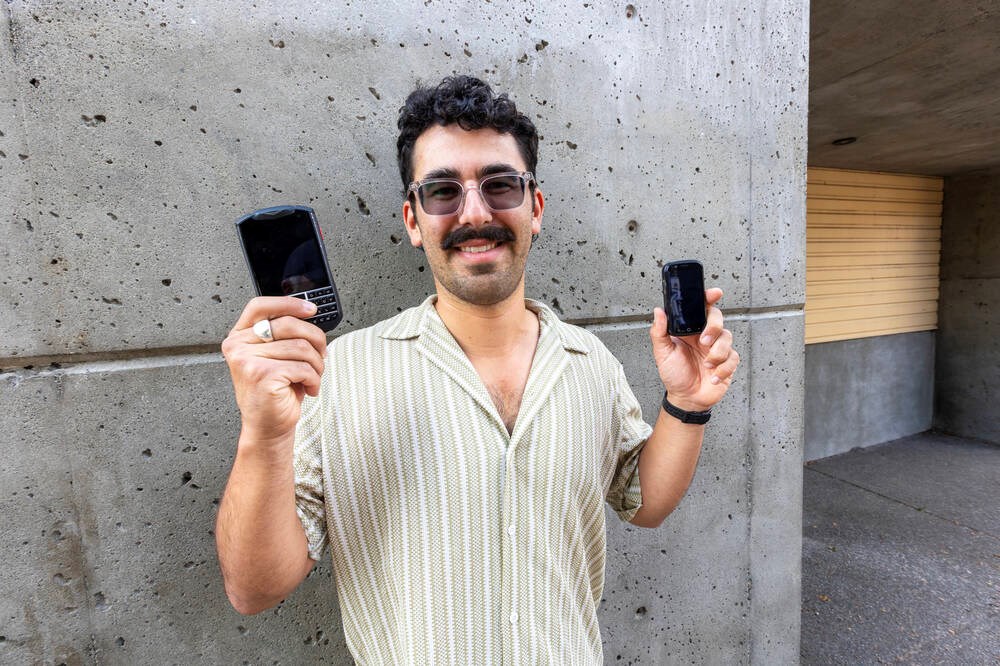
Many are reconsidering their relationships with technology as smartphones become more and more intertwined with our lives.
Samuel Pavez’s cellphone often draws curious — and confused — looks when he pulls it out in public to pay for a coffee.
The device has a three-inch screen and is so small that it fits in the palm of his hand.
“People are really excited when they see it,” said the 28-year-old Camosun College student.
Some might find the tiny Unihertz Jelly Star inconvenient, but that’s exactly why he made the switch last summer, after becoming tired of spending so much time on his phone.
“It’s difficult to use on purpose,” he said.
Pavez is one of many people reconsidering their relationships with technology as smartphones become more and more intertwined with our lives.
He chose a touch-screen smartphone instead of a flip phone — which is usually limited to calling and texting — because he wanted to access apps he uses every day, like Spotify for music and Google Maps for navigation.
Pavez had a work phone that his employer expected him to use on his summer job, so he hasn’t eliminated smartphones from his life, but he said making the switch for his personal use has made him feel less bound to digital connectivity.
“It was an active decision to not participate in the really connected world we live in.”
The only downside, he said, is that the Unihertz Jelly Star’s rarity makes technicians hesitant to do repairs, and replacement parts are hard to come by.
Pavez, who ordered his mini phone online, said he was shocked that telecommunications firms that sell phones in bricks and mortar stores don’t offer “dumb phones” that run modern smartphone software.
“It’s not in their best interest for people to be less connected.”
Finn Murphy is another young person rethinking his smartphone use in a radical way.
While he only graduated from high school a few years ago, he said he’s been reflecting for years on his “addiction” to smartphones.
When AI content started to creep into Murphy’s social media feeds, he decided to opt out, deleting Instagram on his phone a year and a half ago.
But it wasn’t enough to keep him away from temptation. So Murphy ordered a flip phone online this past June and has been using it exclusively ever since.
“It’s been pretty awesome,” he said. “I cannot see myself switching back any time soon.”
Murphy says he’s been reading more books and recently purchased a portable CD player to listen to music without Spotify.
He said people are often surprised by his phone, but enthusiastic about his choice.
“Lots of people say they want one,” he said.
There is a growing community of “dumb”-phone users on Facebook and Reddit, offering advice for others about which phone to buy and how to make the transition.
Used flip phones listed for sale in Greater Victoria on Facebook and Craigslist advertise their use for a “digital cleanse.”
The concept is increasingly popular among younger people who grew up with smartphones, Snapchat and selfies as part of their everyday life as tweens and teens.

University of Victoria writing professor Deborah Campbell with her flip phone. Campbell relies mostly on her landline at home, where she’s so committed to an unplugged lifestyle that she turns off her Wi-Fi at night and for much of the day, checking emails once in the morning and afternoon. ADRIAN LAM, TIMES COLONIST
University of Victoria writing professor Deborah Campbell started the UVic Offline Club last year after years of assigning a project in her non-fiction writing class where students go without their smartphones and write about the experience.
She said students in her class who put their phones away reported being “almost instantly” able to read books again and said that their mental health improved.
Students meet weekly in the library as part of the writing department-sponsored club.
Those studying all disciplines, including computer science, gather to chat, play card games and make friends.
“A lot of people are feeling like technology is running their whole lives,” she said, adding that students often talk about loved ones who are consumed by social media and smartphone games.
“It’s a little foothold on a technology-saturated campus where students can live as university students have for thousands of years.”
Campbell said students going without smartphones sometimes express fear of missing out on student events, which the university often advertises on social media.
So one computer science student suggested programming a simple app to share events without relying on the multi-billion-dollar social media industry for promotion.

Recent UVic graduate Elladee Kay says the fear of missing out is the hardest part of spending time away from social media, adding that she was “really nervous” for the first few days without her phone. DARREN STONE, TIMES COLONIST
Recent UVic graduate Elladee Kay participated in two of Campbell’s “screen cleanses” and said they inspired her to apply for graduate programs to study social media and AI in public policy.
She said the question driving her is: “How do we protect future generations from this attention-grabbing monster that is our phones?”
Kay said the fear of missing out is the hardest part of spending time away from social media, adding that she was “really nervous” for the first few days without her phone.
She was dog-sitting at the time and said she “found the silence to be unbearable.”
Her boyfriend joined her in cutting out screens for the second time during a class with Campbell a year ago.
Kay said the second experience made her feel more creative and in tune to her surroundings, where she details in everyday life that she would have missed if she were scrolling on Instagram.
She joined the offline club and said the best part was chatting with software engineering students about how their technology-based education influenced the way they felt about smartphones.
Kay uses an app that limits her screen time and leaves her phone in another room while she’s sleeping. She said that “creating little moments of friction” when she reaches for social media has been the most effective strategy.
“You don’t realize how much time you’re losing until you get it back.”
Kendal Rockley helped facilitate the offline club on Campbell’s behalf while the professor was away last year. The sociology and business student said she was so fascinated by the experience that it ended up becoming the focus of her honours thesis, where she wrote about dependency on technology.
The club served as a “case study” for the ever-growing trend of people actively seeking technology-free environments after struggling with screen use, she said.
Rockley is still active on social media, citing positive benefits like socialization, but said talking with others in the club and writing her thesis about their experiences changed the way she saw her dependence on technology.
She said she hopes universities, public areas and businesses will start to integrate more “offline spaces” into their common areas in an effort to “re-write the social script” around phone use.
For Campbell, she’s opted to do away with having a smartphone completely, and feels that her life would be “completely different” with one.
Her concern is rooted in fear of data surveillance, after working as a journalist in places in the world where online activity is highly monitored and she had to think about where her data was going.
The danger of data surveillance became evident when her friend in Syria was arrested by secret police after they tracked her online activity.
Campbell now has a flip phone, but relies mostly on her landline at home, where she’s so committed to an unplugged lifestyle that she turns off her Wi-Fi at night and for much of the day, checking emails once in the morning and afternoon.
Campbell often sets aside Sundays as “offline days,” where she doesn’t use Wi-Fi at all.
“It’s wonderful,” she said. “It’s blissful.”
Another Victoria resident, Mary Lloyd, sees the importance of time spent off screens as crucial, too, which has prompted her to host “unplugged” in-person gatherings.
After seeing a video on Facebook of people gathering to read together in Amsterdam, Lloyd reflected on her own experience.
“It’s the feeling of gathering at the summer cottage around that big oak table, playing games.”

Strangers turn into friends at Caffe Fantastico in Quadra Village during a monthly “unplugged” event where people gather without smartphones. VIA MARY LLOYD
She reached out to Caffe Fantastico in Quadra Village and hosted her first event in November 2024, which attracted about 70 people.
“It was like an instant hit. I was blown away by the turnout,” she said.
The event takes place on the third Friday of each month, and participants take part in a variety of activities, such as card games, Scrabble or crafting.
Lloyd said the absence of phones makes people more likely to connect with strangers and make friends.
“If someone comes on their own, they’re always welcome to join another table.”
She said that a room full of people without their phones feels “warmer and cozier” than if they were checking messages and taking photos.
Lloyd is still on Facebook, using it to promote her events, including silent outdoor discos that she started hosting during the COVID pandemic to encourage people to get together while staying safe.
She founded Collective Joy Dance & Events in 2020 and hosts silent discos at schools, hospitals, community centres and beaches.
She’s still conscious of her phone use, though, often putting it in a bathroom drawer at home where she can’t see it or become distracted.
“I just love not having it around. It’s like freedom.”