
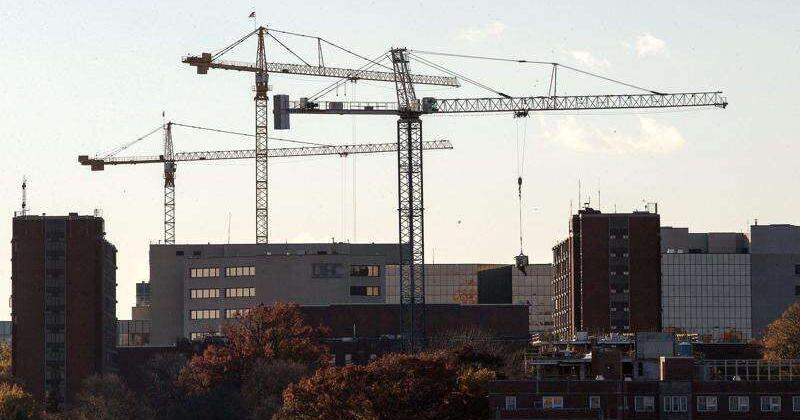

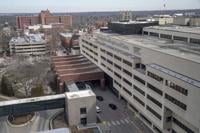
The University of Iowa Hospitals and Clinics campus is seen in March 2024 from the UI Stead Family Children’s Hospital in Iowa City.
The Gazette
IOWA CITY — After {a target=”_self” href=”https://www.thegazette.com/tncms/asset/editorial/2bf14732-bfde-4ed3-9ed2-f7c4ca5d9094”}scrapping plans for a new $2.2 billion inpatient tower{/a} — which it was going to name after a major donor — University of Iowa Health Care has found another way to honor Richard O. Jacobson: naming its existing adult hospital after him.
The Board of Regents will consider transferring Jacobson’s naming rights from the nixed inpatient tower to the main hospital at its meeting next week.
The size and scope of the naming honor matches the $70 million gift the Richard O. Jacobson Foundation committed to the planned patient tower in 2022 — {a target=”_self” href=”https://www.thegazette.com/tncms/asset/editorial/3d72f7b5-9f6b-543a-ac68-7329293a046c”}marking the largest donation in UI history.{/a}
“Jacobson’s most recent gift, the largest in the 175-year history of the UI, adds to his considerable philanthropic legacy,” UI officials said at the time. “During his lifetime and through his foundation, Jacobson has pledged more than $86 million to the UI, including notable support for the Iowa Reading Research Center, the John Pappajohn Entrepreneurial Center and the UI Football Operations Building which bears his name.”
Jacobson’s $70 million donation was supposed to support construction of a new 842,000-square-foot inpatient tower adjacent to Kinnick Stadium on the main UIHC campus in Iowa City — projected to cost $2.2 billion, add about 180 inpatient beds and take until 2030 to complete.
The university first aired those plans in 2022 via its 10-year facilities master plan — mapping out a string of enabling projects to make space for the massive new tower, including a new $17.5 million road, $75 million parking ramp, water tower, and new $250 million Health Sciences Academic Building.
In pitching the project nearly five years ago, UIHC cited increased federal Medicaid support through a directed payment program that promised to “substantially increase UIHC margin over the coming years.”
But recent federal changes — including limits on state-directed payments expected to pull nearly $10 billion from Iowa over the next decade — have stripped UIHC of the funding it planned to use “to modernize facilities and to invest in staffing.”
Specifically, UIHC budget documents for fiscal 2026 show the hospital system would have faced a $124.1 million deficit last year without its $465.7 million in directed payment revenue. Thanks to that extra income, which will be capped in the future, UIHC reported operating income of $341.6 million on the year — although it would have had a 4% deficit without it.
“Due to a challenging financial environment and the need to increase inpatient bed capacity on an accelerated timeline, the board approved a revised capital plan on September 17, 2026,” regents reported in new naming documents released this week. “The revised plan shifts from constructing the tower to modernizing and expanding spaces across the health system.
“This approach will enable UI Health Care to expand services to Iowans more quickly, allowing an estimated 23,000 additional patients to receive high-quality care closer to home and sooner than originally planned.”
Specifically, UIHC is looking to add nearly 100 beds over the next four years across its existing Roy Carver, John Colloton, and John Pappajohn pavilions — costing about $400 million, just 18% of what it had planned to spend on the new tower.
And officials told The Gazette those pavilion names will not be affected by the larger Richard O. Jacobson Hospital naming.
“Nothing is being replaced,” Board of Regents spokesman Josh Lehman said. “Those names all still will exist. This would be the new name of the overall existing adult hospital.”
‘Substantial contributions’
Richard “Dick” Orrin Jacobson was born in October 1936 and grew up in Belmond in north-central Iowa — where he worked several part-time jobs during high school, saving enough to attend the University of Iowa and earn his bachelor’s in business administration in 1957.
He served three years in the U.S. Army before working for the Monsanto Chemical Co. from 1961 to 1966. In 1968, he founded the Jacobson Warehouse Co. and eventually grew The Jacobson Companies into one of the largest privately owned warehouse organizations in the country, according to his family, with more than 9,000 employees, 194 locations and 35 million square feet.
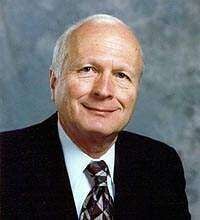
Richard O. Jacobson
He also helped establish Hawkeye Renewables, the third-largest ethanol producer in the U.S.
He created the Richard O. Jacobson Foundation in 1976 “to support children and educational opportunities in Iowa, the Midwest and Pinellas County, Florida.”
His philanthropy helped build facilities at the University of Iowa, Iowa State University, the University of Northern Iowa, Drake University, Grand View University and Special Olympics of Iowa, among others. He provided “substantial contributions” to many more, including the Mayo Clinic Proton Beam Therapy Program, Belmond Elementary School, Iowa Hall of Pride, Des Moines Public Library, Iowa State Fair and Blank Children’s Hospital.
Jacobson’s UI giving has topped $86 million — including for the Iowa Reading Research Center, the John Pappajohn Entrepreneurial Center in the Henry B. Tippie College of Business, and Hawkeye athletics. The Richard O. Jacobson Football Operations Building is named for his football program support.
“Dick Jacobson is an extraordinary example of how Iowans give back to care for Iowans,” former UI Center for Advancement President and CEO Lynette Marshall said in 2022. “His passionate commitment to education and medical research is an inspiration, and we are thankful for his vision, which has continued to be carried out by his foundation.”
Jacobson’s most recent tower gift even caught the attention of Gov. Kim Reynolds, who at the time said, “This generous gift from the Richard O. Jacobson Foundation will not only expand access to world-class care in our state, it will further elevate UI Health Care’s national reputation as a health care innovator and attract more medical professionals to fulfilling careers in Iowa.”