

A new therapy is showing impressive results for people with treatment-resistant depression, a condition where symptoms persist even after they’ve tried multiple medications.
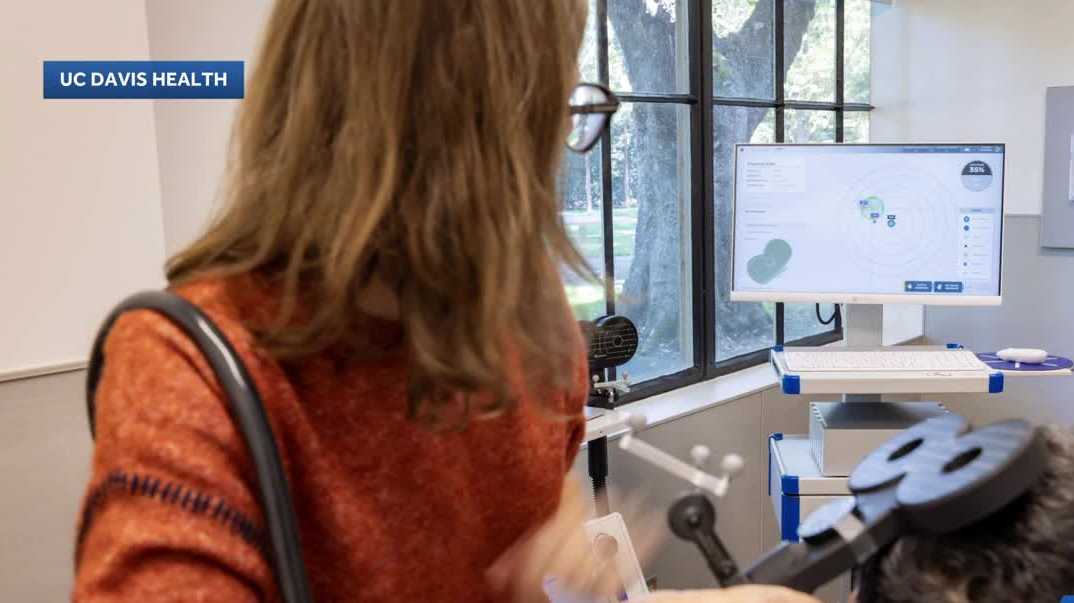
Dr. Debra Kahn, a psychiatrist with UC Davis Health and Medical Director of the Advanced Psychiatric Therapeutics Clinic, is now using the technology on patients. It’s called Stanford Accelerated Intelligent Neuromodulation Therapy, or SAINT, and it uses magnetic stimulation on the brain. Where past magnetic stimulation treatments have been applied more generally and over a period of weeks or months, SAINT uses fMRI scans to map the parts of the brain that should be targeted. Every patient has a precise treatment plan, and the treatment itself is non-invasive.
“Once we know that treatment target, we can use it repeatedly during an accelerated treatment course. So patients get ten sessions a day over five days. Each session is about nine minutes,” Kahn said.
The treatment involves magnetic pulses that stimulate electrical activity in the brain. For the patient, it feels a bit like tapping.
“The magnetic pulses are stimulating electrical activity in the brain below where we are putting the magnetic pulses. And once the electrical activity is stimulated in the brain, it can cause places to reawaken that have been dormant in depression,” Kahn said. “It can cause new pathways to be formed where people can think about their problems in new ways and start feeling joy again.”
The results of the therapy are often visible within days.
“We will often see people come in their first day looking down, not having slept well, not feeling very optimistic,” Kahn said. “And often, by the end of day three, the beginning of day four, they’re starting to look brighter, have more energy to do things in the time period in between their treatments. And it’s been really wonderful to see people improve and to also stay better.”
There’s an urgent need for effective treatments for depression. A Gallup poll from last year showed the percentage of adults with depression in our country was over 18%, a historically high number. Similar Gallup polling shows an increase of 8% in the last ten years. Of those getting help for depression, about 30% have cases classified as treatment-resistant.
Kahn described the impact of depression.
“People with depression struggle with sleep, energy, concentration. They may feel guilty and like they’re a burden on others,” she said. “Things that used to feel fun for them aren’t fun anymore. They may withdraw from family and friends, and in the worst cases, patients may feel like they don’t want to live anymore.”
While the SAINT therapy is still new, with only eight patients treated at her Advanced Psychiatric Therapeutics Clinic so far, Kahn said the results are promising.
“It looks like the treatment can last up to a year,” she said. “For us, we’ve only been doing it for about two months, and I can say that it can last for up to two months. Future directions of research and psychiatry will show us what the optimal pattern of continuation and maintenance will be.”
UC Davis Health also reported that in a small study conducted at Stanford University, 90% of the participants experienced relief from some symptoms of severe depression following SAINT treatment.
Regarding cost, Kahn noted that Medicare covers most patients who meet the criteria for this treatment, and other insurance companies are beginning to cover it with prior authorization.
Kahn emphasized the significance of this breakthrough.
“It’s really amazing. Especially after years of prescribing medications that, in the best case scenario, take four weeks to work,” she said. “So having something that can help in such a short period of time with minimal side effects is really it’s heartwarming. And I love to be involved in psychiatry at this time.”
This story was featured as part of our new California Tonight show. It airs Monday-Friday at 7:30 p.m. Watch on KCRA and KSBW.