
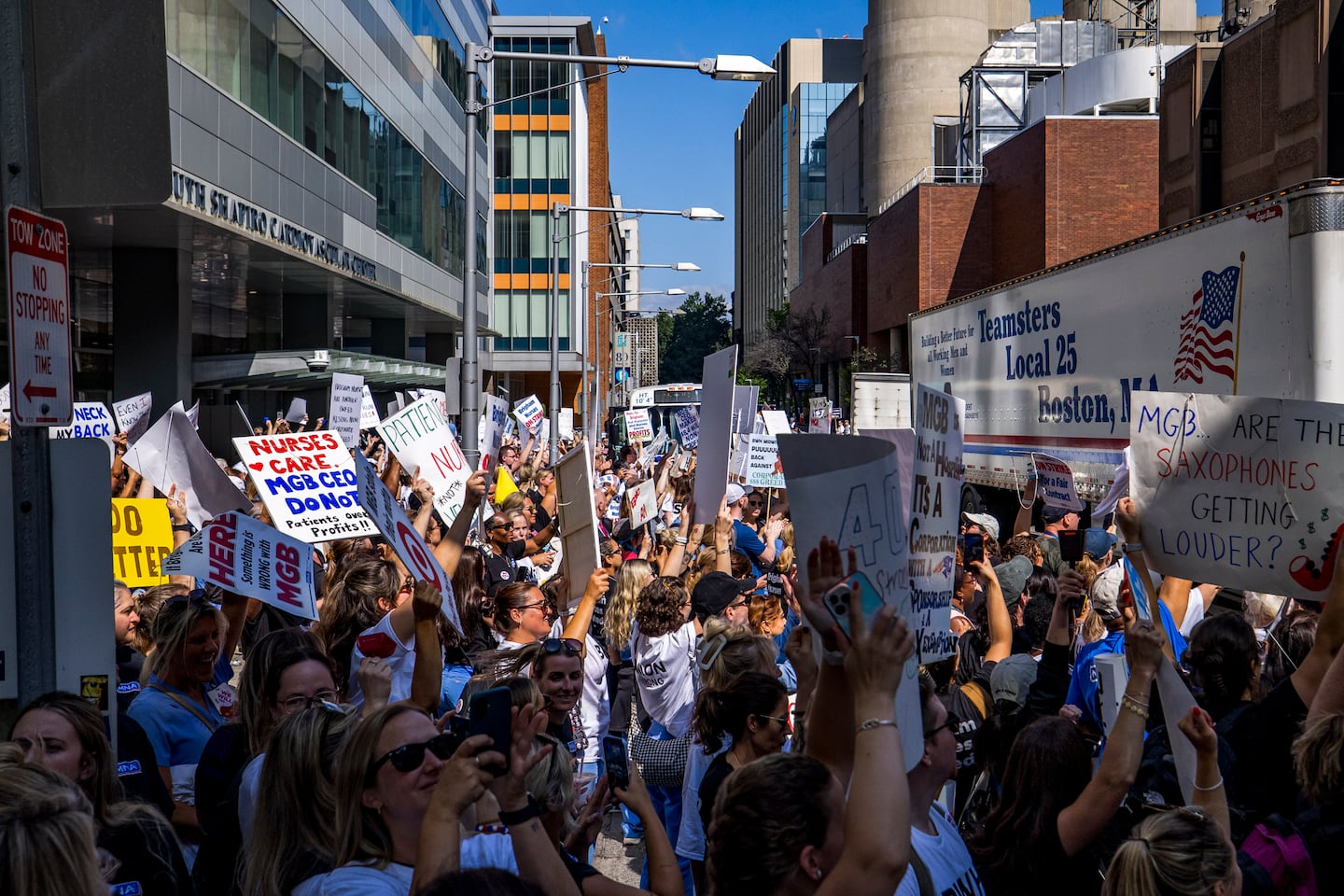
The chapter of the Massachusetts Nurses Association rejected the hospital’s “best and final” contract offer on Oct. 23 after tense negotiations that had been ongoing for about a year. The union had postponed an open-ended strike scheduled for Oct. 14 to let members vote on the offer.
“We want to avoid a strike for the city of Boston and our patients and our nursing staff,” Kelly Morgan, the labor and delivery nurse who heads the MNA chapter and has worked at Brigham since 1999, said last week. Still, the union has scheduled a strike to begin on Thursday, she said, because “we’re hoping this motivates the hospital to come to the table and have more meaningful conversations.”
A federal mediator will assist in the negotiations, as has been the case since April, said Morgan. The nurses’ contract expired in July.
Brigham’s management says it, too, wants to avoid a strike and has offered concessions on matters such as health insurance costs for nurses.
“Ultimately, reaching an agreement requires both parties to find terms they can accept,” management said Friday in an update emailed to employees and signed by several top MGB executives, including chief operating officer Dr. Ron Walls.
In a separate email to media outlets, the health system added: “The hospital’s last, best, and final offer presented to the MNA on Oct. 10 reflected movement in response to priorities raised by the MNA bargaining committee.”
Both sides have been engaged in wrangling for months, with the union repeatedly threatening an open-ended strike. If it happens, it would be the largest indefinite strike by nurses in state history.
On July 8, the union staged a one-day strike. The nurses were then locked out of the hospital for four additional days because management said it was obligated to give temporary replacement nurses five days of work.
The offer rejected by the union last month did not include across-the-board wage increases, which Brigham nurses say is critical because of inflation and the high cost of living in Greater Boston.
The union previously sought a 3 percent raise for the first six months of the contract and a 4 percent raise for the next 12 months. The hospital had not offered an additional across-the-board raise, noting that nurses already receive a 5 percent step increase on the anniversary of their hiring each year until they reach two decades of service.
Brigham nurses working full-time, 40 hours a week, start at $86,700 annually, while those with 20 years of service earn at least $220,000, according to MGB. Nearly one-third of the local union’s members, or 1,322 nurses, earn that maximum amount, MGB said, making them among the highest paid in the state.
“Over the past five fiscal years, Brigham nurses’ base pay has increased by an average of 55%,” Mass General Brigham, the corporate parent of Brigham and Massachusetts General Hospital, said in a recent statement.
However, Morgan said that most nurses at Brigham work 36 hours or less, are considered part-time, and earn less than what Brigham has cited.
Morgan also said it was “disingenuous” for management to object to an across-the-board raise for nurses given that MGB chief executive Anne Klibanski made nearly $9.2 million in 2024, a roughly 9 percent increase from the year prior. Klibanski is the top-paid health system executive in Massachusetts.
Morgan said the nurses are also seeking to cap how long travel nurses can work at the hospital at six months. Currently, she said, some travel nurses have been working at Brigham for five years.
“We’re looking for [Brigham] to invest in permanent staff,” she said.
Hospital management says agency nurses account for slightly more than 1 percent of Brigham’s nursing workforce, or fewer than 75 of more than 4,000 nurses. The private nurses help cover leaves of absence and periods of higher patient volume, management says.
The threat of the strike comes as MGB says it is trying to strengthen its finances. About two weeks ago, the health system disclosed it was making an unspecified number of cuts to jobs and programs to save money.
The goal, says the state’s largest private employer, is for MGB to have an operating margin, or money made from its core work of taking care of patients, of about 1.5 percent of its operating revenue, or $300 million, by Sept. 30, 2028. In fiscal 2025, MGB reported an operating margin of $59 million, or 0.3 percent of operating revenue.
Jonathan Saltzman can be reached at jonathan.saltzman@globe.com.