
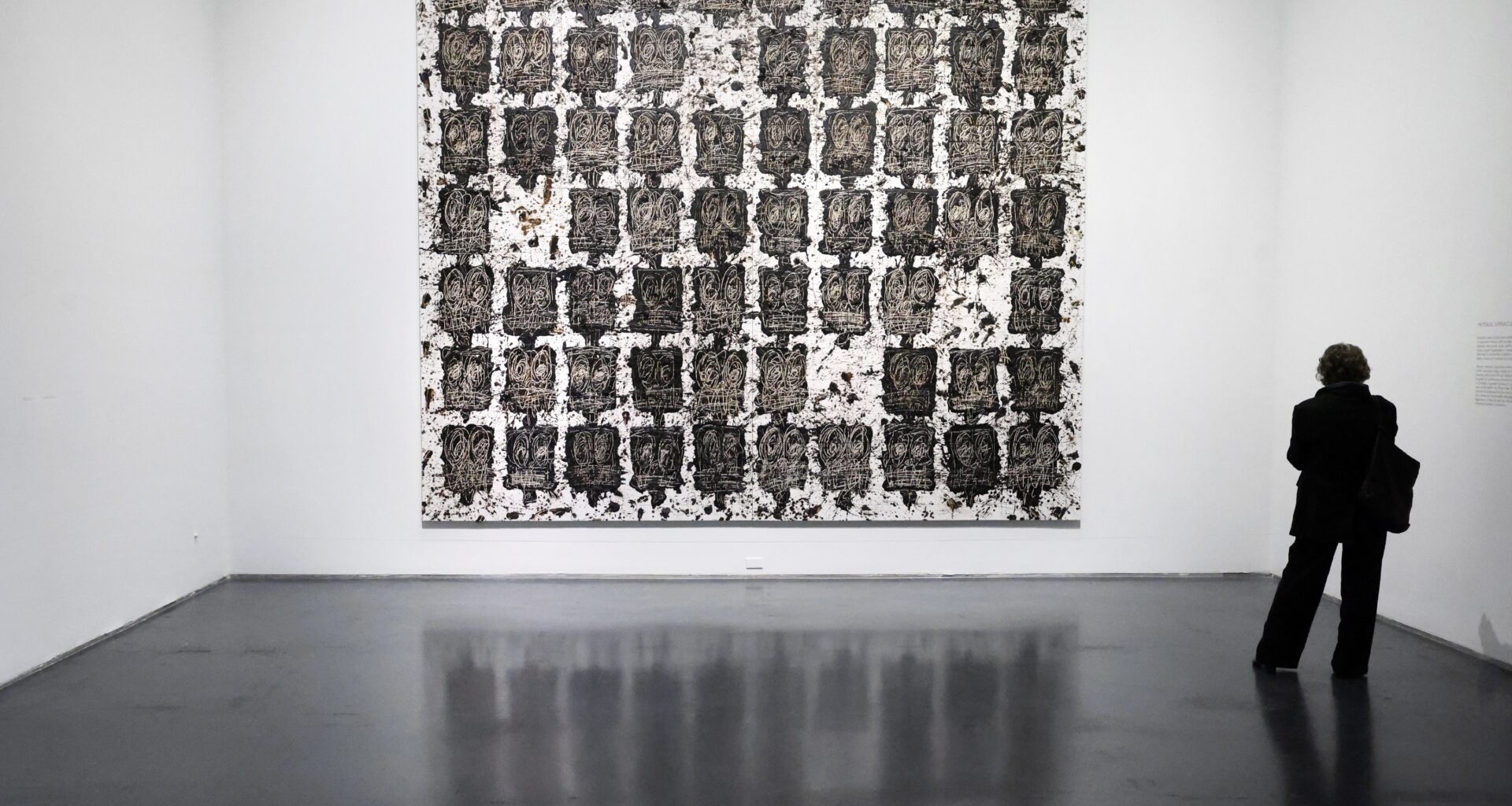
As Chicago-born artist Rashid Johnson, 49, prepared to unveil his “A Poem for Deep Thinkers” exhibition Saturday at the Museum of Contemporary Art Chicago, he found himself in a rare moment of “pause and reflection.”
Having risen to prominence with series such as “Anxious Men and Anxious Audiences,” which explores mental health, and “Seeing in the Dark,” portraits of homeless Chicagoans, Johnson has spent nearly three decades exploring fundamental societal concerns through his multidisciplinary work that includes photography, sculpture, film and painting.
The MCA exhibit offers the artist, who studied at Columbia College Chicago and the School of the Art Institute of Chicago, an opportunity to reflect on his career thus far and consider what the future holds for his work.
Running through April 25, “A Poem for Deep Thinkers” takes visitors on a journey through Johnson’s career, with 70 works that reflect his contributions to art and public discourse over the years. The show includes items from the mosaic tile series “Broken Men,” which Johnson drew from for his piece of the same name featured at the new Obama Presidential Center in Jackson Park.
For Johnson, now based in New York, the exhibition brings him face-to-face with his evolution as an artist and a human being. As time and distance have changed his perspective on life and art, he says he has “become as much a witness to his own practice as he is the practitioner.”
The following is an edited transcript of the Tribune’s conversation with Johnson.
Q: How are you feeling about your return to the MCA with “Rashid Johnson: A Poem for Deep Thinkers”?
A: This is an interesting time for me to put my pen down to some degree. There are very few careers in which you’re asked to get to the middle of it and then reflect on what it is you’ve done. Could you imagine a plumber doing that? Or even a baseball player? I’m at a stage where people are considering this exhibition to be a mid-career survey, a retrospective of what I’ve done to date.
Q: Why is this the right time for this exhibition?
A: It just feels like an interesting time to pause and reflect. I’ve been working for almost 30 years as an artist and I’ve made a lot of work. The thing that’s interesting to me about it is that it follows different stages of my life; from around age 19 until today, thinking about what I’ve seen, what I’ve been exposed to, how it has affected me and how I continue to imagine my relationship to the things I’ve been exposed to.
Q: What are your memories of your first exhibitions or shows in Chicago?
A: My first five or six exhibitions as an artist took place in Chicago, in small venues before moving on to bigger opportunities. …
I’ve always been desperate to impress the Chicago audience. I’ve always been wildly enthusiastic about how they reflect on my work and see it. I continue to have that enthusiasm in relation to this audience because they have witnessed my development as an artist and watched me through it.
There are a number of people, my family included, who’ve seen more or less all that I’ve done from the origin point of growing up in Evanston and Wicker Park. It’s fun for me to bring a lot of the newer ideas that have happened since I left Chicago alongside the things that are familiar to my audience there.
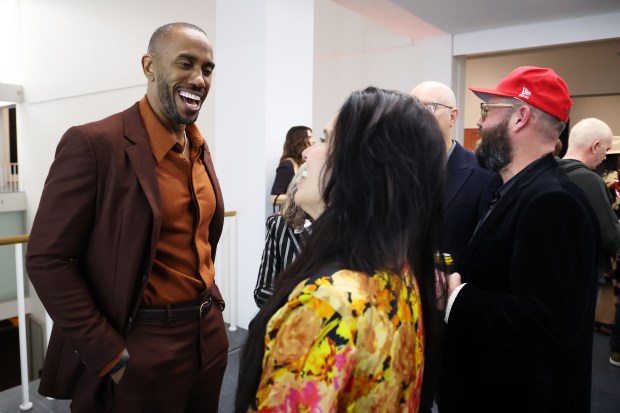 Artist Rashid Johnson, left, mingles with guests at his exhibition “A Poem for Deep Thinkers” at the Museum of Contemporary Art on Nov. 6, 2026. (Terrence Antonio James/Chicago Tribune)
Q: How does it feel to see art from different stages of your life from both Chicago and New York together in the same exhibition?
A: It feels like the evolution of a man. I recognize that, in the course of growing as an artist, you also grow as a human being. Your interests evolve and change. Your understanding of the world evolves and changes. Your proximity to different conditions and circumstances evolves and changes.
I became a father. I became a man who’s living in a different time in his life. I’ve become a little more of a global citizen. I read different things, I’m exposed to different music and I have different circumstances that change my perspective.
More or less, an artist’s practice, in its most ideal state, continues to evolve alongside the practitioner.
Q: With that evolution as an artist and as a man, has your relationship with certain artworks changed over the years? Or do you see them as products of their time?
A: I’ve become as much a witness to my own practice as I am the practitioner. When you’re a number of years removed from something, you get to look at it with different eyes because you’re a different person.
The thing that’s complicated about an exhibition like this is that it’s almost democratizing to the practice. You’ll see something I made when I was 19 years old and you’ll say, “That’s still you.” And it is, but it’s also sitting next to something I made at the age of 49. It’s challenging because they share the same plane. They live in the same space and they’re made by what you assume to be the same man. But I’m not exactly the same man I was when I was 19.
Seeing these things platformed in the same way is sometimes fascinating for me because I’m thinking, “Oh my gosh, look at the naivety of this practitioner versus the solutions I imagine I’m capable of today.” But the reality is that sometimes the 19-year-old me may have been even more evolved than the 49-year-old me.
Q: How did living in Chicago in the early 2000s and working at the School of the Art Institute inform the art you were making?
A: The Chicago I grew up in, and the Chicago I went to school and graduate school in, are not unlike me. It’s evolving. Cities aren’t static and that’s one of the things I find most interesting about them.
I grew up in Chicago at a time when there was a significant amount of white flight. Having grown up in the Wicker Park area, I saw neighborhoods that changed dramatically as a young man. You see what a lot of people refer to as gentrification.
I lived on Potomac and Damen (avenues) in 1981 and it was very different from the Potomac and Damen that exist in 2026. Watching the city evolve and change has been really interesting: watching who occupies it, who’s in what spaces, how those spaces function over time and how even the same locations can feel so different from how they felt when I was younger.
I’ve lived throughout the city: Wicker Park, Rogers Park, Evanston, the South Loop and Lakeview. I’ve had these different experiences in different places at different times. So when people ask, “What is Chicago?” The question that needs to accompany it is: When?
Q: Does that changing landscape have an effect on the arts scene?
A: I can’t claim to have my finger on the pulse of exactly everything that’s happening in Chicago today, but I do recognize that there was a strong do-it-yourself nature to the city when I was living there. That seems to continue to belong to the city and its arts community.
There are a lot of alternative spaces and really interesting young voices coming out of undergraduate and graduate programs in the city. They’re continuing to try to find ways to amplify their projects and illustrate ideas in interesting, evolving ways.
I notice that more so than in cities like New York, which tend to be more invested in concrete institutional positions. Cities like New York are often very indebted to their institutional structures, whether that’s galleries or cultural institutions and museums that hold those positions.
There’s a broad landscape of them, as there is in Chicago, but Chicago actually goes from low to high in a more accessible way.

People view “Antoine’s Organ” by Rashid Johnson in his show “A Poem for Deep Thinkers” at the Museum of Contemporary Art on Nov. 6, 2026. (Terrence Antonio James/Chicago Tribune)

“Untitled Escape Collage Triptych” by Rashid Johnson hangs in his show “A Poem for Deep Thinkers” at the Museum of Contemporary Art on Nov. 6, 2026. (Terrence Antonio James/Chicago Tribune)

Work by Rashid Johnson hangs in his show “A Poem for Deep Thinkers” at the Museum of Contemporary Art on Nov. 6, 2026. (Terrence Antonio James/Chicago Tribune)
Show Caption
1 of 3
People view “Antoine’s Organ” by Rashid Johnson in his show “A Poem for Deep Thinkers” at the Museum of Contemporary Art on Nov. 6, 2026. (Terrence Antonio James/Chicago Tribune)
Q: In an interview with Harper’s Bazaar, you said that if you become too bogged down with the current condition, it takes away the opportunity to think about the forever discourse. How do you not do that when we live in such turbulent times?
A: I have a real awareness of the time that I live in and the tumult of that time. It’s something that I’m actually quite invested in considering. I’m less invested in illustrating that time or being committed exclusively to the responsibility of speaking to it.
Artists have this crazy condition to which we’re responsible for speaking to a really broad history, a history that is incredibly expansive. If you look at art history, that’s what we’re speaking to. I’m in conversation with the painters Ed Clark and Jack Whitten in the 1960s and ’70s. I’m in conversation with Jackson Pollock in the late ’40s or with Jean Dubuffet.
You’re in these conversations that aren’t contemporary because of the way your practice functions, because you’re using the same tools and thinking about the same existential concerns that many of these artists were having to navigate. You have to live in a time machine.
At the same time, just like the filmmaker (Akira) Kurosawa says, the artist’s only responsibility is to not avert their eyes. That means I’m also living in this particular time, recognizing the tumult, concerns and critical exchanges that are happening in this time.
You have to face this wild dichotomy, this polyconscious position of multiple identities. How do I navigate the conversation I’m having with Marcel Duchamp and the Readymade while also recognizing that we’re living in a world that is pushed to the brink by machines and new modes and mechanisms? How do I jostle between those two locations and recognize my ability to navigate both at once? It’s a lot of balls to juggle.
Q: How do you navigate those responsibilities and concerns?
A: That’s really the job, and it’s complicated in that respect. But if you become too didactic or too enthusiastic about being overly prescriptive about the time you live in, you lose the opportunity to speak to the broader conviction of being that art gives us the chance to navigate.
Q: Is that why the “Anxious Men” series has evolved over the years?
A: I recognize that no generation has a monopoly on anxiety. There’s an inherent timelessness to it, while at the same time providing a space and a chance to reflect on the current condition. We all recognize the anxious times we live in and the vulnerable condition of being in this time is definitely something I’m aware of when making that body of work.
But a similar recognition of anxiety can be applied to the Bay of Pigs in the 1960s, the civil rights movement or the Revolutionary War. These ideas of being, and the quality and complexity of being, are universal.
I use that word with some reservation. I don’t necessarily aspire to universality. However, I do aspire to sincerity, vulnerability, honesty and some version of contradiction. Universality is not something I inherently aspire to but sometimes art, without us intending it, achieves that quality.
Adam Davidson is a freelance writer.
If you go
“Rashid Johnson: A Poem for Deep Thinkers” runs through April 25, 2027, at the Museum of Contemporary Art, 220 E. Chicago Ave.; 312-280-2660 and mcachicago.org