
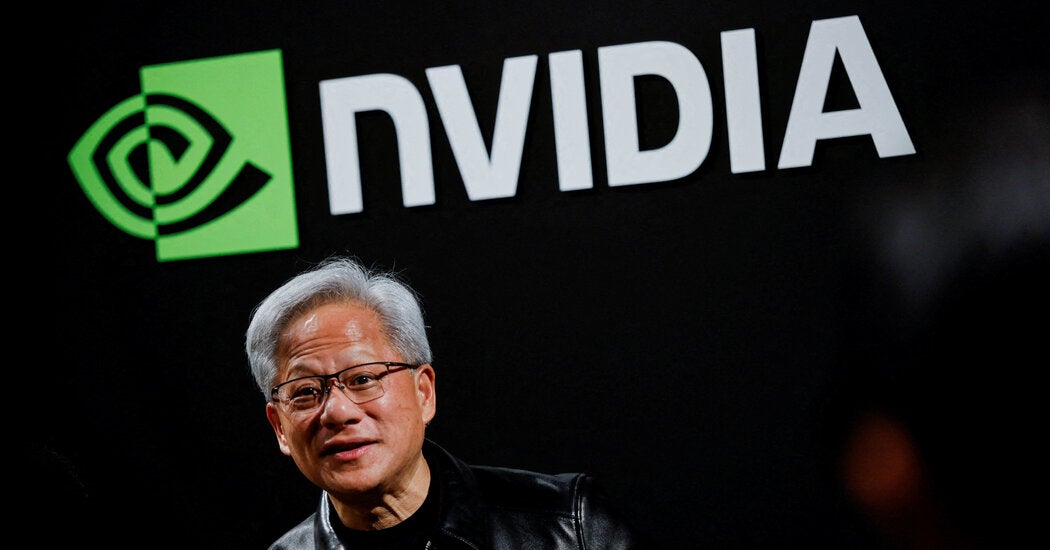
Nvidia’s shares plummeted Thursday, sending tremors through global markets, as the company’s chief executive, Jensen Huang, stepped down from his role.
Shares in Nvidia dropped as much as 14 percent when markets opened for trading on Thursday, extending a decline that has wiped out more than $1 trillion from the company’s market value this month alone. The stock began to reverse most of its losses by late morning.
The broader market rose slightly, too, as investors began to conclude that the fallout of Mr. Jensen’s departure would not fundamentally undermine the artificial intelligence trade. Yields on the 10-year U.S. Treasury rose above 5 percent on Thursday for the first time in weeks. Yields go up when Treasury prices go down.
Nvidia has emerged as central to the A.I. economy because its chips — or graphic processing units — help train and power models across the industry. It has also become a central bank of sorts for several A.I. companies, because its finances are deeply intertwined with those of everyone from frontier A.I. labs to neoclouds, which rent out computing power.
“This is an Nvidia problem before it is an A.I. problem,” said Mark Malek, chief investment officer at Siebert Financial. But he added that Nvidia’s woes could trickle through to other companies.
“Where I would be careful is with the smaller A.I. cloud companies that leaned on Nvidia’s checkbook,” he said. “If the new regime gets more conservative about financing its own customers, that is where it shows up first.”
The company’s board named Colette Kress, Nvidia’s chief financial officer, as its interim chief executive.
With the change in Nvidia’s leadership, investors face uncertainty about one of the poster children of the A.I. trade and how its problems could affect the broader economy.
Among the hardest hit stocks on Thursday were cloud computing providers that have strategic partnerships with Nvidia. Coreweave sank nearly 8 percent, and Nebius plunged nearly 17 percent. Nvidia’s rivals, on the other hand, ticked higher. AMD rose nearly 3 percent and Broadcom gained more than 4 percent on Thursday.
The broader U.S. market, initially weighed down by Nvidia’s troubles, inched higher on Thursday afternoon. The S&P 500 was up 0.2 percent and tech-heavy Nasdaq up 0.1 percent.
Nvidia’s woes reverberated through global markets as well. Taiwan’s TSMC, which produces chips designed by Nvidia, fell nearly 2 percent. But South Korea’s Samsung, which competes with Nvidia on some business lines, gained 1 percent. Shares in Europe’s largest tech company, ASML of the Netherlands, fell less than 1 percent.
Mr. Huang, who co-founded Nvidia in 1993, has become one of the most influential forces in the A.I. boom, which has helped to drive U.S. stock markets to new highs in recent years.
Nvidia’s board deliberations came after revelations that Mr. Huang had an affair with an executive who reports to him as well as with a woman whom U.S. intelligence has identified as a Chinese spy.
Some market analysts covering Nvidia have begun to downgrade their forecasts for its stock. Though the chipmaker is expected to remain a critical part of the A.I. build-out, some noted rising concerns about its governance and lack of a clear succession plan. They argued that these revelations have fundamentally changed Mr. Huang’s position in the tech world, and it was unclear what the implications of his departure from Nvidia could be.
Analysts at Bernstein downgraded Nvidia and sharply lowered their target for its share price. “Our gut tells us that we probably haven’t yet fully probed the depths of what might be found here,” they wrote. “We’ve had enough, and prefer to watch from the sidelines.”
Analysts at RBC Capital Markets also slashed their forecast for the stock, citing the lack of a formal succession plan for chief executive. “Whether any individual can replicate Huang’s singular combination of technical vision, ecosystem-building acumen and ability to serve as the global face of the A.I. revolution remains an open question,” they noted.
Nvidia’s stock is down about a third from its peak at the start of October, putting the company deep in a bear market, defined as a drop of 20 percent or more from a recent high.
The chipmaker retains a central role in the A.I. revolution, said Ken Mahoney, chief executive of Mahoney Asset Management, but he added that there could be more “rumblings” under the surface for investors looking to buy the dip.
“Ultimately, a lot depends on your investment time horizon,” he said. “Short-term traders face tremendous uncertainty, while longer-term investors may find opportunity if the company’s underlying fundamentals remain intact.”
Nvidia became the world’s largest public company by market value for the first time in 2024, exerting an outsize influence over major indexes like the Nasdaq Composite and the S&P 500. Analysts still expect Nvidia to make a profit of well over $200 billion this year, with its chips in high demand as tech companies rush to build giant A.I. data centers. It reports its quarterly earnings next week.
During last week’s market turmoil, Nvidia fell below Apple as the world’s biggest public company.