
Smart Pill Dispensers Market Size
The smart pill dispensers market was valued at USD 165 million in 2025 and is projected to reach USD 184 million in 2026, growing at a CAGR of 11.5% from 2026 to 2035 to reach USD 490 million by 2035.
Smart Pill Dispensers Market Key Takeaways
Share
2025 Market Size
$ 165 Million
2026 Market Size
$ 184 Million
2035 Forecast Market Size
$ 490 Million
Regional Dominance
Largest Market
North America
Fastest Growing Region
Asia Pacific
Key Players
Market Leader: MedMinder led with over 15% market share in 2025.
Leading Players: Top 5 players in this market include MedMinder, AdhereTech, Hero Health, e-pill, etectRx, which collectively held a market share of 47% in 2025.
Get Market Insights & Growth Opportunities
Download Free PDF
The smart pill dispensers market is moving from reminder-oriented consumer hardware toward connected adherence infrastructure that combines dose scheduling, event tracking, caregiver escalation, and recurring software services. Demand is strengthened by aging populations and complex medication regimens, while institutional buyers increasingly prioritize platforms that can document adherence outcomes and fit into established care workflows.
GMI Analyst View
Based on primary engagement with market participants and our discussions with industry experts, the smart pill dispensers market had already reached USD 144 million in 2024, ahead of the current base year, reflecting a demand environment substantially more robust than pre-pandemic connectivity baselines would have implied. Accelerating post-pandemic digital health investment and expanded telehealth reimbursement frameworks catalyzed institutional procurement pipelines well before the base-year period, reinforcing GMI’s confidence in the structural growth trajectory projected through 2035.
Smart Pill Dispensers Market Trends, Growth Drivers & GMI Forecast Outlook
Rising chronic disease prevalence, medication-management complexity, and connected-care procurement are widening the use case for smart dispensing platforms. The forecast depends on whether suppliers can convert connectivity into dependable clinical workflow integration while absorbing security, interoperability, and patient-access constraints.
Key Drivers
DriverEvidence signalMarket-demand implicationGMI forecast conditionChronic disease non-adherence burden50% of patients with chronic diseases globally are non-adherent to long-term medication therapies [1]World Health Organization. “Adherence to Long-Term Therapies: Evidence for Action.” who.intInstitutional demand for automated dispensingMedicare Advantage/value-based care contracts sustain above-market growth through 2030Accelerating global diabetic population589 million adults were living with diabetes in 2024 [2]International Diabetes Federation. “IDF Diabetes Atlas, 11th Edition.” diabetesatlas.orgBroadens addressable patient pool for indication-specific platformsPharma-bundled adherence programs accelerate institutional procurement in second half of forecast periodConvergence of IoT connectivity and AI-driven dosing algorithmsLTE/Wi-Fi sensors, cloud scheduling, and predictive missed-dose risk scoringBidirectional EHR integration and AI risk scores are establishing clinical-channel preferencesPlatforms without EHR sync face displacement from institutional procurement by 2028
Get Market Insights & Growth Opportunities
Download Free PDF
Evidence anchors use cited external data; demand implications and forecast conditions represent GMI analysis.
Medication non-adherence creates a direct operational problem for care teams, families, and payers because missed doses are often associated with forgetfulness, cognitive decline, or regimen complexity rather than deliberate treatment refusal. Connected dispensing shifts the process from passive reminders to recorded dose events and configurable escalation, making the technology more relevant to home health agencies, senior living operators, and managed-care programs that must monitor intervention results.
Diabetes expands the relevant population for platforms that can coordinate multi-drug schedules, caregiver communication, and pharmacy-supported patient services. The commercial opportunity is strongest where adherence technology is incorporated into specialty-drug programs or care-management contracts, because those channels can align device deployment with continuing clinical outreach rather than relying solely on a consumer’s one-time hardware purchase.
IoT connectivity and predictive adherence workflows are changing institutional qualification criteria. Buyers increasingly favor platforms that can receive schedules, transmit adherence events, and flag emerging risk without adding manual documentation work. Suppliers that translate device data into usable clinical information are therefore better positioned to participate in integrated-care procurement cycles.
Key Restraints
RestraintEvidence signalMarket-demand implicationGMI forecast conditionHIPAA-grade data security compliance burdenUSD 9.77 million average healthcare data-breach cost in 2024, the highest of any industry [3]IBM Security and Ponemon Institute. “Cost of a Data Breach Report 2024.” ibm.comEngineering costs and procurement friction in underfunded care settingsHIPAA Security Rule updates burden smaller developers through the mid-forecast periodBehavioral medication non-initiation gap3.8 billion prescriptions are written annually in the United States; approximately one in five new prescriptions is never filled [4]Centers for Disease Control and Prevention. “CDC Grand Rounds: Improving Medication Adherence for Chronic Disease Management.” cdc.govUnreachable patient segment caps addressable demandNon-fill barrier persists near term and compresses as direct-to-patient pharmacy expandsEHR interoperability fragmentationAbsence of universal HL7 FHIR complianceIntegration complexity restricts clinical-channel adoptionONC USCDI requirements reduce friction, but meaningful relief is unlikely before 2028
Evidence anchors use cited external data; demand implications and forecast conditions represent GMI analysis.
Data protection is a material barrier because connected dispensers handle medication schedules, dose events, and caregiver communications that may constitute protected health information. Encryption, access controls, auditability, and vendor-security review add cost and lengthen enterprise evaluations. The burden is especially consequential for smaller developers that must establish clinical-grade controls before they can compete for health-system or payer contracts.
Non-initiation also limits the addressable opportunity. A dispenser cannot improve adherence when medication has not been obtained or loaded into the device. This creates a commercial distinction between markets supported by mail-order pharmacy, coordinated fulfillment, or care-navigation services and settings where affordability, pharmacy access, or fragmented care pathways interrupt treatment before dispensing begins.
Interoperability remains a practical constraint on clinical deployment. Health systems often require bidirectional data exchange, yet local EHR configurations and security policies can turn integration into a bespoke implementation exercise. This favors suppliers with established deployment experience and can defer purchasing decisions among organizations without dedicated digital-health implementation resources.
GMI Analyst View
We believe the market’s next stage will be determined less by device connectivity alone than by the ability to make adherence information actionable inside reimbursed care pathways. Platforms that reduce documentation burden for providers and demonstrate operational value to payers should gain a durable advantage, while standalone hardware providers may face more selective demand.
Smart Pill Dispensers Market Segment Analysis
By Product Type
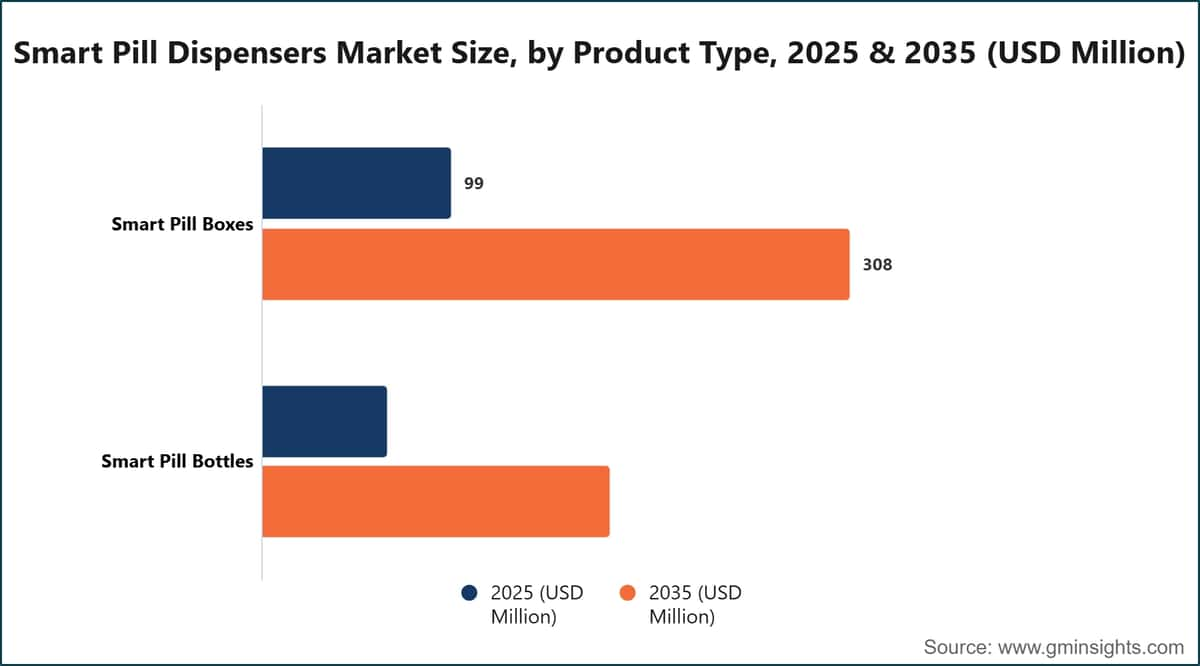
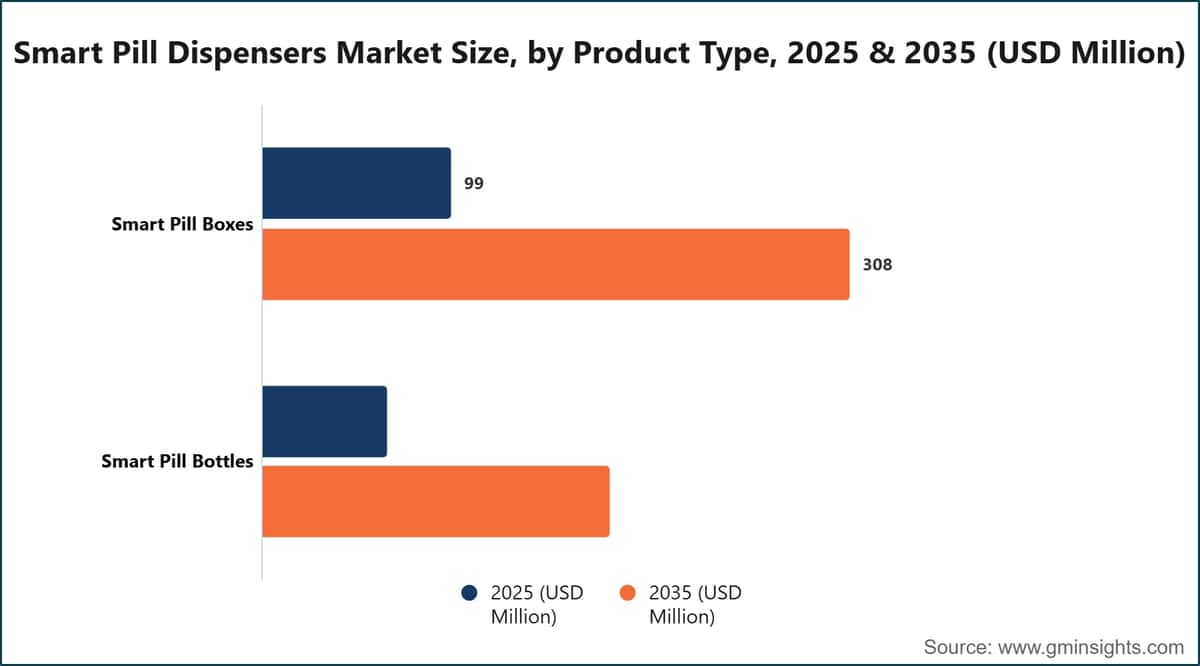
Smart pill boxes generated USD 99 million in revenue in 2025 and are projected to reach USD 308 million by 2035. In the smart pill dispensers market, multi-compartment designs suit polypharmacy management, visual dose confirmation, and caregiver oversight, supporting adoption in home health, memory care, and senior living settings where staff need a consolidated medication-management workflow.
 Smart Pill Dispensers Market Size By Product Type 2025 And 2035 Usd Million
To get key market trends
Download Free PDF
Smart pill bottles held a 40.0% share of the market in 2025 and are projected to expand at a CAGR of 10.7% from 2026 to 2035. Bottle-format products align more readily with existing pharmacy packaging and specialty-drug programs, but their competitive position depends on the quality of associated analytics, alerting, and clinical integration as sensor-enabled caps become more familiar across the market.
By Indication
Dementia & Alzheimer’s generated USD 46 million in 2025 and are projected to reach USD 148 million by 2035. The U.S. population aged 65 years and older living with Alzheimer’s dementia was estimated at 6.9 million [5]Alzheimer’s Association. “2024 Alzheimer’s Disease Facts and Figures.” alz.org. Automated dispensing and caregiver alerts are particularly relevant where cognitive decline prevents reliable self-management and shifts medication responsibility toward families and professional care staff.
Diabetes accounted for 24.2% of indication revenue in 2025 and is projected to generate USD 123 million by 2035. The global number of adults living with diabetes is expected to reach 853 million by 2050 [2]International Diabetes Federation. “IDF Diabetes Atlas, 11th Edition.” diabetesatlas.org. The segment benefits from recurring therapy routines and the potential to connect dispensing with specialty-pharmacy, glucose-monitoring, and care-management programs.
Cancer & Oncology represented 20.0% of indication revenue in 2025 and is projected to grow at a CAGR of 12.5% from 2026 to 2035. Oral oncology programs place a premium on regimen visibility and patient support, creating an attractive setting for connected pill bottles and monitoring platforms that can support sponsor, pharmacy, and care-team engagement.
Cardiovascular accounted for USD 20 million in 2025 and is projected to represent 10.4% of indication revenue by 2035. The indication remains an established medication-reminder use case, but adoption is comparatively mature in better-insured patient groups. Incremental demand is likely to depend on integration with broader chronic-care and polypharmacy programs rather than isolated reminder functionality.
Other Indications are projected to generate USD 61 million by 2035 and expand at a CAGR of 8.9% from 2026 to 2035. Renal, respiratory, psychiatric, and other chronic-care applications broaden the opportunity, although heterogeneous treatment pathways make it harder for suppliers to standardize clinical workflows and product configurations.
By End-Use
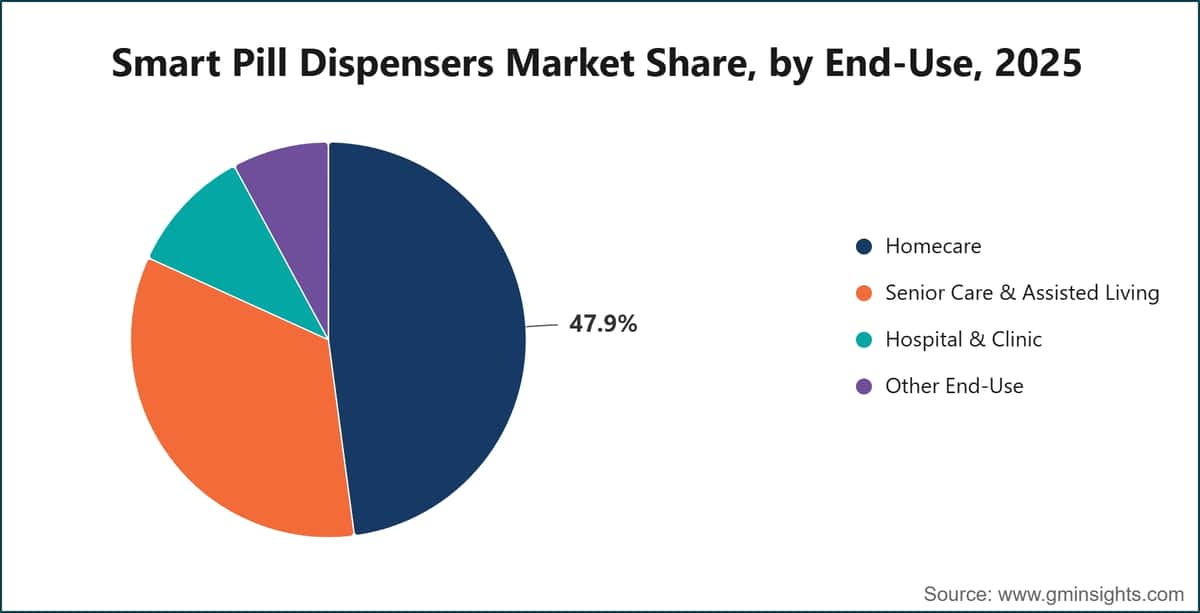
Homecare generated USD 79 million in 2025 and is projected to reach USD 235 million by 2035. The smart pill dispensers market is supported in this setting by aging-in-place preferences and the need to give caregivers visibility into dosing without requiring continuous in-person supervision. Product value depends on reliable setup, simple patient interaction, and timely exception alerts.
 Smart Pill Dispensers Market Share By End Use 2025
Senior Care & Assisted Living is projected to generate USD 183 million by 2035 and grow at a CAGR of 12.6% from 2026 to 2035. Facility-level purchasing can aggregate demand across large resident populations, making the channel particularly attractive for vendors that can integrate dispensing, reporting, and staff workflow management into a repeatable institutional offering.
Hospital & Clinic settings generated USD 17 million in 2025 and are projected to account for 8.8% of end-use revenue by 2035. The channel is increasingly oriented toward transitional care, with devices supporting medication continuity after discharge rather than replacing established in-facility medication-administration systems.
Other End-Use accounted for 7.9% of total revenue in 2025 and is projected to generate USD 29 million by 2035. Correctional, workplace, and wellness-oriented deployments can create targeted demand, but their fragmented procurement structures and varied clinical requirements limit the scale and consistency available in core care settings.
GMI Analyst View
We see institutional value concentrating in platforms that can serve several indications and care settings on a shared software foundation. Product differentiation will increasingly rest on workflow fit, caregiver visibility, and subscription durability, not on dispensing mechanics alone. This favors suppliers capable of balancing broad usability with clinical-grade reporting.
Smart Pill Dispensers Market Regional Analysis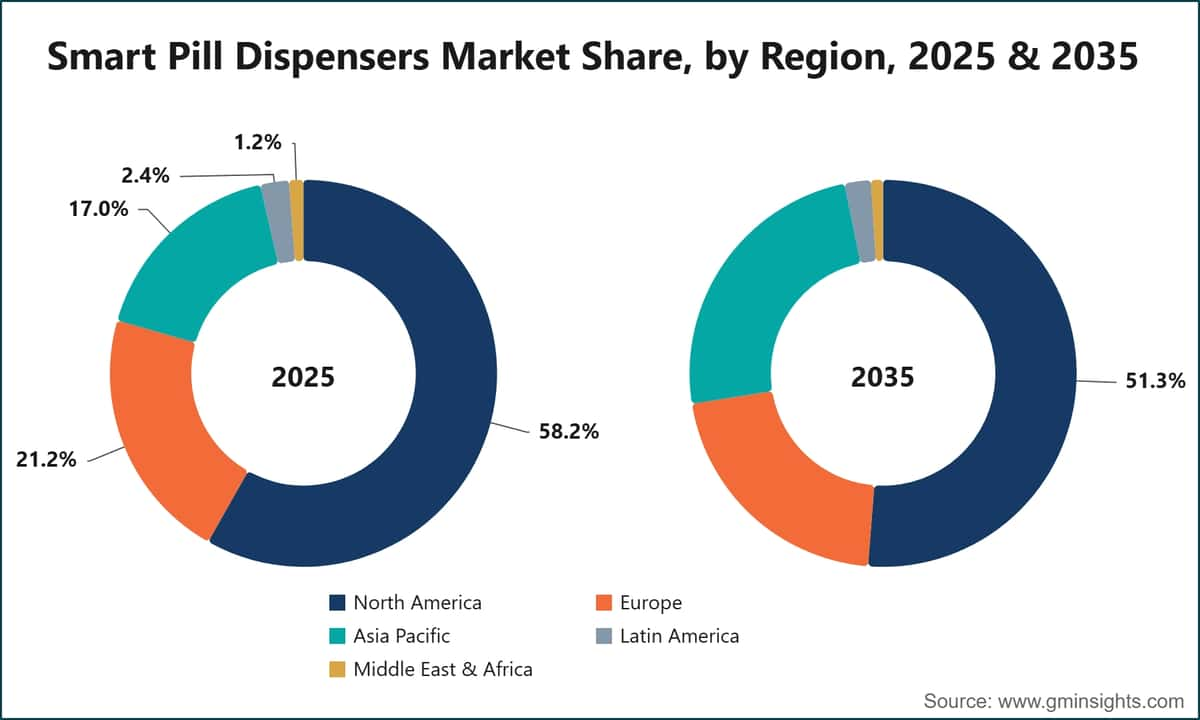 Smart Pill Dispensers Market Share By Region 2025 And 2035
Learn more about the key segments shaping this market
Download Free PDF
North America Smart Pill Dispensers Market Analysis
North America held a 58.2% share of the global market in 2025 and is projected to reach USD 251 million by 2035. The Smart Pill Dispensers Market in North America benefits from mature digital-health infrastructure, established reimbursement pathways, and a large population managing chronic conditions and polypharmacy. Institutional adoption is reinforced where connected dispensing can support remote monitoring, care coordination, and senior-care operations.
United States
The United States generated USD 90 million in 2025 and is projected to grow at a CAGR of 10.0% from 2026 to 2035. Reimbursement-supported remote care, large homecare networks, and a mature pharmacy ecosystem provide an established environment for clinical and consumer-connected dispensing models, although adoption is increasingly shaped by integration quality and payer eligibility.
Canada
Canada generated USD 6 million in 2025 and is projected to reach USD 17 million by 2035. Provincial aging-in-place initiatives and digital-health strategies create an expanding route for connected medication-management solutions, particularly where homecare providers can incorporate devices into coordinated care plans.
Europe Smart Pill Dispensers Market Analysis
Europe is projected to reach USD 104 million by 2035 and accounted for 21.2% of the global market in 2025. The Smart Pill Dispensers Market in Europe is shaped by public-system procurement, national digitization programs, and varying reimbursement structures. Suppliers must navigate fragmented regulatory, purchasing, and interoperability environments even as demand rises for tools that support older populations and chronic-care management.
Germany
Germany is projected to reach USD 31 million by 2035 and grow at a CAGR of 12.0% from 2026 to 2035. Its structured digital-health reimbursement environment and large elderly population provide a comparatively strong institutional foundation for connected adherence platforms.
United Kingdom
The United Kingdom generated USD 8 million in 2025 and is projected to reach USD 24 million by 2035. National procurement frameworks and remote-monitoring initiatives can give qualified suppliers access to concentrated demand, provided they satisfy public-sector assessment and implementation requirements.
France
France generated USD 6 million in 2025 and is projected to grow at a CAGR of 12.2% from 2026 to 2035. Expansion in digital-health reimbursement and national health-record infrastructure can improve the conditions for connected adherence tools, particularly as providers seek scalable chronic-care support.
Italy
Italy generated USD 4 million in 2025 and is projected to reach USD 11 million by 2035. Demand is supported by an aging population, but regionally varied health-system procurement and implementation practices may slow broad national rollout.
Spain
Spain generated USD 3.5 million in 2025 and is projected to reach USD 9 million by 2035. Adoption is likely to remain concentrated in autonomous communities with more developed digital-health budgets and institutional social-care programs.
Netherlands
The Netherlands is projected to reach USD 7 million by 2035 and grow at a CAGR of 13.3% from 2026 to 2035. Strong digital-health adoption and insurer participation can accelerate connected-device use, although growth starts from a comparatively smaller revenue base.
Rest of Europe
Rest of Europe includes a varied group of markets with uneven reimbursement frameworks, digital-health readiness, and procurement practices. Opportunities are strongest where public or private payers create a defined route for connected medication-management tools.
Asia Pacific Smart Pill Dispensers Market Analysis
Asia Pacific generated USD 28 million in 2025 and is projected to grow at a CAGR of 15.6% from 2026 to 2035. The Smart Pill Dispensers Market in Asia Pacific is supported by population aging, expanding digital-care infrastructure, and distinct national approaches to healthcare procurement. Growth is likely to combine institutional deployments in developed care systems with consumer and private-provider adoption in rapidly digitizing markets.
China
China accounted for 17.9% of the Asia Pacific market in 2025 and is projected to grow at a CAGR of 17.0% from 2026 to 2035. Public digital-health initiatives, large-scale urban healthcare systems, and expanding connected-care pilots create a substantial opportunity for suppliers able to meet local integration and commercialization requirements.
India
India is projected to reach USD 21 million by 2035 and grow at a CAGR of 15.4% from 2026 to 2035. Near-term demand is concentrated in private hospital networks, corporate health programs, and digitally engaged urban consumers, while broader public-system integration is expected to develop more gradually.
Japan
Japan generated USD 7 million in 2025 and is projected to reach USD 26 million by 2035. A deeply aging population and established homecare infrastructure support institutional use cases for medication-management technology, especially where connected platforms can reduce caregiver workload.
Australia
Australia generated USD 3 million in 2025 and is projected to reach USD 10 million by 2035. Digital-health infrastructure and assistive-technology support can create routes for connected adherence devices in homecare, disability support, and coordinated chronic-care programs.
South Korea
South Korea accounted for 14.3% of the Asia Pacific market in 2025 and is projected to grow at a CAGR of 14.9% from 2026 to 2035. Its advanced digital ecosystem and increasing policy attention to aging-related care create favorable conditions for connected medication-management platforms.
Rest of Asia Pacific
Rest of Asia Pacific includes markets where smartphone-led health engagement is expanding but reimbursement and regulatory pathways remain uneven. Suppliers may need lower-cost form factors, localized support models, and channel partnerships to convert consumer interest into sustained adoption.
Latin America Smart Pill Dispensers Market Analysis
Latin America generated USD 4 million in 2025 and is projected to reach USD 11 million by 2035. The Smart Pill Dispensers Market in Latin America remains early stage, with demand concentrated in urban private-care settings and emerging digital-health programs. Affordability, import dependence, and uneven insurance coverage remain significant determinants of market access.
Brazil
Brazil generated USD 2.5 million in 2025 and is projected to reach USD 6.5 million by 2035. The market is supported by a combination of private supplementary coverage in major cities and an expanding public digital-health agenda, creating distinct pathways for premium and institutional deployments.
Mexico
Mexico accounted for 25.0% of the Latin America market in 2025 and is projected to grow at a CAGR of 11.6% from 2026 to 2035. Urban telemedicine uptake and private healthcare access support adoption, while procurement remains concentrated in metropolitan markets with stronger digital-health readiness.
Argentina
Argentina generated USD 0.4 million in 2025 and is projected to reach USD 1.0 million by 2035. Senior-care programs offer a limited institutional entry point, but macroeconomic volatility and hardware-import constraints can restrict the pace of deployment.
Rest of Latin America
Rest of Latin America presents selective opportunities in markets where private insurance, urban provider networks, or public digital-health initiatives support connected-care adoption. Broader expansion remains dependent on pricing accessibility and formal reimbursement development.
Middle East & Africa Smart Pill Dispensers Market Analysis
Middle East & Africa generated USD 2 million in 2025 and is projected to reach USD 5 million by 2035. The Smart Pill Dispensers Market in Middle East & Africa is concentrated in a limited number of urban care environments where health digitization mandates, private insurance coverage, and purchasing capacity support connected devices. Most markets remain constrained by affordability and limited implementation infrastructure.
Saudi Arabia
Saudi Arabia accounted for 40.0% of the Middle East & Africa market in 2025 and is projected to reach USD 2.0 million by 2035. Centralized healthcare procurement and national digitization priorities create a potential route to institutional scale once connected dispensers meet local approval and formulary requirements.
UAE
The UAE generated USD 0.5 million in 2025 and is projected to grow at a CAGR of 13.7% from 2026 to 2035. Advanced urban care systems, high digital engagement, and private-provider demand support early adoption of connected medication-management tools.
South Africa
South Africa generated USD 0.4 million in 2025 and is projected to reach USD 0.8 million by 2035. Premium private-care programs offer the principal channel for deployment, while device-import costs and income inequality constrain wider market penetration.
Rest of MEA
Rest of MEA remains nascent, with adoption concentrated in private hospital chains and affluent urban patient groups. Regulatory pathways, affordability, and reliable connectivity will determine whether pilot deployments can move into broader care delivery.
GMI Analyst View
We expect regional performance to depend on the strength of each market’s procurement and reimbursement architecture rather than on demographic need alone. Mature systems can turn adherence tools into repeatable institutional programs, while faster-emerging markets may require localized pricing, distribution, and implementation models before their demand potential becomes commercially scalable.
Smart Pill Dispensers Market Share & Competitive Landscape
The smart pill dispensers market is moderately concentrated, with the five leading players collectively holding approximately 47% of global market share in 2025. Smart pill dispensers market share is shaped by software capability, reimbursement access, EHR integration depth, and the ability to win institutional customers, rather than by device form factor alone. Competitive intensity remains high because suppliers must demonstrate clinical workflow fit alongside dependable hardware and patient support.
MedMinder held a 15% market share in 2025. Its connected pharmacy, dispensing, and adherence-monitoring approach positions the company strongly in elderly and polypharmacy care, where remote oversight and coordinated fulfillment can create a more integrated offering than a standalone device sale.
AdhereTech held a 12% market share in 2025. The company’s smart-bottle model is well suited to specialty-pharmacy and clinical-trial settings, where the packaging format can fit existing distribution workflows and adherence data can inform patient-support activities.
Hero Health held a 9% market share in 2025. Subscription-oriented automated dispensing, dose tracking, and caregiver alerts align with homecare and reimbursed remote-care models, where ongoing service delivery is increasingly important to competitive positioning.
e-pill Medication Reminders serves consumer, pharmacy, and assisted-living channels with medication-management products spanning simple reminders and multi-alarm dispensers. Its broad range can reduce adoption friction across varied patient needs, although greater clinical integration is likely to become increasingly important in institutional purchasing decisions.
etectRx differentiates through its ID-Cap ingestible sensor system, which is designed to confirm medication ingestion rather than merely record container interaction. This capability can be particularly relevant to clinical research and specialty applications where a higher standard of adherence evidence is required.
Livi, PillDrill, DoseTap, SMRxT, Pill Connect, MedReady, Pillohealth, Loba, Tenovi, and Tricella broaden competitive activity across automated dispensing, smart-bottle connectivity, remote monitoring, and adherence analytics. Their ability to establish channel partnerships, satisfy security requirements, and support implementation at scale will influence whether they can move beyond niche or regional positions.
Recent Industry Developments
In July 2025, MedMinder announced a partnership with the New England Center for Children to deploy its connected pharmacy and medication-adherence platform across the organization’s central school and residential homes [6]MedMinder. “NECC Selects MedMinder to Transform Their Medication Management for Individuals with Autism They Serve.” medminder.com. The collaboration demonstrates the extension of connected dispensing into behavioral-health and neurodevelopmental care environments.
In August 2025, AARDEX Group and Pill Connect announced a strategic partnership integrating Pill Connect’s connected dispenser hardware with AARDEX’s adherence software for a multi-cohort Phase 2A dose-selection clinical trial [7]AARDEX Group. “AARDEX Group and Pill Connect Partner to Advance Dose Selection with Real-Time Adherence Monitoring in Phase 2A Clinical Trial.” aardexgroup.com. The partnership illustrates the role of connected dispensing technology in decentralized pharmaceutical research and evidence-generation workflows.
Need a specific section of this report?
Purchase regional analysis, country-level analysis, company profiles, or any other segment-level insights separately
based on your research needs.
Request Sectional Pricing