
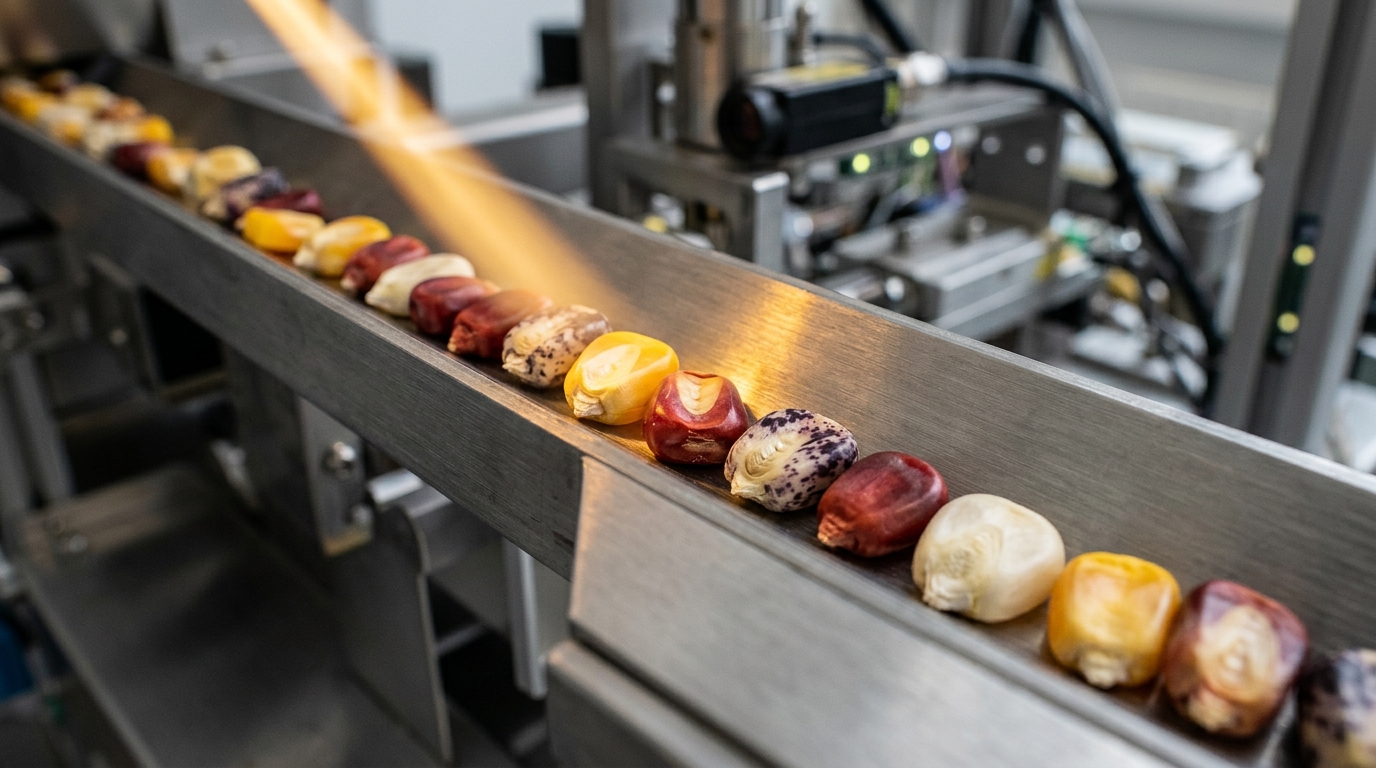
Plant scientists evaluating doubled haploid breeding methods in maize have demonstrated that an automated single-kernel near-infrared reflectance spectroscopy sorter can distinguish maternal haploid kernels from hybrid kernels across diverse field and sweet corn populations. Doubled haploid technology dramatically shortens the development cycle for homozygous inbred lines in Zea mays from six or more generations of self-pollination down to just two generations. However, because haploids typically occur at low frequencies following induction crosses, separating rare haploid kernels from the overwhelming bulk of hybrid seed represents a laborious operational bottleneck. The new experimental assessment shows that pairing high-oil haploid inducer lines with single-kernel spectroscopy allows automated classification without relying on conventional visual pigmentation markers, which frequently fail in sweet corn varieties where anthocyanin accumulation is genetically suppressed.
In standard maize breeding pipelines, breeders induce haploids in vivo by pollinating a female donor line with pollen from specialized male haploid inducer lines. Although modern inducer lines carry genetic factors that elevate the maternal haploid induction rate up to fifteen percent, haploids still comprise only a small minority of the total harvested grain. Commercial and academic breeding programs have historically sorted these populations by visually inspecting seed for the dominant R1-navajo anthocyanin color marker, which stains the embryo and endosperm aleurone purple in fertilized diploid hybrids while leaving haploid embryos colorless. Visual sorting is not only time-consuming and subjective, but it also collapses in sweet corn backgrounds, where breeders deliberately select for recessive endosperm mutations and suppressed kernel anthocyanin pigmentation to satisfy consumer preferences. To bypass these visual limitations, researchers have increasingly examined biological and chemical distinctions, such as embryo oil accumulation driven by the paternal genome.
To rigorously test automated optical and chemical discrimination, the research team generated twelve distinct haploid induction cross populations at the Iowa State University Agricultural Engineering and Agronomy Research Farm. The experimental crosses combined four female donor hybrids with four high-oil haploid inducer lines designated IHO-1 through IHO-4. The donors comprised two commercial field corn hybrids, Viking 51 and Viking 60, alongside two commercial sweet corn hybrids, CCO-1 and CCO-2, known for moderately suppressed kernel anthocyanin expression. The male inducers were derived from crosses between the high-oil inbred line IHO and the elite haploid inducer BHI305, incorporating marker-assisted selection for the induction quantitative trait loci qhir1 and qhir8. Across these twelve populations, the resulting kernels were visually categorized into normal and defective classes, tracked individually in multi-well plates, and verified for true ploidy status using genomic DNA markers targeting the MATRILINEAL haploid induction gene.
Spectral data collection was conducted using a custom-built single-kernel near-infrared sorter equipped with an illuminated light tube and an InGaAs photodiode array spectrophotometer spanning wavelengths from 906 to 1679 nanometers. Kernels dropped through the optical chamber, where fiber optic cables captured reflectance spectra within a fraction of a second before a two-way solenoid air mechanism routed each kernel into designated bins. The collected spectral data were trimmed to the 940 to 1640 nanometer region and converted to absorbance values. In parallel, reference oil values for calibration were established using nuclear magnetic resonance analysis. While previous nuclear magnetic resonance instruments achieve accurate oil-based kernel separation exceeding ninety-five percent, they require several seconds per kernel to weigh and scan. The near-infrared system captured full spectral signatures in approximately 0.25 seconds per kernel, offering the high physical throughput required for commercial plant breeding programs.
The researchers investigated two primary computational frameworks for sorting: direct classification based on predicted oil content and multivariate machine learning using the complete near-infrared spectrum. Chemical sorting exploits the xenia effect, wherein hybrid kernels inherit a paternal contribution from the high-oil inducer and accumulate substantially more oil in their embryos than haploids, which inherit only maternal embryo genetics. Using partial least squares regression calibrated against nuclear magnetic resonance, the system estimated individual kernel oil content. Across all twelve populations, hybrid kernels displayed significantly higher predicted oil content than haploid kernels, yielding an overall average difference between hybrid and haploid classes of 1.77 percent.
To evaluate oil-based decision rules under realistic breeding scenarios, the team developed two non-calibrated algorithms: a lowest percentage method and a dynamic threshold method. The lowest percentage approach designated the bottom four to twenty percent of kernels ranked by oil content as haploids, selecting fourteen percent as the optimal global parameter. The dynamic threshold method classified kernels as haploid if their predicted oil fell below the population mean minus a fixed offset value, with an offset of 2.0 selected as optimal. Both algorithms were evaluated against strict operational benchmarks established by doubled haploid production facilities: a false discovery rate of 0.25 or less, ensuring that hybrid contamination in the haploid bin remains minimal, and a false negative rate of 0.50 or less, preventing excessive loss of true haploids. Because kernel oil distributions overlapped considerably between classes, both general oil-based algorithms satisfied both performance benchmarks in only two of the twelve tested populations.
To transcend the limitations of intermediate oil predictions, the researchers evaluated supervised multivariate machine learning models trained on standardized spectral profiles. Using partial least squares discriminant analysis, random forests, and support vector machines with radial basis functions, models were tested via hold-one-population-out cross-validation across the twelve induction populations. The general support vector machine model achieved superior classification accuracy, successfully sorting four of the twelve populations under the operational criteria with an overall mean false discovery rate of 0.32 and a false negative rate of 0.38.
A critical operational hurdle addressed by the study is the presence of defective kernels arising naturally during in vivo induction from embryo or endosperm abortion. The authors found that defective kernels shared overlapping oil profiles with haploid kernels, rendering oil-only sorting ineffective for removing them. However, defective kernels exhibited highly distinct near-infrared spectral signatures across the 940 to 1640 nanometer band. The team therefore constructed a dedicated secondary multivariate model using partial least squares discriminant analysis to filter defective kernels out of the predicted haploid pool, achieving false discovery and false negative error rates below 0.10 across all populations containing defective seeds.
Integrating the general support vector machine with the secondary defective-kernel filter created an end-to-end two-stage sorting pipeline that delivered impressive recovery metrics in responsive populations. Across the twelve populations, eight achieved final haploid purity exceeding 0.50, with six populations surpassing 0.80 purity. End-to-end haploid recovery exceeded 0.50 in nine populations, demonstrating that most viable haploids could be successfully salvaged from raw induction harvests. Detailed confusion matrix analyses confirmed that remaining contamination in the recovered pool consisted almost entirely of misclassified hybrid kernels rather than non-viable defective seed. In the top-performing sweet corn cross, the two-stage pipeline delivered a haploid purity of 1.00 with an overall recovery rate of 0.79, illustrating the power of multi-stage spectroscopic sorting in genetic backgrounds where visual sorting has historically failed.
Statistical variance partitioning revealed that maternal donor genetics exerted the dominant influence over sorting success, accounting for 60.3 percent of the total variation observed in delta oil. Crosses involving the field corn donor Viking 51 and the sweet corn donor CCO-1 generated wide oil differentials and proved highly amenable to both optical and chemical sorting. Conversely, the sweet corn donor CCO-2 exhibited strong biological resistance to inducer-driven oil inflation across all tested inducers, resulting in compressed delta oil values and poor classification accuracy under all modeling strategies. Furthermore, the analysis detected an inverse relationship between oil divergence and haploid induction rate among the tested inducer lines, highlighting a fundamental breeding trade-off between maximizing paternal oil transmission and maintaining high induction frequencies.
The study concludes that single-kernel near-infrared spectroscopy provides a robust, objective, and high-speed alternative to manual seed inspection for maize breeding programs, particularly when working with anthocyanin-suppressed sweet corn. Because the general support vector machine operates across diverse populations without requiring cross-specific training or genetic testing, it can be deployed directly into operational doubled haploid pipelines. The authors emphasize that future enhancements will depend on breeding high-oil haploid inducer lines that reliably overcome donor-side resistance and elevate embryo oil differences across broader elite germplasm pools. Expanding spectral training libraries to encompass wider genetic diversity will further solidify automated spectroscopic sorting as a standard tool for rapid maize improvement.
Subject of Research: Automated haploid kernel identification in maize using single-kernel near-infrared spectroscopy and high-oil inducers
Article Title: Single-kernel near-infrared spectroscopy enables haploid kernel sorting in field and sweet corn using high-oil haploid inducers across diverse donor-inducer combinations
Article References: Sharma, S., Gustin, J. L., Frei, U. K., Settles, A. M., Lübberstedt, T., Resende, M. F. R., Jr., & Hershberger, J. (2026). Single-kernel near-infrared spectroscopy enables haploid kernel sorting in field and sweet corn using high-oil haploid inducers across diverse donor-inducer combinations. Theoretical and Applied Genetics, 139(12), Article 332. https://doi.org/10.1007/s00122-026-05424-1
Image Credits: AI Generated
DOI: 10.1007/s00122-026-05424-1
Keywords: Maize breeding, Doubled haploid technology, Near-infrared spectroscopy, skNIR sorter, High-oil haploid inducers, Haploid kernel sorting, Sweet corn, Field corn, Support vector machine, Partial least squares, Kernel oil content, Defective kernels, R1-navajo marker, Plant breeding automation, Chemometrics, Zea mays