

Volunteers with Entergy help plant native trees in a section of City Park’s Couturie Forest that was covered with Chinese rain trees in New Orleans, Thursday, Nov. 12, 2026. STAFF PHOTO BY SOPHIA GERMER
Sophia Germer
Mark Campo, a lawyer in Entergy’s tax department, remembers planting Louisiana irises on the banks of a lagoon in City Park’s Couturie Forest during a company volunteer event in spring 2025. A year later, he saw the gratifying results of his effort as leaves and flowers dotted the landscape.
“We planted them in just a bank of mud by the pond,” Campo said. “Then come back a year later and see them all bloom, and no one trampled on them, they survived. That was fun.”
Campo and around 20 others from the tax department were back in the forest last week, planting swamp hibiscus, southern wax myrtle and other native shrubs in the forest, a 60-acre glen on the north side of the park. Within a couple of hours, they had met their goal of planting 70 shrubs.
Such volunteer sessions are part of a large effort to restore the native ecosystem in the Couturie Forest, which was decimated after Hurricane Katrina in 2005 and then overrun with invasive plants. In the decades since, a lot of the park’s volunteer efforts have been focused on eradicating the invasive plants and restoring native ones.
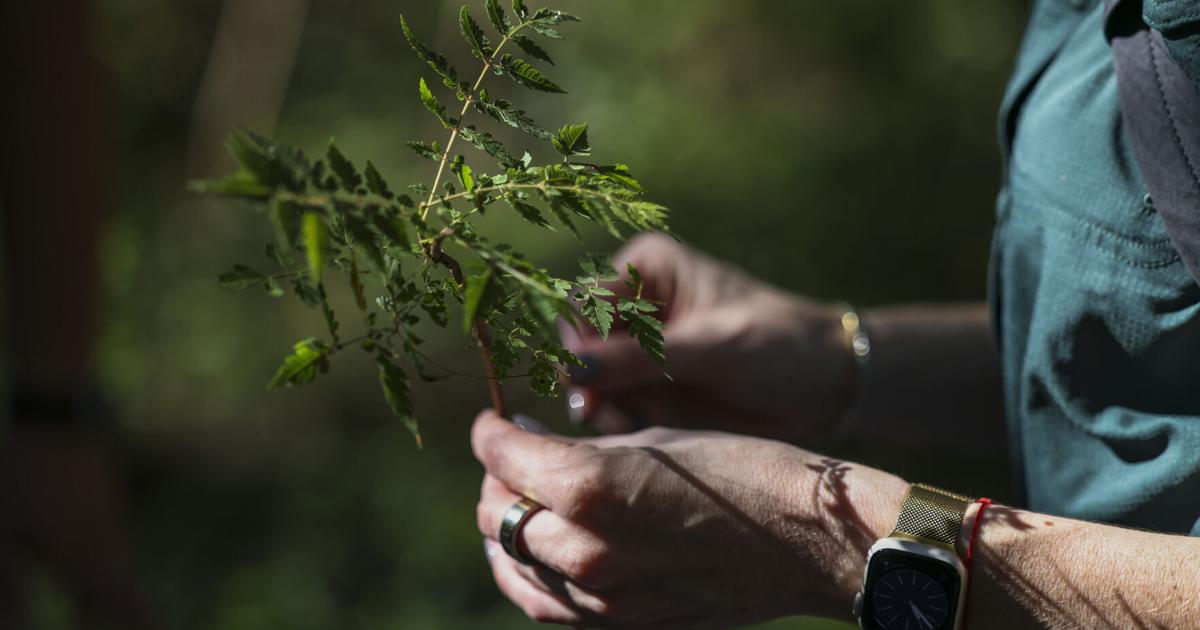
Last year, arborists with City Park began removing dozens of invasive, wide-canopy Chinese rain trees, which produce peach-colored flowers and outcompete native plants for sunlight and nutrient resources.
Now, park officials believe they’ve removed enough trees in part of the forest to make room for native flora. A couple weeks ago, one volunteer group planted southern magnolias, persimmons and other native trees. The Entergy group filled in the understory during their recent trip.
City Park officials will continue to use their primarily volunteer workforce to restore the native ecosystem throughout the forest. That will help sustain wildlife and improve its storm resiliency, said Kylie Lesko, an arborist with City Park.
“Native trees originated here, they have these adaptations to the climate and they’re ready for storms, and they have specific adaptations for pests and all these things,” Lesko said. “If we restore the area with natives, it’s going to be a lot more resilient in the long term.”
A mature Chinese rain tree grows and flowers at City Park’s Couturie Forest in New Orleans, Thursday, Nov. 12, 2026. STAFF PHOTO BY SOPHIA GERMER
Sophia Germer
Chinese rain trees were first brought to the U.S. because of their attractiveness. Over time, birds, wind and water carried the seeds into the Couturie Forest, where they flourished. Greg Genuardi, volunteer manager with City Park, said the part of the forest where volunteers were working had been on the verge on becoming a “monoculture” of Chinese rain trees.
But Chinese rain trees aren’t the only invasive species challenging park officials. Invasive vines like bush killer wrap around native plants, choking them out as they reach for sunlight. In other areas of the forest, volunteers have worked to remove the invasive vines.
Restoring the native ecosystem also means restoring a diverse habitat, where understory plants and tall trees work together. Native species like live oaks have evolved to withstand frequent storms. Clearing the understory plants would make the trees much more vulnerable as storms roll in, Lesko said, as the trees then would be more exposed.
In addition, the native wildlife in the Couturie Forest, including box turtles and swamp rabbits, depend on native plant diversity for food and shelter. The forest is known as one of the best birding spots in the state, Genuardi said — a place where migratory birds stop and rest during their long journeys.
Park officials have even seen screech-owl and great horned owl nesting pairs in the forest, Genuardi said.
“Removing the invasive stuff, giving the native stuff a chance to survive, you might even see an increase of those native species,” Genuardi said, “Because that’s what they’re used to having around, and used to having that for food and shelter.”
A butterfly flies around Lantana flowers at City Park’s Couturie Forest in New Orleans, Thursday, Nov. 12, 2026. STAFF PHOTO BY SOPHIA GERMER
Sophia Germer
Without volunteers, the park would not be able to do the restoration work in the forest, Lesko said.
Ever since Entergy’s tax department first volunteered at City Park a few years ago, its employees have returned twice a year for a day of service. It’s always a popular event, Campo said.
A native of New Orleans, Campo grew up fishing and playing in City Park, but he had not visited the Couturie Forest until the first volunteer event. Now, he takes his kids and dogs to the forest to hike on its trails.
Walking around in the Couturie Forest, you forget that you’re in a city, Genuardi said. He said he’s seen residents hiking, fishing or even meditating in the forest.
“It’s nice to just get lost in here,” Genuardi said. “It should be, and hopefully is, a safe space for people to just come into, get lost for a little bit, unplug, just enjoy nature.”