
Astronomers call the cosmos in its first half-billion years the baby universe. It is a time before mature galaxies settled into graceful spirals, when gravity was sculpting the raw hydrogen-helium fog left by the Big Bang. Catching this era is like finding an infant photograph in a family album the size of the sky—and JWST’s latest frame is the clearest yet.
Back then, everything was hot gas—mostly hydrogen and helium—with no stars yet shining. Earlier telescopes could only study this era by looking at the cosmic microwave background, a faint “after-glow” from when the universe was just 380 000 years old.
But the microwave view shows only fuzzy temperature spots. The James Webb Telescope, working in infrared light, can zoom in to see the first tiny galaxies that formed inside those spots. “We built Webb to see the first objects that formed after the Big Bang,” says Nobel Prize–winning scientist John Mather, who has guided the telescope from day one.
How the James Webb Telescope snapped such a distant picture
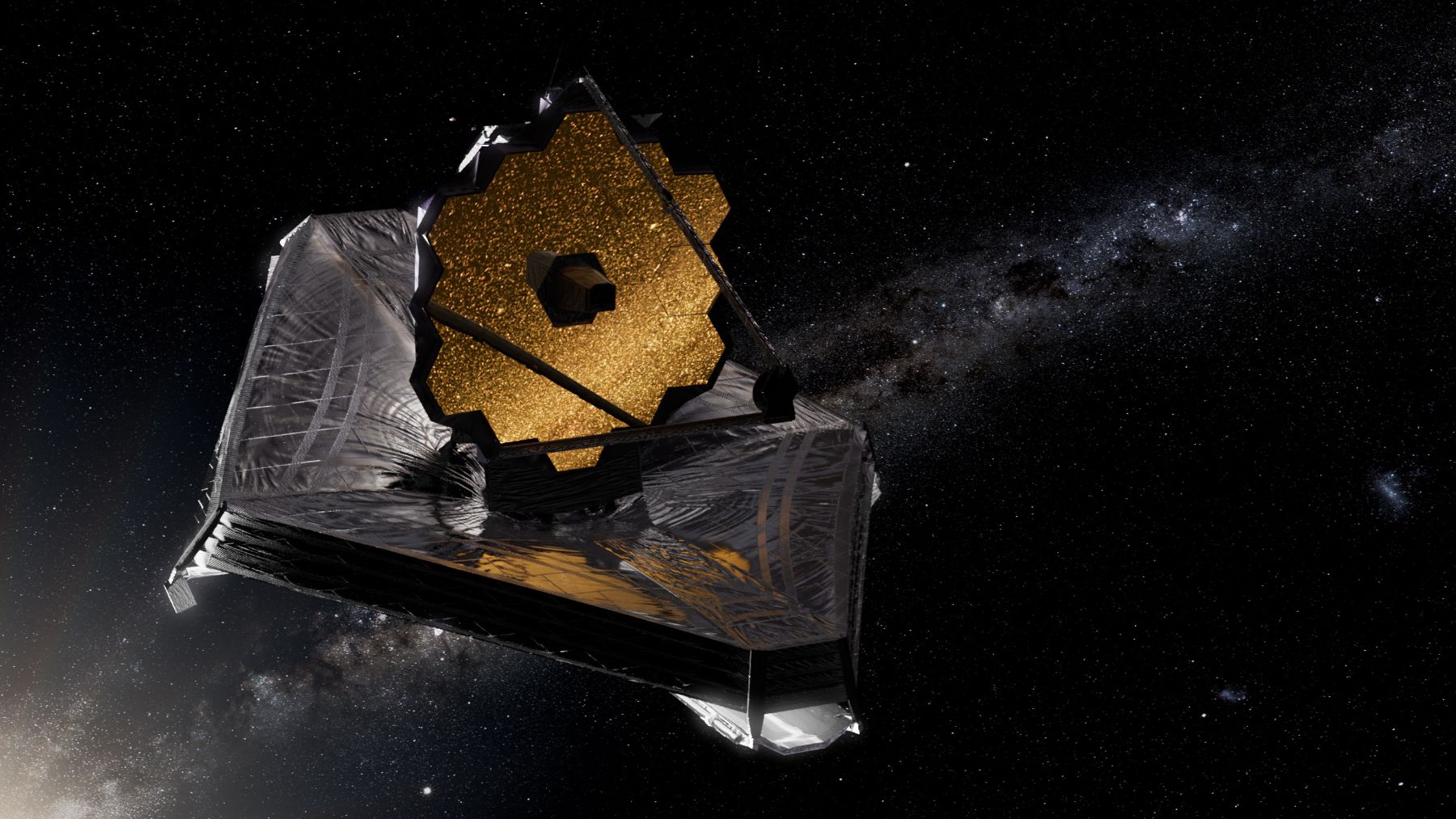
Webb’s giant gold mirror is six and a half meters wide—about the size of a house. It sits in deep space, kept colder than minus 380 °F, so its own heat won’t blind the cameras. During a long observing session called JADES, Webb aimed its NIRSpec instrument at the faint smudge of JADES-GS-z14-0. Ten hours later, the data showed a record redshift of 14. That number tells astronomers how much the universe has stretched the light on its way to Earth. Dr. Jane Rigby, who runs the day-to-day science team, calls Webb “a time machine letting us watch galaxies grow up.”
Operations lead Jane Rigby calls the telescope “a time machine … letting us see some of the earliest galaxies, as they looked several hundred million years after the Big Bang.”
What the image tells us about our cosmos
The scene shows stars blazing inside compact clumps of nearly pure hydrogen and helium—the first metals had barely formed. Gas filaments appear to be funneling material onto the young galaxy, a process JWST specialists dub “cold streams.” These flows likely fed the rapid growth of an early black hole, helping solve the mystery of how some supermassive black holes reached a billion solar masses in barely 800 million years.
The new data dovetail beautifully with ACT’s microwave map, confirming that the same density ripples seen in the CMB blossomed into real galaxies on schedule. Cosmologists call this victory for the ΛCDM model “boring in the best way”: the numbers match theory, but the precision now exposes subtler puzzles, like the ongoing tension in Hubble-constant measurements and the nature of dark energy.
Ground-based instruments will soon add fresh clues. The Simons Observatory, ACT’s successor, will map the CMB with even finer grain, while NASA’s Nancy Grace Roman Space Telescope will survey distant galaxies en masse. Together with JWST, these tools promise to fill in the missing pages of the baby universe story.
Webb’s recent cosmic cameo reel
While probing the baby universe is Webb’s marquee act, the telescope has also racked up a diverse photo album much closer to home. In our own galaxy, it peeled back dusty curtains in the Tarantula Nebula, exposing tens of thousands of newborn stars inside a giant stellar nursery.
Swinging to the Solar System, it snapped Uranus with its entire ring system aglow and even picked out a few faint moons in the same frame. Webb then turned its gaze 15,000 light-years away to capture the Wolf-Rayet star WR 124, a rare pre-supernova giant casting off shells of glowing gas. And in the nearby Fomalhaut system, the observatory revealed three nested debris belts—including two never seen before—hinting at unseen planets sculpting the dust.
Keeping the telescope in perfect condition 1 million miles from Earth is a human challenge too. Rigby jokes that looking after Webb is “like caring for a far-away baby,” while Mather says every download feels like “a postcard from the baby universe.” No wonder astronomers around the world are nine times overbooked for observing time.
However, the James Webb Telescope is going to be busy the next few years. As Mather likes to say, the goal is “to trace our own origin—from quantum fluctuations to galaxies, to the atoms in our bodies.” The baby universe has never looked so lively—and thanks to the James Webb Telescope, the best pictures are surely still to come.