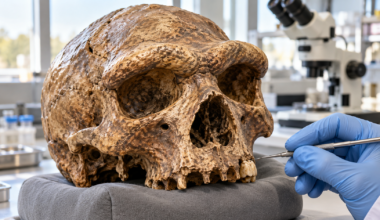
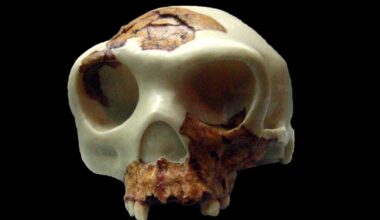
SScience Read More Ancient DNA identifies 146,000 year-old ‘Dragon Man’ as a DenisovanOctober 12, 2026 Ancient DNA and proteins identify China’s nearly complete “Dragon Man” skull as Denisovan.The fossil, at least 146,000 years…
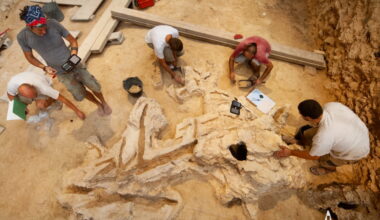
SScience Read More Neanderthal woodworking was far more advanced than we thought, new study showsOctober 8, 2026 Neanderthals did far more with wood than burn it. A new study of 597 wooden remains and imprints…
SScience Read More Africa’s Turkana Rift has entered a critical stage of continental breakupSeptember 19, 2026 The crust beneath the Turkana Rift has thinned to about 13 kilometers, placing the region in an advanced…
SScience Read More ‘Hobbits’ walked more like humans than previously thought, study findsAugust 29, 2026 The pelvis of Homo floresiensis was more human-like than earlier studies suggested, according to a new study of…
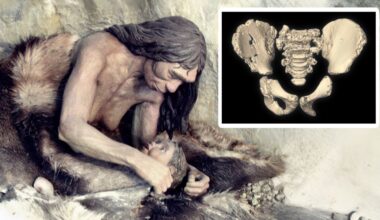
SScience Read More Neanderthal pelvises challenge a long-held idea about childbirth and walkingAugust 26, 2026 For decades, scientists have used the human pelvis to study a basic question about our evolution: how did…
SScience Read More Archaeologists Thought These Early Cannibals Mostly Ate Children. They Were WrongJuly 29, 2026 Homo antecessor is among the oldest known human relatives in Europe. Their fossils have long shown grim signs…
SScience Read More Science news this week: Life on Mars, weird water and a curious human cousinJune 27, 2026 When you buy through links on our articles, Future and its syndication partners may earn a commission. Life…
SScience Read More Mystery cave collapse uncovers ‘advanced human time capsule’ | History | NewsJune 24, 2026 Archaeologists have uncovered a remarkably preserved prehistoric cave that is helping researchers piece together a crucial chapter in…
SScience Read More Largest Denisovan DNA study reveals ancient genes still active in Oceanian populationsJune 21, 2026 Ancient DNA inherited from Denisovans, an extinct group of human relatives, still influences the biology of people living…
SScience Read More Early humans used fire in Wonderwerk Cave up to 1.8 million years agoJune 8, 2026 New evidence from South Africa’s Wonderwerk Cave suggests early humans were using fire inside caves far earlier than…
SScience Read More China scientists argue that harsh settings, not warm climates, drive early human creativityMay 24, 2026 Archaeologists in central China have directly challenged the long-held belief that humanity’s earliest ancestors reached their creative peak…
HHealth Read More Why Can’t We See Ultraviolet Light? An Evolutionary Biologist ExplainsMay 24, 2026 Humans can only see less than 1% of the electromagnetic spectrum. Here’s why evolution may have intentionally hidden…