

Abstract
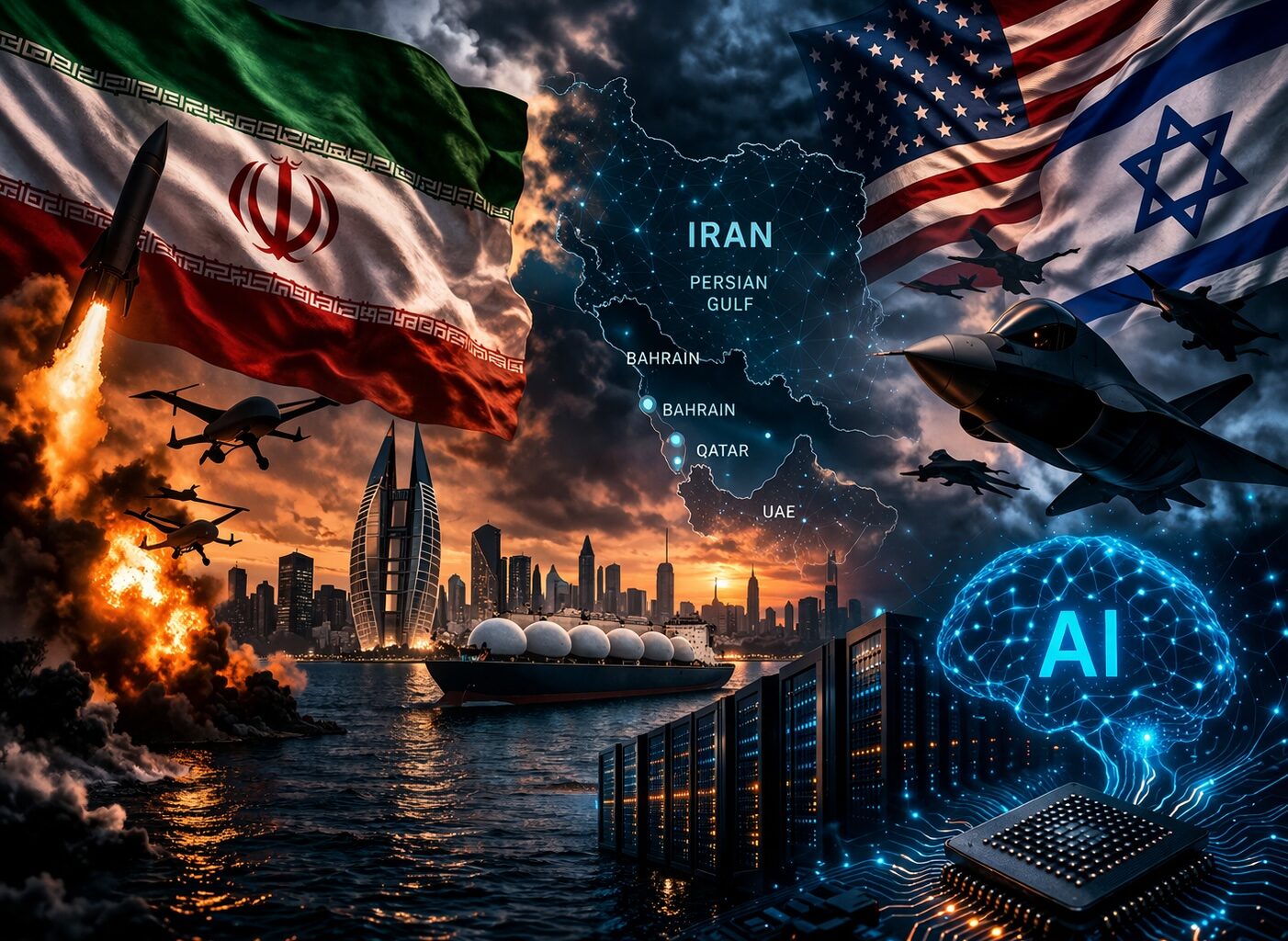
AI is at the heart of the Iran war. On one hand, the US and Israeli militaries use AI technologies massively in order to wage war against Iran. However, Iran retaliates and strikes the Persian Gulf countries. Iran strikes targets, among others, AI infrastructures, while directly threatening the offices and the staff of the US AI companies. And on a larger scale, the economic and energetic consequences of the war threaten the very development of the AI sector.
Context
On the very first day of the Iran War, February 28, 2026, more than 1,000 Iranian targets were struck by US airstrikes. This is almost double the number of strikes carried out on the first day of the Iraq War, launched in 2003. The intensity and precision of these strikes are inextricably linked to the massive use of artificial intelligence (AI)by the American and Israeli militaries.
However, Iran is also involved in the militarization of AI, conducting drone and missile strikes in the air, while also investing heavily in cognitive warfare through the production of deepfakes on social media to destabilize public opinion among its adversaries.
But the interplay between the Iranian war and AI deepens further with Iranian strikes and Qatar’s inability to export liquid helium. Liquid helium is a chemical component essential for cooling the machines and photolithography plants that print the semiconductors needed for the computers and data centers of artificial intelligence companies. And Qatar accounts for more than 38% of global helium production.
Finally, the kinetic strikes on data centers in Bahrain and the United Arab Emirates also reveal the physical vulnerability of artificial intelligence infrastructure. (This potentially includes submarine fiber optic cables, which ensure the flow of data and information between data centers in the Persian Gulf and Africa, the Middle East, and Asia).
In other words, the Iran War is evolving into a global hyperwar system, accelerating the militarization of AI while simultaneously plunging both the American and Chinese AI sectors into overlapping systems of pressure. These systems directly exploit the financial and physical vulnerabilities of AI, which has become the new engine of power.
We argue here that the Iran War is transforming into a vast system of co-integration between the artificial intelligence sector, warfare, and disruptions to the oil and gas sectors, particularly Qatari oil and gas.
US Hyperwar vs. Iranian Hyperwar
AI on the Battlefield
During the first four days of the Iran War (February 28–March 3, 2026), combined US and Israeli military strikes reportedly hit over 4,000 targets in Iran. This pace appears to have continued since then. The intensity and speed of the targeting, execution, and precision of the strikes exemplify how the integration of artificial intelligence capabilities is redefining warfare.
Indeed, AI systems, such as Palantir and Claude, are coupled with machine learning systems within integrated architectures, including Project Maven. Similarly, the theater of operations is being transformed into a data matrix due to the integration of various forms of space-based observation, electronic eavesdropping, and the deployment of airborne and ground-based sensors. Nevertheless, the use of these technologies does not eliminate the risk of errors, such as what appears to have been a tragic strike on a school, which reportedly killed nearly 175 schoolgirls.
Thus, Iran is literally embedded in a digital battlefield, and the country is the generator of the data that feeds the AIs that generate it. This “augmentation” of military capabilities through AI is part of the history of the phases of technological modernization since World War II, including radio communications, radar, sonar, missiles, and nuclear weapons. Then, during the Cold War, computer science and space imaging became dominant, culminating in the Revolution in Military Affairs of the 1990s and the integration of digital and space capabilities to integrate the various branches of the US military.
The Ukrainian and Middle Eastern Laboratories
But the war in Ukraine is a pivotal moment, enabling the co-integration of both the American military and Silicon Valley AI giants in a single theater of operations, facing Russian military power. Since 2022, the Ukraine war has become a giant technological attractor, with the massive projection of drones on the battlefield, as well as the militarization of data feeds, in order to mass produce targets. That transformation takes place in Ukraine and Russia.
Furthermore, during the Gaza War and the Lebanon War of 2023 and 2024, the Israeli army learned to use AI on a massive scale to compile target lists and launch strikes at an unprecedented rate.
This dual wealth of historical and technological experience fuels the military use of AI in Iran, targeting regime officials as well as military installations, critical infrastructure, and weapons and drone production sites with rapid response.
Iran versus Big Tech
But Iran is responding to this hyper-offensive by the United States and Israel with its own version of hyper-war. To this end, Iranian forces have carried out strikes on three Amazon AWS data centers in the United Arab Emirates and Bahrain. Iran has also published a list of American companies it considers “legitimate targets” in the Persian Gulf.
These include Google, Microsoft, Palantir, Amazon, Oracle, Nvidia, and IBM, which have offices and representations in the Persian Gulf countries and Israel. This threat particularly highlights how the Islamic Revolutionary Guard Corps has grasped how the contemporary intertwining of AI and the military is redefining strategic power.
Meta-Offensive
Against AI Production
Following this line of reasoning, the Iranian strikes against Qatari gas facilities, as well as the partial closure of the Strait of Hormuz, take on a particular significance, as they reveal a “meta-targeting” of the very factory of AI.
The Helium Crisis
But the situation in the Persian Gulf is also blocking Qatari exports of liquid helium. This component is a by-product of the emirate’s gas production. However, liquid helium plays a crucial role in the production of semiconductor wafers.
These highly specialized products are manufactured at ultra-low temperatures in a few state-of-the-art factories in Taiwan and South Korea. Their production is exported worldwide, particularly to meet the needs of hyperscale data centers, which supply major cloud service providers and thus enable massive data storage and processing.
Qatar, the AI Hub
Qatar accounts for 38% of global liquid helium production, while the US accounts for 46% and Algeria for 5%. Furthermore, liquid helium is also used by specialized machinery in high-level chemistry and medical imaging. The blockade of Qatari liquid helium exports is therefore akin to both a physical attack on AI’s upstream industrial sector and a financial blow, given that liquid helium prices were already rising due to its ever-increasing use.
This disruption, which creates a shortage upstream in the AI industry chain, is also spreading through the financial channels of investments made by AI giants in 2026.
Indeed, as Michael Kern points out, these AI giants have embarked on massive investment strategies aimed at developing a network of data centers and associated logistics chains across the United States. This hyper-scaling strategy aims to materialize the productivity gains announced as the objective and cornerstone of integrating AI into the very fabric of the American economy.
Financial Danger
Thus, Apple has announced it will invest $500 billion by 2030, Amazon plans to invest $200 billion in data centers by 2026, Google is preparing to do the same with $180 billion, Microsoft is at $105 billion, and Metatech is at $400 billion over four years. In other words, the AI sector could see nearly $700 billion in investments in 2026 and $1.6 trillion in investments by 2030.
However, as Michael Kern points out, the purpose, rationale, and returns on these investments are inextricably linked to the smooth functioning of the industries and supply chains that underpin the AI sector. Should the blockade of Qatari liquid helium exports persist, the resulting shortage will threaten Taiwanese and Korean production capacity, as well as investor confidence in the GAFAM Google (Alphabet), Apple, Facebook (Meta), Amazon, Microsoft, Palantir, and Nvidia companies’ ability to install the infrastructure and thus generate the power necessary for hyperscaling and productivity gains.
Furthermore, with the tech sector now playing a major role in the US economy, its dual risks—both material and financial—may have significant stock market repercussions.
Added to this is the threat posed by gas prices to electricity prices. Iranian strikes on Qatar, along with disruptions to shipping in the Strait of Hormuz, have led to a 50% increase in gas prices. Meanwhile, in the United States, the artificial intelligence sector is consuming an increasing amount of electricity.
Considering only the electricity consumption of data centers, this reached 32 gigawatts in 2024, and the anticipated increase in 2030 could reach more than 124 gigawatts. For reference, 1 gigawatt represents 1 million kilowatts, or 1 billion watt-hours. Gas-fired power plants already provide 43% of electricity production in the United States, while coal accounts for 16% and nuclear power 18.6%, with the remainder coming from renewable energy sources.
But rising oil and gas prices are bound to be passed on to gas prices in the United States. In that case, the energy frontier of AI development is reinforced by a financial frontier, while the US government must remain vigilant in decoupling household bills from those of Big Tech.
Thus, Iranian strikes on the Persian Gulf countries, particularly Qatar, are putting the AI sector under intense pressure, just as this sector is becoming a central driver of the contemporary economy.
A US-China shared AI Crisis
However, this potential threat triggered by the Iran-Iraq War, which is spreading throughout the US AI sector via supply chains, is not limited to, and does not threaten “only,” the US AI sector. On the contrary, it is integrated into the highly complex interactions between the United States, China, and the Middle East in the field of AI.
Electricity in China
Indeed, the Chinese AI sector is experiencing growth just as impressive as that of the American sector, and is just as electricity-intensive. Chinese electricity production capacity is far more developed than that of the United States. Alongside the development of coal-fired power plants, this is primarily due to the triple development of hydroelectric, solar, natural gas, and nuclear power, which must meet the energy needs of a population of 1.3 billion people undergoing massive urbanization.
However, the development of the AI sector therefore places a significant constraint on China’s electricity production capacity. China buys oil and gas from Iran, as well as from all producers in the Persian Gulf. The widespread rise in gas prices, therefore, affects the industrial sector.
A Shared Crisis
The same is true for the liquid helium crisis. Between 2018 and 2024, the Trump and Biden administrations drastically reduced semiconductor exports to Chinese companies, prompting Beijing to strengthen its domestic semiconductor industry, which is gradually catching up to the sophistication of the American and Taiwanese industries. However, Chinese companies also need liquid helium.
The Iran War is therefore putting the entire global AI sector, as well as the Sino-American divides that run through it, under intense strain. Given AI’s centrality in the definition of geopolitical and strategic power, this upstream crisis affects both the US and China. The two major powers thus share a common strategic dilemma: how to position themselves in relation to the Iran War?