
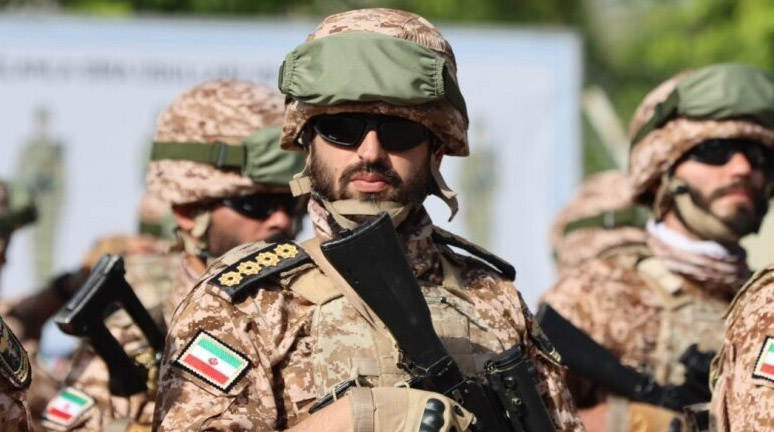
The reality that regime change is not going to happen as a result of this war seems to have settled in at the White House. When American policymakers reflect and wonder why Iran did not react like Venezuela under pressure, they will not just be misreading Iran — they will be misreading how coercive pressure works. Iran’s resilience rests on internal and external pillars that a Venezuela comparison completely misses. Internally, the Supreme Leader’s authority is anchored in a theocratic order where religious legitimacy underwrites a sprawling economic system. At its center are the Islamic Revolutionary Guard Corps and parastatal religious foundations. Framed as a “resistance economy,” these networks control significant shares of domestic and external commerce and operate outside conventional oversight, allowing them to reroute capital and absorb sanctions pressure.
Externally, geography amplifies that resilience. Control over the northern shore of the Persian Gulf and the Strait of Hormuz — a chokepoint for a substantial share of global energy flows — gives Iran disproportionate strategic leverage. Together, these features blunt the fracturing effects pressure produces elsewhere.
American strategy has long assumed that sufficient economic and political force will fracture adversarial systems. That assumption holds in some cases, but it breaks down when structurally different regimes are treated as if they respond the same way.
External pressure does not operate uniformly. In Venezuela, it accelerated fragmentation by exploiting existing fractures. For example, U.S. financial and oil-sector sanctions beginning from 2017 to 2019 restricted Venezuela’s access to credit and export revenue, accelerating the decline of oil production and weakening central fiscal authority. As state resources contracted, competition among military, political, and local actors intensified, contributing to fragmentation within the regime’s governing structure. By contrast, in Iran, external pressure has often produced consolidation. Institutional design — such as dual security structures, quasi-state economic networks, and elite-linked commercial entities — absorbs shocks, reshapes dissent, and reframes legitimacy around resistance. Strategies that assume uniform responses risk miscalculation. Those calibrated to structure can exploit real vulnerabilities without reinforcing the system.
As Steven Levitsky and Lucan Way argue, a regime’s “organizational power” — its capacity for elite coordination and coercive enforcement — determines whether pressure triggers fragmentation or consolidation. While Venezuela’s fragmented elite structure faced systemic disarticulation under sanctions, Iran’s dense institutional networks enabled coordinated adaptation. External pressure, therefore, is not a uniform force but a stressor filtered through a state’s specific institutional architecture.
The Contrast
In Venezuela, pressure compounds existing fractures through identifiable institutional and economic mechanisms. U.S. financial sanctions imposed under Executive Order 13808 in 2017 restricted the Venezuelan government’s access to international credit markets, prohibiting new debt issuance and sharply limiting the regime’s ability to refinance obligations and sustain patronage networks. This was followed by the 2019 sanctions on Petróleos de Venezuela, which cut off the regime’s primary revenue source by targeting oil exports. The result was not simply economic decline, but institutional disarticulation: Venezuela’s oil production fell from approximately 2 million barrels per day in 2016 to below 700,000 by 2020. This eroded state revenue streams and hollowed out institutional capacity, weakening elite cohesion as access to rents diminished and enabling competing centers of authority to emerge. The U.S. recognition of Juan Guaidó as interim president in 2019 further formalized a dual sovereignty crisis, fragmenting both domestic and international legitimacy. Under these conditions, external pressure did not create instability — it accelerated and deepened preexisting fractures by disrupting the material and institutional foundations that sustained regime coherence. Iran is built differently.
Pressure there tends to compress rather than fracture. External threats reorder internal politics: factions close ranks, dissent is reframed, and legitimacy — however strained — gets rebuilt around resistance. The same pressure that might destabilize another system instead reinforces this one. This is not incidental. It is structural.
Iran’s ability to absorb pressure is grounded in institutional design. Its dual security system, split between the conventional military and the Islamic Revolutionary Guard Corps, creates redundancy and internal balance. At the same time, quasi-state economic networks, including bonyads (quasi-state foundations) and Guard-linked commercial entities, act as shock absorbers. These structures redistribute economic strain, preserve elite cohesion, and maintain regime functionality under sustained pressure.
As Erica Frantz notes, resilience built on elite consolidation is not equivalent to broad popular legitimacy. In Iran, this distinction is empirically visible in repeated protest cycles — from the 2019 fuel protests to the unrest in 2022 and 2023 following the death of Mahsa Amini — where large-scale societal dissent was met with repression, yet elite cohesion and security apparatus loyalty remained intact. In Iran’s case, this elite and security cohesion coexists with persistent societal discontent, illustrating that consolidation operates differently across institutional layers. Furthermore, public reporting and economic data from 2025 to 2026 — including U.S. Treasury assessments and International Monetary Fund estimates of Iran’s partial oil export recovery despite sanctions — indicate that Islamic Revolutionary Guard Corps-linked sectors and quasi-state networks have enabled continued revenue generation despite macroeconomic shocks, demonstrating structural endurance under external pressure.
Pressure does not simply hit Iran — it is absorbed, redirected, and converted into internal cohesion. This is where U.S. strategy often misfires. The default approach favors speed — shock, disruption, and rapid escalation. The expectation is that pressure will force a visible break: elite defection, institutional collapse, or mass political realignment. But that logic only works if the target system is already predisposed to break. Iran’s wasn’t.
Before escalation, Iran was under measurable macroeconomic strain: inflation remained persistently above 40 percent, the Iranian rial lost more than 80 percent of its value against the U.S. dollar between 2018 and 2025, and real household purchasing power sharply declined, fueling visible public dissatisfaction. Under different conditions, those pressures might have driven gradual internal change. Instead, external confrontation shifted the terrain. It provided a unifying narrative and a reason to consolidate. In effect, pressure interrupted the very internal dynamics it was supposed to accelerate.
The economic shock from 2025 to 2026 illustrates this dynamic through a clear causal chain. After the U.S. withdrawal from the Joint Comprehensive Plan of Action in 2018, sanctions targeting oil exports and restricted access to the Society for Worldwide Interbank Financial Telecommunication forced economic activity into alternative channels outside the formal financial system. These channels included informal trade networks, shadow shipping fleets, and non-dollar transactions.
These adaptive pathways are not neutral — they are disproportionately controlled by regime-linked actors. This includes Islamic Revolutionary Guard Corps-affiliated entities like the Khatam al-Anbiya Construction Headquarters, front companies identified in American designations, and bonyads. As access to formal markets contracts, economic power concentrates within these sanctions-resistant networks. The result is a redistribution of economic control toward actors already embedded within the regime’s coercive architecture. This shift is observable in the expanding role of Islamic Revolutionary Guard Corps-linked firms across the energy, construction, and logistics sectors during peak sanctions periods, even as Iran’s broader private sector contracted.
Furthermore, this shift has coincided with sustained oil exports (estimated at over 1 million barrels per day from 2023 to 2025 despite sanctions) and a growing reliance on shadow shipping networks and non-dollar transactions documented in U.S. Treasury enforcement actions. Rather than fragmenting elites, pressure restructures incentives in ways that reinforce elite cohesion: survival becomes tied to participation in regime-controlled channels, and defection becomes materially and politically costlier.
This pattern has precedent. Under external threat, political systems — especially those with strong institutional depth and ideological framing — often stabilize rather than unravel. What appears as coercion from the outside functions as cohesion on the inside.
Zbigniew Brzezinski warned that fusing nationalism with ideological resistance strengthens rather than weakens the Iranian system. Today, his concern regarding strategic overreach — where confrontation expands beyond its initial scope — has shifted from a theoretical risk to a systemic reality embedded in the current environment.

What This Means for Policy
Policy ought to abandon false analogies. Comparisons to cases such as Panama, Iraq, or Venezuela obscure more than they clarify when applied to a system as structurally distinct as Iran, where institutional depth and elite integration fundamentally alter how external pressure is processed. Strategy must begin with structural diagnosis, not historical precedent.
Effective strategy requires distinguishing between forms of pressure that fragment regimes and those that consolidate them. Broad sectoral sanctions — particularly those targeting oil exports — tend to reinforce internal cohesion by enabling the regime to externalize blame and mobilize nationalist sentiment.
More selective measures operate differently when they target identifiable nodes within elite-controlled systems. In Iran’s case, this includes financial and commercial networks linked to Islamic Revolutionary Guard Corps-affiliated entities. Key examples include front companies operating through regional hubs in the United Arab Emirates and Turkey, and procurement chains for dual-use industrial components. It also applies to the maritime logistics networks often referred to as the “shadow fleet,” including tanker operations linked to sanctioned facilitators such as Triliance Petrochemical Company. These systems have been repeatedly documented in U.S. designations and investigative reporting.
Targeting these specific channels — rather than broad sectors — disrupts revenue flows and operational capacity at the level where elite power is concentrated. For example, policy could restrict access to specialized industrial inputs used by Islamic Revolutionary Guard Corps-linked firms. Alternatively, it could sanction intermediaries facilitating non-dollar oil transactions through regional financial nodes. Doing so imposes costs directly on regime-linked actors without diffusing pressure across the broader population. This creates asymmetric pressure by concentrating strain within elite networks while preserving broader civilian economic channels. Ultimately, this limits the regime’s ability to externalize blame and increases internal friction within its core support structures.
This approach should extend to the financial architectures enabling sanctions evasion, including cryptocurrency-based transaction networks, stablecoin intermediaries, and informal value transfer systems. Emerging evidence indicates that some Islamic Revolutionary Guard Corps-affiliated procurement channels have experimented with these mechanisms to facilitate cross-border transactions outside the regulated financial system. Targeting these architectures — through coordinated financial regulation, exchange-level enforcement, and monitoring of transaction flows — can disrupt emerging sanctions-evasion pathways before they scale into durable alternatives to the formal financial system.
This recalibration also requires a shift in tempo. Rapid escalation prioritizes visibility over effectiveness and often backfires in adaptive systems. Slower, targeted pressure — combined with preserving limited civilian economic channels — can instead exploit internal vulnerabilities without sealing them under a shared external threat.
This same logic directly applies to the maritime domain. Rather than relying solely on deterrence within chokepoints such as the Strait of Hormuz, the United States and its partners should prioritize the development of alternative regional infrastructure and export corridors. Reducing structural dependence on vulnerable transit routes diminishes the strategic leverage such chokepoints provide, effectively neutralizing the ability of target states to convert geographic position into geopolitical influence.
None of this suggests that pressure should be abandoned. It suggests that its effectiveness depends on alignment with the target system’s structure. When applied broadly, pressure can consolidate regimes like Iran by reinforcing elite cohesion and nationalist framing. When applied selectively — against identifiable financial, logistical, and procurement nodes tied to elite power — it can instead generate internal friction without triggering systemic consolidation. The core mistake, therefore, is not tactical but analytical: Misdiagnosing how pressure is processed leads directly to strategic failure.
Iran did not behave like Venezuela because the conditions that produce fragmentation in one case produce cohesion in the other. Treating them as interchangeable leads to flawed expectations — and, ultimately, self-defeating outcomes. The critical variable is not the intensity of pressure, but the structure it acts upon. Where institutions are fragmented, pressure accelerates breakdown. Where they are cohesive and internally aligned, it can instead reinforce regime stability. Until that distinction is taken seriously, the same question will keep resurfacing. And it will remain the wrong one. Ultimately, these unique pillars of institutional depth and geographic leverage are precisely why Washington’s standard coercive playbook repeatedly failed in Iran but succeeded in Venezuela.
Dr. Rashed M. Aba-namay is a legal scholar specializing in institutional resilience and coercive statecraft. He developed the Abanamay Sovereignty Spectrum Theory and its analytical formula, which examines how authority is distributed in complex states and how external pressure produces divergent sociopolitical and legal outcomes. He is president of the National Law Center, a Riyadh-based legal firm specializing in energy security, maritime law, and strategic infrastructure analysis.
Image: Hassan Gholampour via Wikimedia Commons