
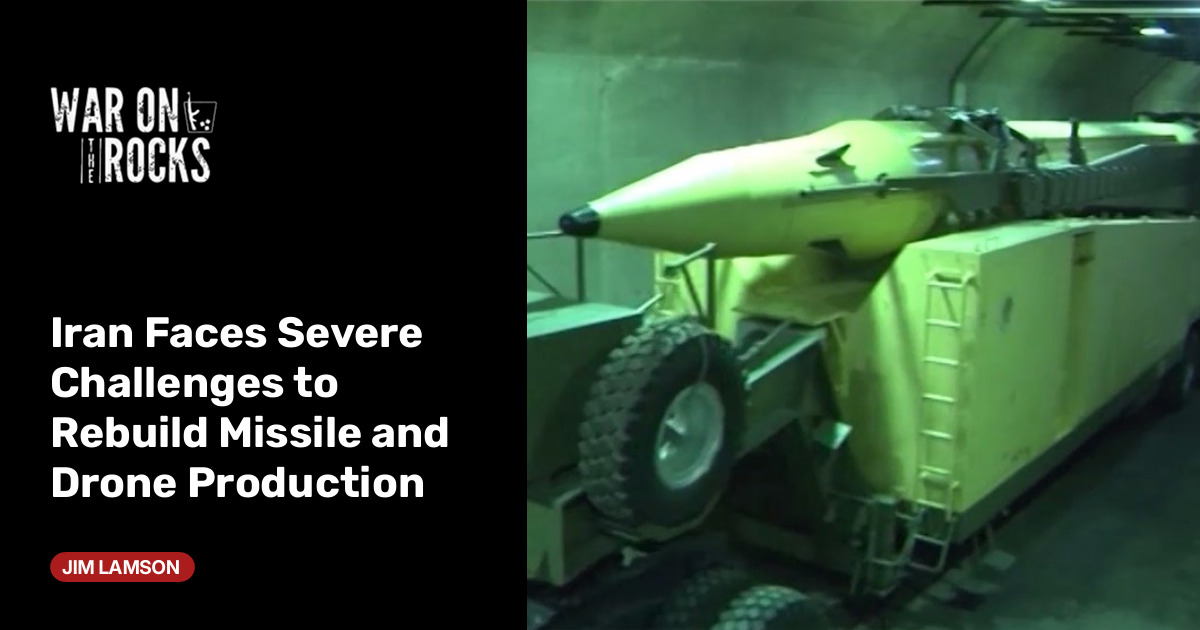
With the significant Israeli and U.S. military attacks against Iran in 2025 and early 2026, analysts have discussed and debated Iran’s ability to replenish its missile and drone arsenal. Since 2024, Iran has burned through thousands of ballistic missiles, cruise missiles, and one-way attack drones in its retaliatory attacks against Israel, U.S. military bases, and other targets in the region. In addition, air and missile strikes destroyed many more Iranian missiles and drones along with their launchers. Importantly, Israeli and U.S. attacks in 2024, 2025, and especially 2026 cumulatively caused severe damage to Iran’s missile and drone industry as well as its larger defense research-industrial base. Thus, Iran’s ability to replenish its arsenal of operational missiles and drones has become an important topic for policymakers, intelligence analysts, military planners, and outside experts.
Since the Israeli and U.S. militaries halted their attacks on Iran’s missile and drone industries in April 2026, there have been conflicting claims about the status of Iran’s ability to produce new systems. For instance, many American and Israeli officials have claimed that Iran can no longer produce missiles and drones. However, Iran’s rapid recovery after the spring 2026 war reportedly stunned some Israeli officials and raised concerns that Iran may return to producing hundreds of missiles per month. For their part, Iranian officials have claimed that, despite the attacks, Iran has continued to produce and improve missiles and drones. This is likely bluster for deterrence purposes and, if anything, reflects Iran’s assembly of missiles from finished parts, rather than the reconstitution of its industries and supply chains.
So, what is the state of Iran’s missile and drone industry? What are Iran’s options for replenishing its arsenal and rebuilding its production capabilities? What challenges does Iran face in replenishing and rebuilding? In the shorter term, Iran can conceivably assemble new ballistic missiles, cruise missiles, and drones — perhaps hundreds or even thousands — from its prewar stockpiles of finished components. In the longer term, Iran will need to rebuild its severely damaged missile and drone industries to produce new systems and, importantly, to make improvements to existing systems and to develop new ones.
Impact of Israeli and U.S. Strikes on Iran’s Missile and Drone Industries
Israeli and U.S. attacks targeted the production and supply chains of Iran’s missile and drone industries. In doing so, they targeted both the core organizations that develop and produce missiles and drones, as well as the key domestic suppliers and industries that support them. According to U.S. officials, the goal was to “obliterate Iran’s missiles and drones and facilities that produce them” and to destroy its defense‑industrial base to “ensure that Iran cannot reconstitute the ability to project power outside their borders.”
According to my evolving assessment, the strikes from 2024 to 2026 targeted more than 40 ballistic missile industry sites, almost 20 cruise missile industry sites, and more than 20 drone industry sites — plus dozens of other defense research-industrial sites that support Iran’s missile and drone production. In doing so, Israeli and U.S. military forces focused on critical “bottleneck” elements of Iran’s missile and drone industries, including sites important to guidance and control, propulsion, warheads, airframes, launchers, and the final assembly of missiles and drones. Israel and the United States also targeted elements of Iran’s defense research establishment, including key universities that support the design and development of these systems. Additionally, they struck dual‑use industrial facilities producing strategic materials such as carbon fiber, steel, and aluminum.
The Israeli and U.S. campaigns severely degraded Iran’s research and development, production capacity, supply chains, and long‑standing pursuit of self‑sufficiency. Together, these elements have formed a central pillar of Iran’s asymmetric deterrence and warfighting strategy, enabling Tehran to use its missiles and drones to offset the conventional military superiority of Israel and the United States.
First, the cumulative strikes dealt a significant blow to the ability of the Ministry of Defense and Armed Forces Logistics, the Islamic Revolutionary Guard Corps, the regular military (Artesh), and associated organizations to conduct development, production, and supply activities across Iran’s aerospace sector. The strikes severely impacted production lines for ballistic missiles, cruise missiles, and drones, and, importantly, also degraded Iran’s ability to develop new and improved missiles and drones. Thus, the strikes have significantly affected Iran’s capacity to replenish its arsenal with existing missile and drone types, as well as its ability to make technical advancements and develop entirely new missiles and drones. Iranian officials have highlighted efforts to increase warhead destructive power, extend range, improve accuracy, enhance maneuverability, reduce radar detection, and improve the ability to defeat enemy electronic warfare and air and missile defenses. The strikes have likely undermined these efforts, which Iran will need to resume to make improvements based on important technical and operational lessons it learned from its recent wars. In addition, the fate of Iran’s apparent program to develop an unidentified new 4,000-kilometer-range intermediate-range ballistic missile — which it used in an unsuccessful attack against Diego Garcia in March 2026 — is in question. Similarly, the damage has also impacted the Ministry of Defense and Armed Forces Logistics’ and Islamic Revolutionary Guard Corps’ ambitious efforts to develop space launch vehicles — some of which would make highly capable long-range missiles if Tehran decided to do so.
Second, the strikes severely degraded the supply chains of domestic suppliers that feed components, materials, and production and test equipment to the missile and drone programs. This includes key items that are “insourced” — made in-house by the core production organizations — and those that are “outsourced” to the wider network of dozens of Iranian industries, research centers, and companies. Indeed, Supreme Leader Mojtaba Khamenei recently requested efforts and regular updates on the supply chain issue from the commander of the Islamic Revolutionary Guard Corps Aerospace Force, which produces missiles and drones.
Third, through their cumulative impact on the development and production organizations and domestic supply chains, the Israeli and U.S. attacks severely undermined the self‑sufficiency of Iran’s aerospace industry. For decades, Iran has sought to expand its domestic capabilities, increase its self-reliance, and minimize its dependence on foreign suppliers, particularly on strategic, bottleneck technologies. Of note, Israeli and U.S. strikes targeted critical sectors that Iran has spent decades developing, such as those involved in producing guidance and control components, solid rocket motors and solid propellants for ballistic missiles, turbojet and piston engines for cruise missiles and drones, explosives for warheads, and carbon fiber for composite missile airframes, to name a few. As a result of the overall impact of the strikes, Iran’s dependence on foreign suppliers and illicit procurement networks will likely grow in the immediate term and for years to come, with its longstanding focus on self‑sufficiency temporarily given a back seat.
Iranian Options to Replenish and Rebuild
In the face of this extensive damage, what are Iran’s options for replenishing its arsenal of missiles and drones and for rebuilding its production capabilities? To replenish its arsenal, Iran has three basic options. First, it can assemble new systems using stockpiles of finished components in underground production sites — something Iran is reportedly already doing — which may be conducted within underground bases of the Islamic Revolutionary Guard Corps and in an underground production site run by the Ministry of Defense and Armed Forces Logistics.
In this way, Iran can restock its arsenal in limited numbers without relying on new production from its industries and supply chains. It is unclear how many missiles and drones — whether hundreds or thousands — Iran can build from existing stockpiles. It is also unclear how long these stocks will last. In any case, assembling new missiles and drones from existing stockpiles will provide only a limited, short‑term fix, as these stockpiled components will run out and Iran cannot refill them without new production.
Second, Iran can purchase complete missiles and drones from foreign suppliers. Iran has reportedly received some complete drones from Russia and is seeking more advanced ones. Furthermore, China has reportedly agreed to provide supersonic anti-ship cruise missiles to Iran. Iran could pursue ballistic missiles and other cruise missiles and drones from these two countries, or possibly from North Korea. But this is also only a limited fix, and one that does not further Iran’s traditional emphasis on self-sufficiency.
Third, and likely its longer-term preference, Iran can seek to restart the development and production of new missiles and drones using newly produced components supplied by domestic and foreign sources. Iran will need to rebuild its domestic organizations and supply chains and will likely pursue both domestic and foreign pathways to do so.
As part of its domestic pathway, Iran has four basic options to rebuild its ability to develop and produce missiles and drones. First, it can repair and rebuild its existing sites, although we have seen little evidence of this happening so far, and Iran is likely well aware of the risk of renewed strikes on these facilities if Israel or the United States detects their resumed operation. Second, Iran can relocate critical activities to secure sites. Iranian officials have claimed they moved critical bottleneck equipment from key facilities before the war and moved development and production activities underground. Third, Iran can build new facilities. Iranian officials have claimed they reconstructed facilities in secure locations and that they were producing missiles and dronesin sites unknown to Iran’s adversaries. On this point, it is possible that Iran had already built new sites before 2026 that the open-source community has yet to identify. Finally, Iran could convert the production lines of defense and non-military industries to supply missile and drone components, perhaps similar to how General Motors will reportedly make components for Patriot and other missiles for the U.S. missile industry. For instance, Iran might increasingly tap into companies located within its numerous industrial towns scattered across the country, many of which Iran has already used as suppliers. In any case, Iran will likely attempt a combination of all four options to increase the resilience and minimize the vulnerabilities of its missile and drone industries moving forward.
One important distinction needs to be made: Rebuilding Iran’s industries and supply chains to produce ballistic missiles — and to a lesser extent, cruise missiles — will likely be a more complex and dangerous undertaking than for drones. The facilities, technologies, and processes involved in producing ballistic missiles are more complex, dangerous, and have a footprint that is harder to hide — and to move underground — than those required to produce drones. The manufacture and testing of liquid rocket engines and solid rocket motors provide an important example. Moreover, Iran can rely to a greater extent on commercial and dual-use components to produce drones than it can for ballistic missiles.
As part of its foreign pathway, Iran will need to procure many types of parts, materials, and equipment from international suppliers — both to outfit rebuilt or new facilities and to restart missile and drone production lines and development programs. Before the wars in 2025 and 2026, Iran already relied on foreign components to a certain extent for its missile and drone programs, but the “demand signal” for foreign technology has likely significantly increased, driven by the extensive damage to its core organizations and supply chains.
Moving forward, Iran is apt to pursue extensive procurement from China, Russia, and possibly North Korea, while also relying on illicit procurement networks to acquire commercial and dual-use components, materials, and equipment from Western and Asian suppliers. In addition to purchasing complete weapon systems as noted above, Iran will probably seek complete subsystems, including engines for cruise missiles and drones; components such as guidance instruments, engine parts, and electronic components; raw materials, including chemicals for propellants and explosives, steel and aluminum alloys, and carbon fiber; and production and test equipment needed to manufacture systems, subsystems, components, and raw materials.
To highlight one important aspect of its rebuilding efforts, Iranian program managers and supply chain managers will be forced to review and recreate the many bills of materials that are critical to this work. Each production line and development program has its own unique bill of materials, which is a master list of the hundreds of components required to make a particular missile or drone, and the specific companies (domestic or foreign) that supply them. Iranian officials will need to assess each bill of materials based on the strike damage: What items did the strikes affect, especially bottleneck technologies? Were any warehouses with stored components destroyed? Was internal production damaged? What suppliers sustained damage, and when (if at all) can they restart production? Are alternative suppliers necessary? Importantly, the strikes will force Iranian officials to rethink “make versus buy” decisions for many of the items: What do we attempt to make internally? What can we purchase from domestic suppliers? What should we procure from foreign suppliers? As a result of these reviews — and given severe resource constraints and competing military and civilian reconstruction priorities — Iranian officials may need to make difficult decisions to prioritize, streamline, or curtail missile and drone production lines and development programs. This might require reorganization of Iran’s aerospace industries and possible merging of some key organizations and programs. For at least the next few years, officials may be required to focus on the highest‑priority systems — and their associated technologies — rather than attempt to revive the dozens of pre‑war families of missiles and drones.
 Steep Challenges to Rebuilding
Iran faces significant challenges to rebuilding. First, Iran will continue to face Western trade controls, sanctions, and interdictions designed to hinder procurement, alongside a reported Israeli covert campaign targeting its efforts to acquire technologies to restore damaged production lines. It may also confront a renewed Israeli “campaign between wars,” including sabotage and assassinations, directed against its aerospace industry. Second, Iran will need to avoid foreign detection and identification of new facilities — both those involved in development and production as well as suppliers of key technologies. Third, Iran will face serious logistical challenges and risks of moving critical activities underground. Building electronic and mechanical components underground poses limited risks, but if Iran attempts to move more hazardous activities underground — such as those associated with producing solid rocket motors and warheads — the hazards will be significant. Fourth, as noted above, Iran will increase its reliance on foreign suppliers, at least for the near term. This increases its vulnerability to interdicted shipments and disrupted supply chains, and intensifies the need to protect against the risk of sabotaged components. Lastly, Iran’s rebuilding efforts face the prospect of renewed Israeli or U.S. military attacks, whether in the form of limited strikes to “mow the lawn” or conduct “spot hits” against critical bottleneck sites, or in the form of larger military operations. Israeli Prime Minister Benjamin Netanyahu has stated that the threat posed by Iran’s missiles has been “distanced” but not eliminated, and that Israel would achieve its objectives either through agreement or military force. Consequently, Iran’s efforts to rebuild its missile and drone industries in the coming months and years will confront significant technological, industrial, economic, logistical, intelligence, and military challenges.
Opportunities for Nonproliferation?
In the near term, Iran likely has a limited ability to replenish its missile and drone arsenal, although it can also acquire new systems from Russia and China. However, in the longer term, Iran faces significant challenges to reestablish something close to its prewar capability to develop and produce missiles and drones.
These challenges to Tehran offer opportunities for the enhanced effectiveness of nonproliferation tools. First, the probable, significant uptick in Iran’s need for foreign components, materials, and equipment — which will likely include many items controlled by multilateral and national export controls — offers the opportunity to increase the effectiveness and “bite” of these controls to disrupt Iran’s rebuilding efforts. Countries can coordinate via the Missile Technology Control Regime and Wassenaar Arrangement to enhance their detection and disruption of Iranian illicit procurement efforts of critical items. This can include issuing updated and expanded watchlists of technologies and Iranian entities, as well as increased outreach to governments and companies around the world. Second, the opportunities for interdictions of sea shipments, especially from China, will probably increase due to the sheer quantity of items, such as propellant ingredients, that Iran will presumably seek from China. Third, the expansion of Iranian procurement will create opportunities for increased engagement and cooperation through diplomatic and intelligence channels with countries concerned with Iran’s rebuilding, as well as for “strategic disclosures” and sanctions that publicly expose important Iranian procurement efforts and actors. Iran has expanded its missile and drone industries since the 1980s in the face of export controls, sanctions, interdictions, and other nonproliferation actions. But Tehran’s urgency, plus the sheer scope and volume of what Iran will now likely seek from foreign suppliers — including sensitive, controlled items — increases the chances of these tools being more effective at detecting and disrupting Iran’s procurement efforts now than they were in the past.
But undermining Iran’s rebuilding efforts will not be easy. Iran can conceivably rely on domestic companies to supply some key items, as well as its decades of experience in conducting illicit foreign procurement, which it will employ to the maximum extent in the coming months and years. Importantly, efforts to disrupt assistance from China, Russia, and North Korea will be difficult. Iran has longstanding military and defense relationships with these countries, which may not be willing to limit or halt their cooperation with Iran. The options to disrupt their shipments to Iran — including those by air, rail, and via the Caspian Sea — will also face limitations.
Although assessing the timeline for Iran’s rebuilding efforts is difficult, it will plausibly require several months to re-establish the most critical bottleneck elements, and at least two to three years to restore its wider industrial capabilities and domestic supply chains to something resembling their prewar status. But this is a low-confidence assessment due to the complexity of factors involved, such as the technical and industrial challenges Iran faces, the scope and nature of assistance from China, Russia, and other foreign suppliers, and especially the potential nonproliferation and military actions by foreign actors that could undermine Iran’s efforts.
Looking forward, Iran will almost certainly work to restore some semblance of its prewar ability to produce and improve missiles and drones, as this is an important pillar of deterrence and resistance against Israel and the United States. Its capabilities to do so are clearly degraded, but its intentions to do so appear firmly intact; it remains to be seen whether Iran can overcome the significant challenges it faces to recover and restore its previous status.
Jim Lamson is a senior research associate at the James Martin Center for Nonproliferation Studies and a visiting research fellow with the Department of War Studies at King’s College London. Prior to that, he worked for 23 years as an analyst with the CIA. This article is based in part on his recent report, “Israeli and US Strikes on Iran’s Aerospace Industry, 2024–2026: An Initial Impact Assessment and Future Outlook.”
Image: Islamic Revolutionary Guard Corps Aerospace Force via Wikimedia Commons