
Where you live could add or take away more than a decade from your life, according to new figures.
The latest data from the Australian Bureau of Statistics shows Australians face a postcode lottery of longevity, with life expectancy ranging from just 74 years in the Northern Territory to nearly 87 in Sydney‘s Inner West.
Residents living in inner-west suburbs including Balmain, Leichhardt and Rozelle have an average life expectancy of 86.9 years.
In stark contrast, people living in Greater Darwin and remote regions in the Northern Territory can expect to live just 74.3 years.
The New South Wales Central Coast (86.7 years), Sydney’s Parramatta (86.3), and North Sydney and Hornsby (85.7) all rank among the nation’s healthiest regions.
The Northern Territory, Coffs Harbour-Grafton in NSW (78.5), and WA’s Wheatbelt (78.7) are at the lower end of the scale.
The average life expectancy across Australia is 83.
Life expectancy has improved dramatically for both sexes in the last century, according to the Australian Institute of Health and Welfare.
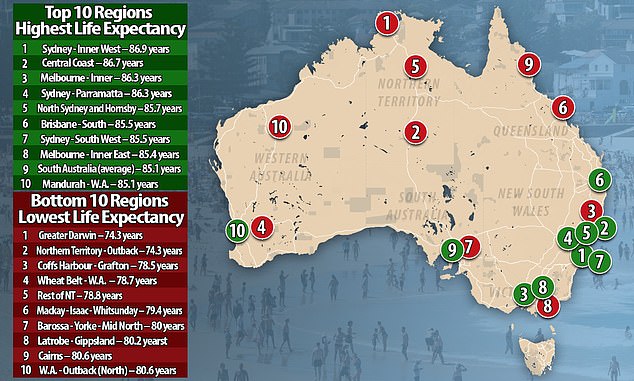
The east coast capitals dominate a list of the areas with the highest average life expectancy in Australia, according to fresh data from the ABS
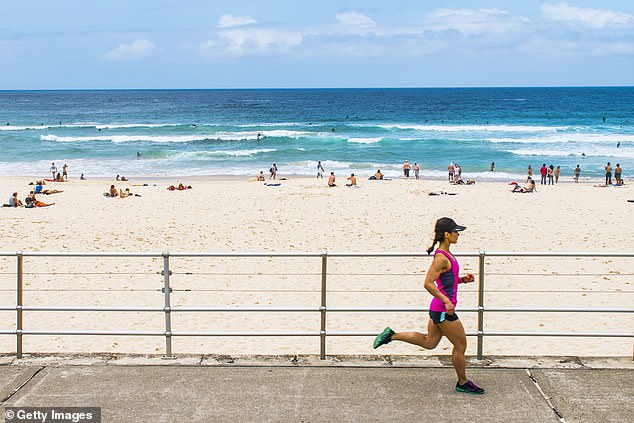
Sydney has dominated a list of the areas with the highest average life expectancy in the nation
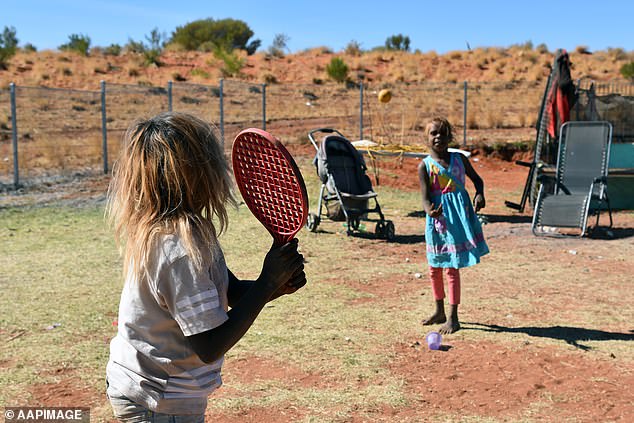
Two young girls play in Titjikala, an Aboriginal community 120km south of Alice Springs. In stark contrast, people living in Greater Darwin and remote regions in the Northern Territory can expect to live just 74.3 years
Compared with their counterparts in 1891 to 1900, boys and girls born in 2021 to 2023 can expect to live around 30 years longer.
A study published in The Lancet Public Health found Australia has made progress in reducing socio-economic inequalities in life expectancy since the late 2010s, setting the country apart from many other high-income countries.
Lead author Dr Sergey Timonin from ANU said while the trend is encouraging, women in the most disadvantaged areas still live 4.9 years less, and men 6.6 years less, than those in affluent areas – underscoring the need for ongoing public health efforts to close the gap.
‘We found that three major causes of death consistently contribute to life expectancy gaps – lung cancer, chronic respiratory diseases, and heart disease,’ he said.
‘In addition to chronic diseases, external causes such as suicide, road traffic injuries, and substance-related deaths also played a major role in life expectancy differences, particularly among men.’
The study also placed Australia in an international context by comparing life expectancy in socio-economically advantaged and disadvantaged areas with national averages in countries such as Japan, a global leader in longevity, and the United States.
‘Female life expectancy in all Australian areas by socio-economic status sits between Japan and the US, while male life expectancy in Australia’s five most advantaged areas (comprising around half the population) surpasses Japan’s national average,’ he said.
‘While this may be bad news for Americans, it is good news for Australians. Even in our most disadvantaged areas, life expectancy is higher than the US average for both men and women.’
Australians enjoy one of the highest life expectancies in the world, at 83.2 years in 2023 for males and females at birth combined – ranked 10th behind Switzerland, Japan, Spain and Israel.
Share or comment on this article:
Australia’s longevity lottery: Where you live can add or take away a DECADE from your life – as the best and worst regions are revealed